
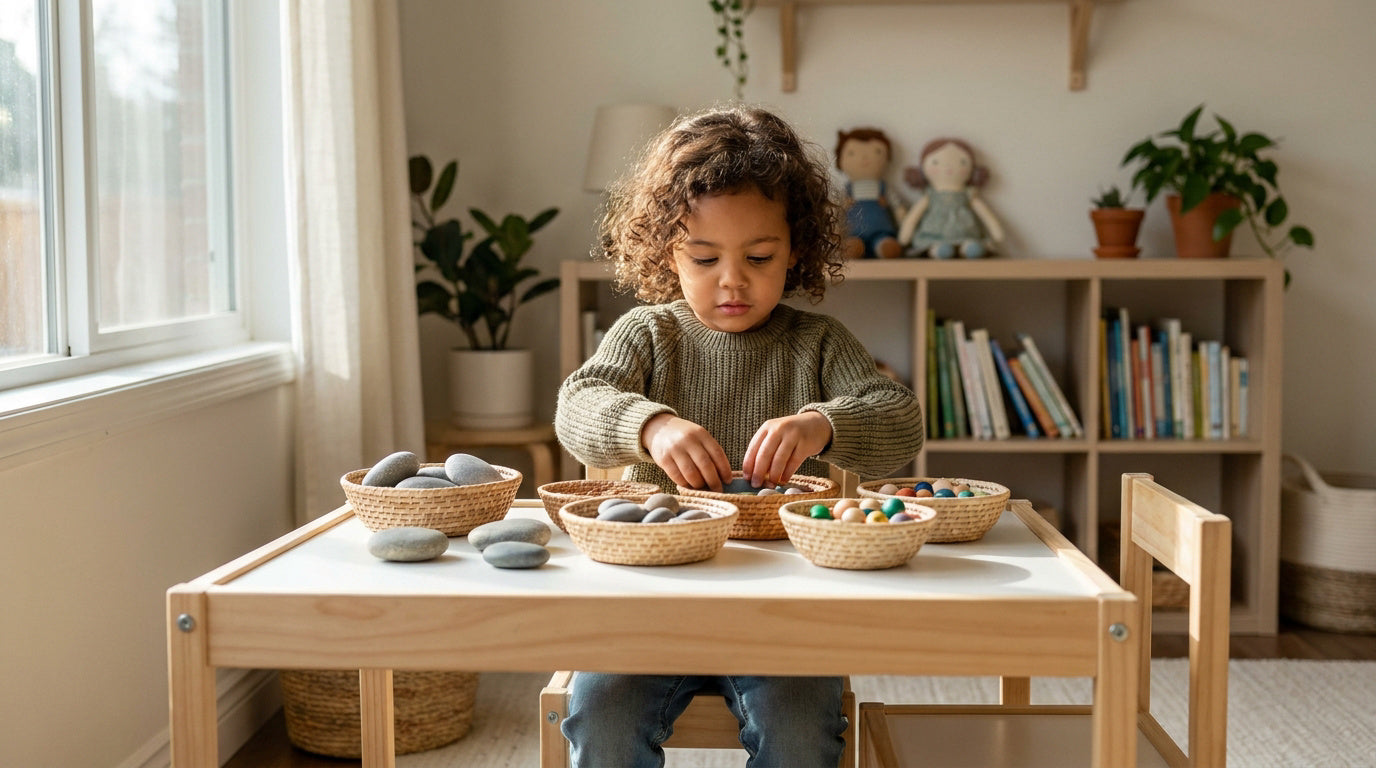
Adopting the Montessori approach at home on a small budget
The key takeaway: Montessori at home rests first on your attitude of observation and on adapting what you already have, not on expensive purchases. By repurposing your current furniture and making a few simple activities, you support independence without breaking the bank. One tip that changes everything: leave only 3 or 4 activities visible at a time.
We often get the impression that we need to invest in expensive materials to "do it right". Yet the essence of this approach cannot be bought: it is a way of looking at the child and organising the space.
Here is where to start when the budget is tight, and where to invest if you only buy one thing.
Your priorities before getting out your bank card
Observation counts more than materials
Take the time to watch your child act without intervening. This step back shows you what really occupies them right now: pouring, stacking, opening and closing, climbing.
Identifying this current need avoids many unnecessary purchases. A child who wants to pour does not need a new toy, but two containers and a little water.
Your attitude as an adult is the foundation: stay in the background, let them do it, only intervene if necessary. It costs nothing and changes everything.
Telling useful materials apart from marketing
A good material isolates a single difficulty at a time. Toys that do everything at once, with sounds and lights, scatter attention instead of supporting it.
The word "Montessori" is not protected: it appears on many products that have nothing to do with the approach. Trust the object, not the label.
Prefer natural materials, wood or metal, for their sensory feedback. A wicker basket filled with everyday objects is often worth more than a complex activity centre.
Setting up at child height without building work
Repurposing your current furniture
Lower an old shelf, remove the door from a low cupboard, set up open baskets: the child sees what is available and helps themselves.
For sleeping, a mattress on the floor replaces an expensive cot. Remember to insulate it from the cold and place it on a ventilated base to avoid condensation. We detail this transition in our article on the Montessori floor bed.
In the hallway, hooks at their height and a floor marker for shoes are enough to structure the coming-home routine.
Making things safe so you can say no less often
Fix heavy furniture to the wall, tidy away cables, protect sockets. These are modest expenses that save you having to watch every move.
A safe space considerably reduces permanent prohibitions, and that is where freedom of movement becomes possible. Our article on keeping your baby safe without shutting them in details the method room by room.
Be careful, though: no layout removes the need for supervision. It reduces risks, it does not eliminate them.
Creating activities with what you have
The treasure basket
Gather everyday objects with varied materials: a cold, heavy stainless steel spoon, a soft brush, a fabric ball, a small wooden bowl.
These contrasts of weight, temperature and texture captivate far more than a single-colour toy. Just check that nothing is breakable or small enough to be swallowed.
Renew the contents when interest wanes: remove what is neglected, add a new material.
Sorting and pouring games
An egg box or an ice cube tray make excellent sorting supports. Two identical jugs and a little water are enough to work on precision of movement.
Keep a small sponge nearby: being able to clean up what you have spilled yourself is part of the exercise.
A cardboard box, a few cut-out slots and some lids: there you have a shape sorter for zero euros. Sand any wooden piece you make to avoid splinters.
Rotation, the trick that avoids buying
Limit the number of visible activities: three or four are enough. Too much choice scatters attention instead of nourishing it.
Store the rest out of sight and reintroduce it periodically. A toy forgotten for three weeks becomes new again, without spending anything.
Watch for the moment when an object no longer attracts: that is the signal for a change, far more reliable than a fixed calendar.
If you only buy one thing
When the budget is limited, one versatile piece is better than ten small purchases. The right criterion is not the displayed price but the cost per year of use.
A learning tower is used every day from 12 months, in the kitchen as in the bathroom, and some models then turn into a table. It is probably the most cost-effective purchase at this age. The foldable version is suitable if space is short.
A climbing arch, from 18 months, covers the need to climb and turns into a den, a rocker or a reading nook over the years.
Also think second-hand: second-hand platforms are full of developmental furniture in good condition. Check the strength of the joints, that the screws are all there and that there are no cracks before buying.
Independence in everyday gestures
Kitchen and bathroom
A low mirror and a towel rail at their height let the child wash their face alone. A stable step stool gives access to the tap.
In the kitchen, reserve a low cupboard for them with their crockery. Real objects, even fragile ones, teach them to be careful far better than unbreakable plastic.
Visual cues that cost nothing
Draw the sequence for getting dressed, stick a marker on the floor for shoes, fix low hooks. The child knows what to do without being told again.
In the morning, offer a choice of two outfits rather than the whole wardrobe: fewer conflicts, and a real decision to make.
Getting started with Montessori mainly costs observation time and a little reorganisation. Materials come afterwards, and in small quantities. Understanding the principles of the approach will help you sort the essential from the superfluous.
FAQ
Can you start Montessori without breaking the bank?
Yes. The essentials rest on your attitude of observation and on adapting what you already have: lowering a shelf, removing a cupboard door, using everyday objects. Specific materials come afterwards, and in small quantities.
How do you make low-cost activities?
With cardboard, egg boxes, fabric scraps and two containers, you already cover sorting, pouring and shape sorting. The principle: isolate a single difficulty at a time. Check the safety of materials and sand any wood you work with.
Why does toy rotation save money?
By leaving only three or four activities visible and storing the rest, you create novelty without buying anything. A toy reintroduced after a few weeks regains all its interest, and the child concentrates better with fewer choices.
Which changes should you make first?
Those that affect daily life: a step stool and low mirror in the bathroom, an accessible cupboard in the kitchen, hooks at their height in the hallway. And above all, make things safe: fix heavy furniture to the wall and tidy away cables.
Where can you find quality materials at a reduced price?
Second-hand platforms specialising in childcare regularly offer developmental furniture in good condition. Check the strength of the joints, that the screws are complete and that there are no cracks. You can also pool certain purchases between parents.

Written by Charles CAIGNOL






Leave a comment
This site is protected by hCaptcha and the hCaptcha Privacy Policy and Terms of Service apply.