
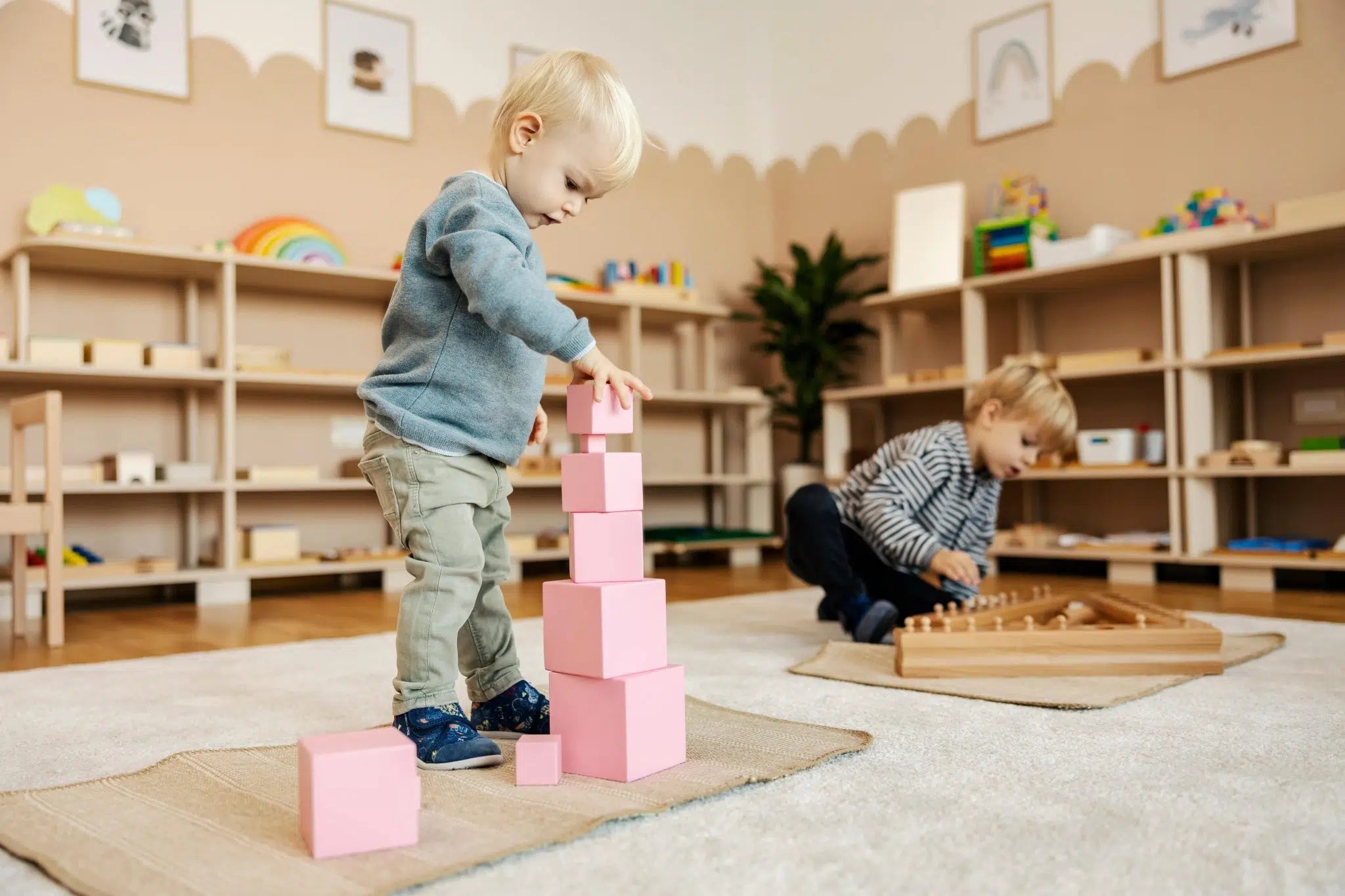
Understanding the Montessori approach and putting it into practice
The foundations of the Montessori method
The Montessori method, developed by Maria Montessori, rests on several fundamental principles that have revolutionised our understanding of early childhood education. This unique approach considers that every child has an innate disposition to flourish and develop at their own pace. Unlike traditional educational methods, the Montessori method does not seek to "fill" the child with knowledge, but rather to create the optimal conditions for them to build themselves.
This scientific method of education is based on careful observation of children and on understanding their developmental needs. Maria Montessori identified that children go through different "sensitive periods" during which they are particularly receptive to certain types of learning. By recognising these periods, educators can offer suitable activities and materials to maximise the child's learning potential.
The prepared environment is a central pillar of this method. It is a carefully arranged space where every element has its place and its purpose. This environment is designed to be:
- Suited to the child's size and physical abilities
- Orderly and predictable, encouraging independence
- Aesthetically pleasing and inviting
- Rich in opportunities for exploration and discovery
- Safe, to allow freedom of movement
Maria Montessori: pioneer of modern education
Born in 1870 in Italy, Maria Montessori was an extraordinary woman who broke down many barriers. The first female doctor in Italy, she quickly turned her research towards the development and education of children. In 1907, she opened the first "Casa dei Bambini" (Children's House) in a disadvantaged district of Rome, laying the practical foundations of her method.
Her scientific training allowed her to observe and methodically analyse children's behaviour, developing an educational approach based on empirical data rather than preconceived theories. Over the course of her career, she identified the sensitive periods of child development, periods during which the child shows a particular interest and an increased capacity for learning in certain areas.
Her major contribution was to understand that the child has an "absorbent mind" that allows them to naturally take in their environment. This fundamental discovery made it possible to rethink the educational approach entirely by placing the child at the centre of the learning process.
Montessori materials: tools for independence and discovery
Montessori materials are one of the most remarkable innovations of this method. Each piece of material is designed with a precise educational objective and respects several essential characteristics:
- Isolation of one quality: each material focuses on a specific concept
- Self-correction: the child can identify and correct their mistakes without adult intervention
- Aesthetics: the materials are beautiful and attractive, inviting use
- Progression from concrete to abstract: allowing a gradual understanding of concepts
Here are some significant examples of Montessori materials:
Practical life materials
These tools are designed to develop the child's independence and motor coordination:
- Kitchen utensils suited to the child's size
- Dressing frames to learn to button, zip and lace
- Pouring sets to develop precision of movement
- Miniature brooms and brushes to take part in household chores
These activities, often neglected in traditional education, are fundamental because they develop the child's concentration, hand-eye coordination and self-confidence.
Sensorial materials
These materials help the child refine their perceptions and classify sensory information:
- Knobbed cylinders to differentiate dimensions
- Touch tablets to distinguish surfaces
- Sound boxes to discriminate sounds
- Colour tablets to recognise and name shades
These sensorial activities indirectly prepare the child for academic learning by developing their capacity for observation and discrimination.
Mathematics materials
Ingeniously designed to present mathematical concepts in a concrete way:
- Number rods to visualise quantities
- Golden beads to understand the decimal system
- Seguin boards for learning the numbers from 11 to 99
- Bead chains to explore the squares and cubes of numbers
These materials allow the child to "see" and "touch" mathematics before tackling abstract symbols.
Language materials
Designed to facilitate the natural acquisition of language:
- Sandpaper letters to link the sound to the shape of the letters
- The movable alphabet to compose words without the difficulty of writing
- Nomenclature cards to enrich vocabulary
- Grammar boxes to explore the functions of words
Specific equipment
-
The Montessori learning tower: This stable structure allows the child to reach adult-height worktops, encouraging their participation in daily activities and developing their independence.
-
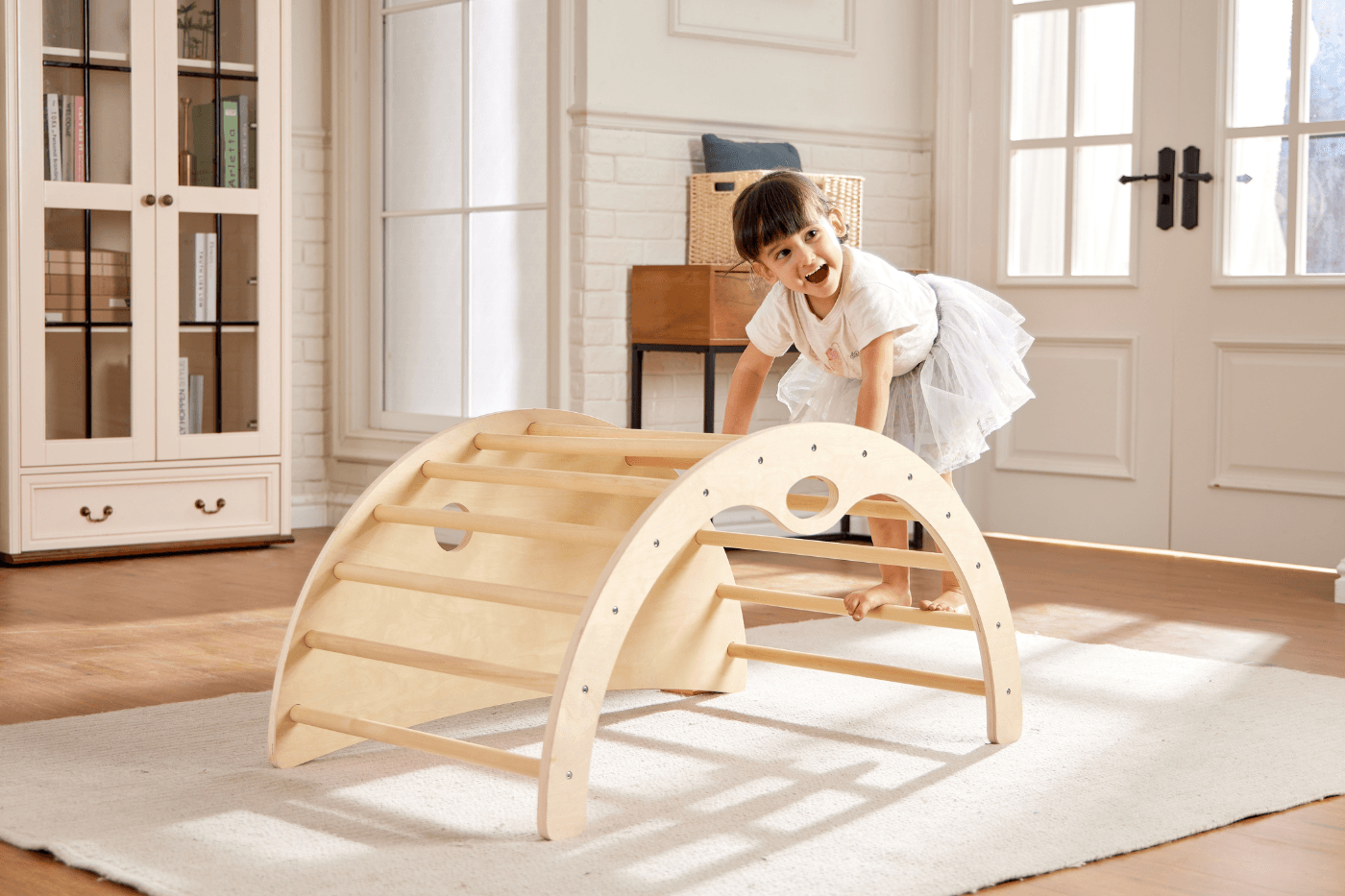
The Pikler triangle: Inspired by the work of Emmi Pikler, this climbing frame encourages the child's free motor development. It allows them to explore their physical abilities at their own pace, strengthening their confidence in their bodily skills and their coordination.
Creating a Montessori environment at home
Bringing Montessori principles into the home does not necessarily require investing in expensive materials. Here are a few guidelines for setting up a Montessori environment at home:
Arranging the space
- Adapt the environment to the child's size (low shelves, hooks at their height)
- Create areas dedicated to different activities (reading corner, creative space, movement area)
- Limit the number of toys available at any one time to encourage concentration
- Favour order and tidiness, with a defined place for each object
Choosing materials
- Select quality toys and materials, preferably in natural materials
- Favour objects that allow active rather than passive use
- Gradually introduce materials that match the child's interest and level of development
- Include real tools suited to the child's size rather than figurative toys
Promoting independence
- Arrange the home so the child can carry out daily tasks on their own
- Involve the child in household activities (cooking, cleaning, gardening)
- Respect the child's pace and choices in their activities
- Create predictable routines that make the child feel secure and encourage their independence
The Association Montessori Internationale sets precise standards to guarantee the quality of Montessori environments. These standards cover the physical layout, the training of educators, the choice of materials and the educational approach, ensuring a faithful implementation of the principles established by Maria Montessori.
The essential role of the Montessori educator
In the Montessori approach, the educator (parent or teacher) plays a fundamentally different role from the one given to them in traditional education. Rather than being the source of knowledge, they become a guide who:
- Carefully observes the child to identify their interests and needs
- Prepares the environment so that it is suited to the child's development
- Presents the materials clearly and precisely, then steps back to let the child explore
- Respects each child's individual pace, without forcing or interrupting concentration
- Nurtures independence by avoiding doing for the child what they can do themselves
The essential qualities of a Montessori educator include:
- Patience and the ability to observe
- Humility and the willingness to serve the child rather than direct them
- Unconditional kindness and the absence of judgement
- Trust in the child's natural abilities
The training of Montessori educators is rigorous and includes both theoretical and practical aspects. This training allows educators to adapt the Montessori approach to different contexts, including for children with specific needs, demonstrating the flexibility and inclusiveness of this method.
The Montessori method in France: evolution and outlook
In France, the Montessori method has seen remarkable growth over the past several years. More and more parents and educators are turning to this approach, which places the child at the centre of the educational process.
Montessori schools are multiplying across France, offering an educational alternative that meets families' growing expectations for personalised education that respects the child's development. What was once considered an alternative pedagogy is gradually gaining institutional recognition.
A significant development is the extension of the Montessori method beyond nursery and primary school. Montessori secondary schools are emerging, allowing educational continuity and consistency in the pedagogical approach throughout the school journey.
The influence of the Montessori method is also being felt in the traditional education system, where certain principles and practices are gradually being integrated, testifying to the relevance and effectiveness of this approach.
Conclusion
The Montessori method offers a deeply respectful vision of the child and their development. By creating a suitable environment, providing appropriate materials and adopting a caring, supportive stance, this approach allows every child to develop their full potential.
As Maria Montessori so rightly said: "One way to measure the relevance of an educational model is the level of happiness of a child." This quotation sums up the very essence of this method, which places the child's fulfilment at the heart of all its concerns.
Whether in a Montessori school or within the family, the principles of this method offer valuable tools to support children in their development and learning, while preserving their natural joy of learning and discovering the world.
FAQs
What are the main principles of the Montessori method?
The main principles of the Montessori method rest on respect for the child as an individual in their own right, education based on the child's sensitive periods, and learning through the senses.
Who was Maria Montessori?
Maria Montessori was an Italian doctor and educator who developed an educational method based on independence, sensory learning and respect for the child's pace.
What are Montessori materials?
Montessori materials are designed to encourage independent learning. They are sensorial, self-correcting and suited to the different stages of the child's development.
How can the Montessori method help a child?
It encourages independence, self-confidence and active learning while respecting each child's natural development.
What is the Association Montessori Internationale?
Founded by Maria Montessori in 1929, the AMI works to preserve and promote the Montessori method throughout the world.
Which Montessori activities suit children aged 0 to 3?
Activities focused on fine motor skills, sensory exploration and independence, such as treasure baskets and shape-sorting games.
Which Montessori activities suit children aged 3 to 6?
Practical life, language, mathematics and sensory exploration activities, suited to their curiosity and their need for concrete learning.
What is the Montessori method for educating young children?
It rests on the prepared environment, suitable educational materials and respect for each child's individual pace.
What role do educators play in Montessori education?
Educators are guides who observe, encourage independence and offer activities suited to each child's needs.
What is a sensitive period according to the Montessori method?
Sensitive periods are phases during which the child is particularly receptive to certain kinds of learning, such as language, movement or order.

Written by Charles CAIGNOL







Leave a comment
This site is protected by hCaptcha and the hCaptcha Privacy Policy and Terms of Service apply.