
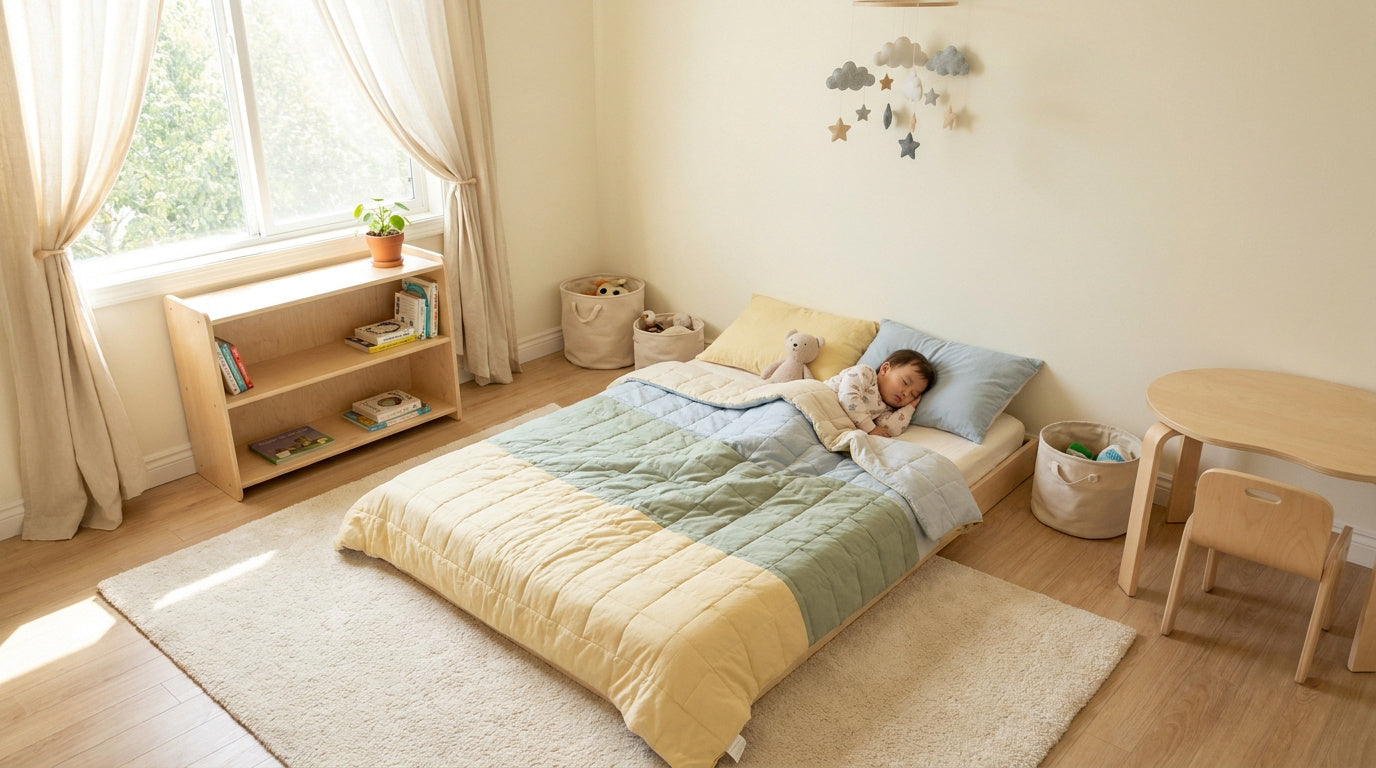
Montessori floor bed: at what age and how to make it safe?
The key takeaway: the transition to a floor bed most often takes place between 18 months and 3 years, as soon as your child walks confidently and understands simple instructions. This step supports motor independence and self-confidence. On the safety side, two actions matter above all: fixing heavy furniture to the wall and choosing a firm mattress, placed on a base that lets air circulate.
The Montessori floor bed becomes truly functional once your child has mastered walking, generally around 18 months.
Yet leaving a little explorer free to move around their bedroom can quickly turn your evenings into permanent surveillance. Let's take stock of the signs of readiness to watch for and how to make their sleeping space safe without losing your nerve.
Montessori floor bed: at what age should you make the move?
The move to a floor bed most often happens between 18 months and 3 years, as soon as the child walks confidently. There is no universal age: your child's signals decide, not the calendar.
Spotting the signs of readiness
Watch how they walk. They must be able to get in and out of their current bed alone. This ease limits clumsy exits in the middle of the night.
Your child must also understand simple instructions. If they already respect the limits of their play area during the day, there is a good chance they will stay in their bed.
Interest in independence is a good indicator: if they want to get dressed alone or tidy their toys, it is often the right time. A child who is already climbing over the bars of their cot is giving you a fairly clear signal.
Why the 18-month benchmark comes up so often
Around 18 months, the child has better control of their body in space, which reduces falls when getting out of bed. It is a reassuring benchmark, not an obligation.
At this age, the open setting also reduces wakings linked to a feeling of confinement. Many children get back to sleep alone more easily when they are not stuck behind bars.
Listening to the child's need for limits
Some children go through a period of separation anxiety and need a contained setting. A bedroom that is too big can worry them rather than reassure them.
In that case, mark out the space: firm cushions along the mattress, a rug that marks the sleeping area, a soft night light. You can open things up gradually.
If the child explores without stress, the transition is a success. If they cry or wake up more for more than two weeks, there is nothing to stop you going back and trying again later.
5 precautions to make the bedroom safe
Once the right moment is identified, setting up the room becomes the priority. A child free to move at night must be in a bedroom designed for that.
Fix heavy furniture and protect electrics
Screw chests of drawers and bookcases to the wall: a child can climb on open drawers and tip the furniture over. This is the most important measure on the whole list.
Fit socket covers, run lamp or baby monitor cables through trunking, and leave no wire hanging within reach. Remove heavy hanging frames, and place nothing massive above the mattress.
Prepare the floor
A thick, non-slip rug near the bed cushions unintentional exits from bed and provides thermal comfort.
Clear the walkways: a free floor makes night-time movement easier and limits falls in the dark. Add corner protectors on low furniture.
Control exits from the bedroom
A safety gate at the door limits access to the rest of the home while you sleep. This is often more effective than trying to keep the child in their bed.
Check that windows are locked and make sure no furniture allows climbing up to them. A video baby monitor lets you follow movements without entering the room.
None of this equipment replaces an adult's vigilance: it reduces risks, it does not remove them.
Mattress and bedding: what really matters
Beyond the safety of the room, the quality of the bedding determines comfort and hygiene.
Firmness and materials
Choose a firm mattress, suited to the child's build. Models that are too soft sag and support the back poorly. A firm mattress is also the constant recommendation for safe sleeping in young children.
Natural, breathable materials such as latex or coconut fibre regulate moisture well. Above all check the dimensions: no gap must remain between the mattress and a wall or frame, to avoid any trapping.
Why avoid direct contact with the floor
A mattress placed directly on the floor accumulates condensation underneath, which encourages mould and dust mites. A slatted base, even a very low one, lets air circulate.
If you don't have a base, lift and air the mattress regularly. The slight elevation also keeps the cold of the floor away.
If your child leaves their bed at night
The first nights of freedom often bring a desire to explore rather than sleep. That is normal, and it passes.
An evening ritual in an uncluttered setting
Reduce visual stimulation: too many toys in sight prevent falling asleep. A tidy bedroom signals that playtime is over.
A low reading nook, with accessible books, allows an independent return to calm. Keep a consistent routine: the brain associates these repeated gestures with bedtime.
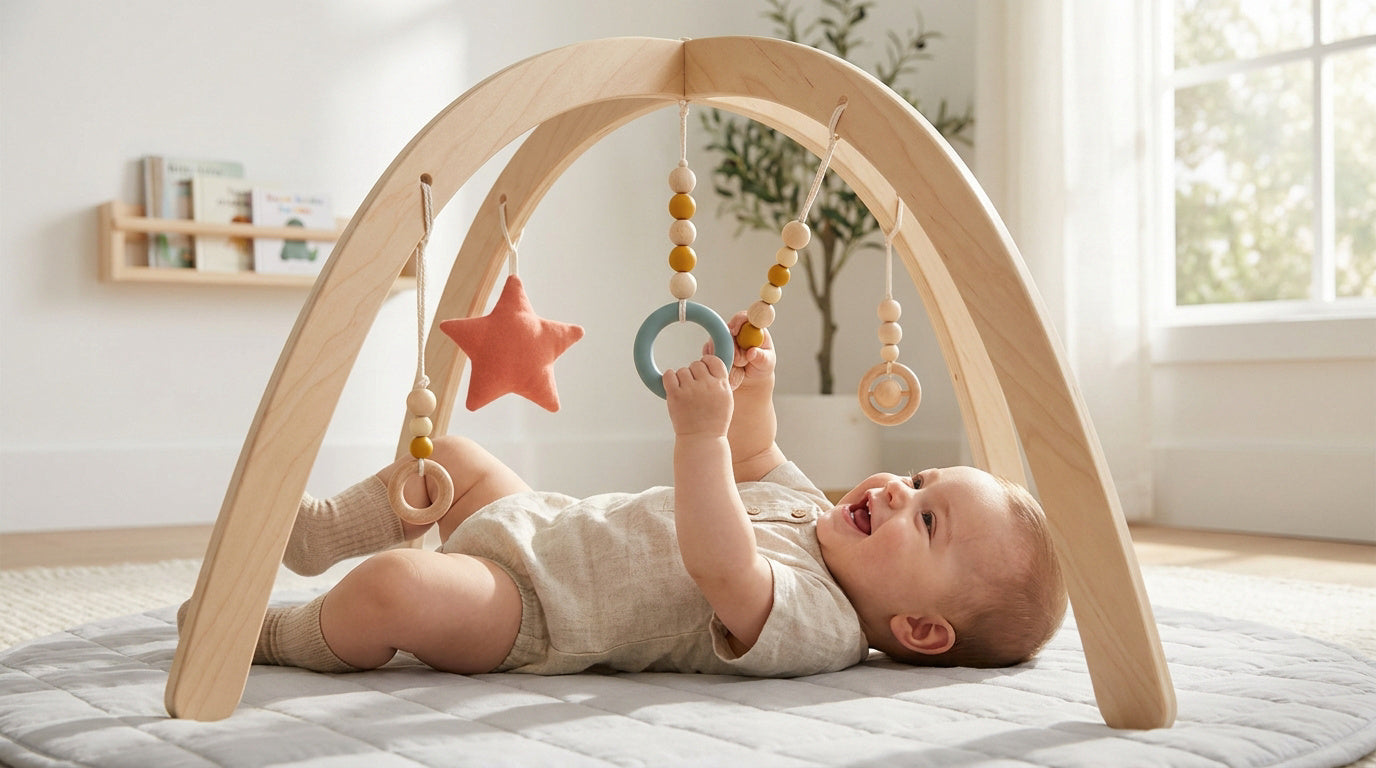
Think about the daytime too: a child who has been able to move, climb and let off steam falls asleep more easily. A movement space in the home, such as an arch to climb, channels this need before the evening rather than in the hallway at 10 pm.
Handling night-time wanderings
Take your child back calmly, without making it a game or a punishment. Stay neutral: the bed remains the only destination.
Removable gates can help in the first weeks. And if the transition proves really difficult, temporarily going back to the cot is not a failure: a few more weeks are often enough.
The move to a floor bed is prepared above all beforehand, in the layout of the bedroom. To go further, see our complete guide to setting up a Montessori bedroom, age by age.
FAQ
When should you move to a Montessori floor bed?
Most often between 18 months and 3 years, but age matters less than the signals: confident walking, ability to get in and out alone, understanding of simple instructions. A child who is already climbing over the bars of their cot is telling you it's time. You can start with naps to test gently.
How do you make the bedroom safe before the transition?
It is essential to fix heavy furniture to the wall, fit socket covers, tidy away cables and remove small objects. Place a thick rug at the foot of the bed and hang nothing heavy above the mattress. A gate at the bedroom door prevents exploration throughout the home.
Which mattress should you choose for a floor bed?
A firm mattress, suited to the child's size, in breathable materials such as coconut fibre or latex. Make sure no gap remains between the mattress and a wall or frame. Avoid soft models, which support the back poorly.
Can you put the mattress directly on the floor?
It is possible but not really recommended over time: condensation builds up under the mattress and encourages mould and dust mites. A very low slatted base solves the problem. Failing that, lift and air the mattress regularly.
What if my child won't stay in bed?
Take them back calmly, without making it a game, and stay neutral in your exchanges. A regular evening ritual in an uncluttered bedroom helps a lot. If the transition seems too difficult, going back to the cot for a few weeks is a perfectly reasonable option.

Written by Charles CAIGNOL






Leave a comment
This site is protected by hCaptcha and the hCaptcha Privacy Policy and Terms of Service apply.