
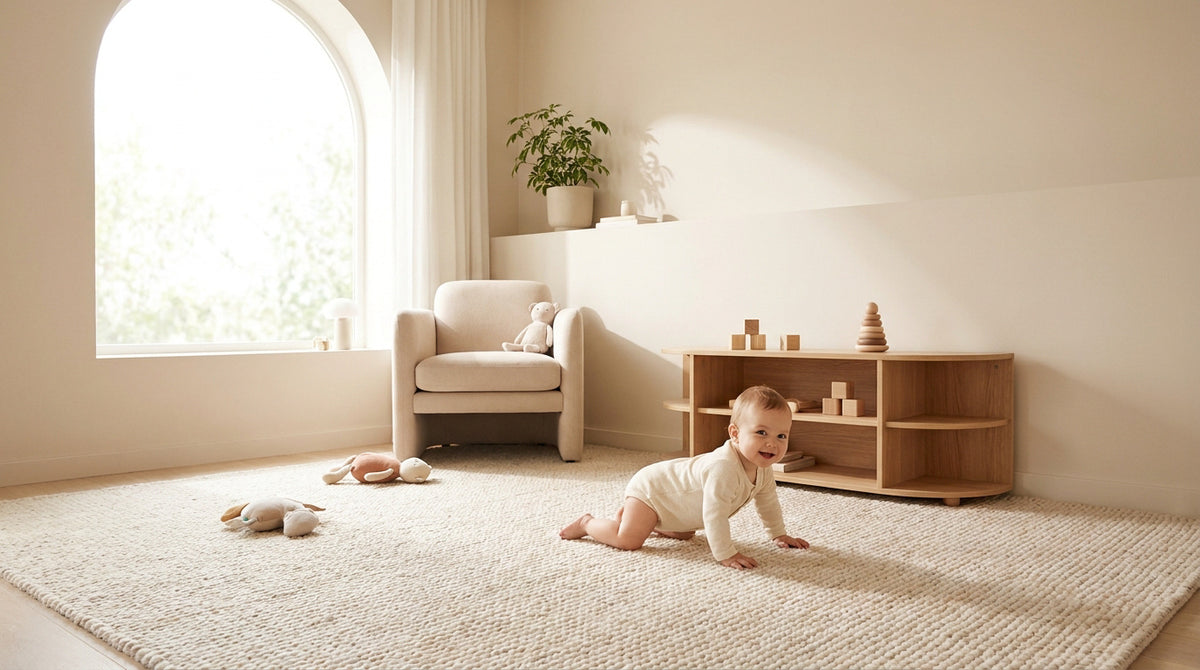
Keeping your baby safe without shutting them in: our kind advice
The key takeaway: making the home safe is better than restricting the child. From 6 to 9 months, go round each room at their height, secure heavy furniture, protect stairs and windows. The goal is not zero risk, which is impossible, but an environment where the child can explore under your watch.
Most babies start crawling between 7 and 9 months, and the living room suddenly becomes an adventure ground. You then hesitate between barricading everything and spending your days saying no.
There is a third way: adapt the home rather than limit the child. Here is how.
Keeping them safe without shutting them in: the approach
Why the playpen cannot be the only answer
The playpen limits movement at precisely the moment when the child needs it most to build their body. Crawling, going around things, pulling up: these movements build their coordination.
Sensory exploration counts just as much. Touching different textures, changing surfaces, meeting obstacles: all useful information for their brain.
That said, the playpen still has legitimate uses: the time of a shower, answering the door or preparing something in the kitchen. It is its prolonged, default use that raises questions.
When to act
Around 6 months, the child rolls onto their tummy and pushes up on their arms: this is the time to start.
Around 9 months, movement speed increases and furniture becomes a support for pulling up. Objects up high come within reach.
Anticipate rather than react: every week brings a new ability, and so a new risk to assess.
Going round at child height
The floor-level observation method
Lie down and move on all fours through each room. This position reveals what you never see standing up: small objects under the sofa, loose screws, corners at forehead height.
Check the stability of whatever is within reach: a lamp that can be pulled, a light side table, a plant balanced precariously.
The risks that are easy to miss
Hanging blind cords present a risk of strangulation: wind them up and fix them out of reach.
Electrical cables behind furniture: gather them in cable trunking.
Unused sockets: shutter-type socket covers.
Small objects left on coffee tables: a button or a button battery can be swallowed in a second.
Room by room
Kitchen and living room
Protect heat sources, store knives up high or in a locked drawer, and put cleaning products out of reach, ideally up high rather than under the sink.
Mark out an area where the child does not go while cooking. Technical devices do not replace learning: explain, repeat, show.
Stairs and windows
A gate at the top and bottom of the stairs. At the top, you must choose a screw-fixed model: pressure-fit gates are not suitable for this location.
For windows, restrictors let you air the room without opening fully. And never place furniture under a window: it would serve as a step.
The bedroom
Fix chests of drawers and shelves to the wall with straps or brackets: a chest of drawers tips over when several drawers are open.
For sleeping, a firm, well-fitted mattress, with no pillow or bulky soft toy in the toddler's bed.
Place toys on low shelves: the child chooses alone, which reduces frustration and climbing towards what is too high.
Choosing the right equipment
Screw-fixed or pressure-fit gates
Screw-fixed: essential at the top of the stairs, where mechanical fixing makes the difference.
Pressure-fit: practical between two rooms on the same level, with no tools or marks. Adapt to the surface: plasterboard needs specific plugs, and pressure can mark woodwork.
In all cases, test the strength after fitting and check again regularly: a gate that has worked loose gives a false sense of security.
Solutions for tenants
Magnetic locks fit inside cupboards, with no visible drilling. Adhesive straps let you secure furniture without damaging the wall.
Prefer rotating socket covers, easy to use every day: a device that is too fiddly ends up not being used.
Including rather than excluding
The observation tower in the kitchen
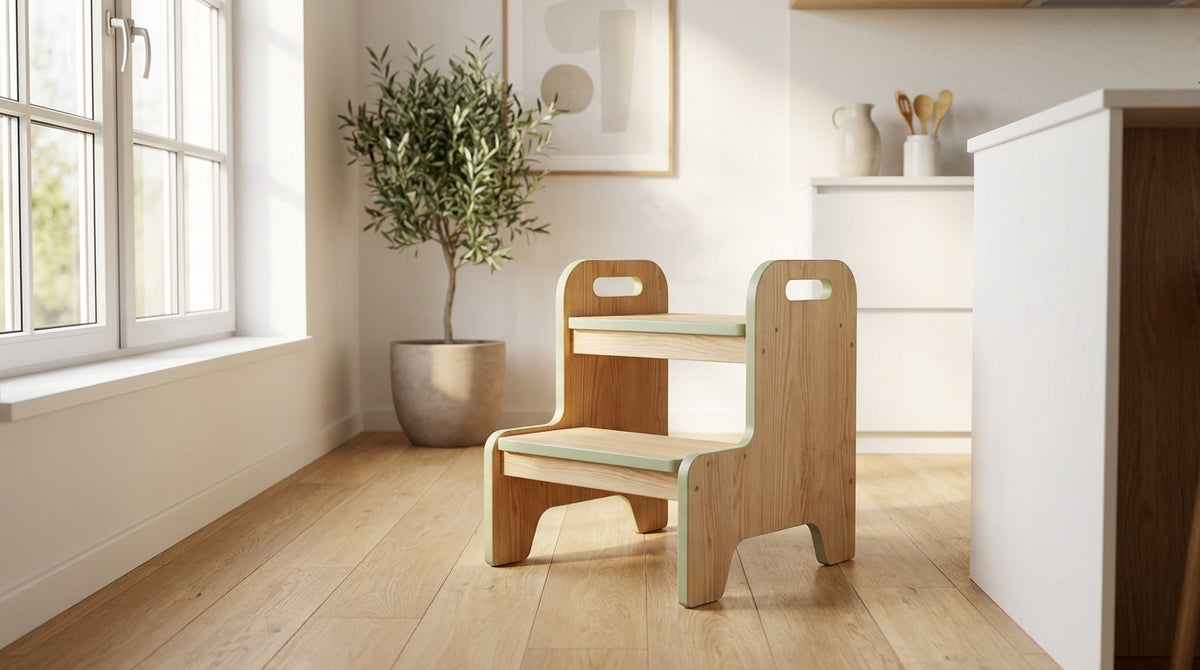
The kitchen concentrates the risks, and it is precisely where the child wants to be. An observation tower puts them at your height with a guard rail, rather than at your feet or on an unstable chair.
They then take part in simple tasks: washing vegetables, stirring. The kitchen goes from forbidden zone to shared space, which also reduces conflict.
The structure limits sideways falls, but does not remove the need for your presence: keep the child away from the hob and oven when in use.
Free but structured play areas
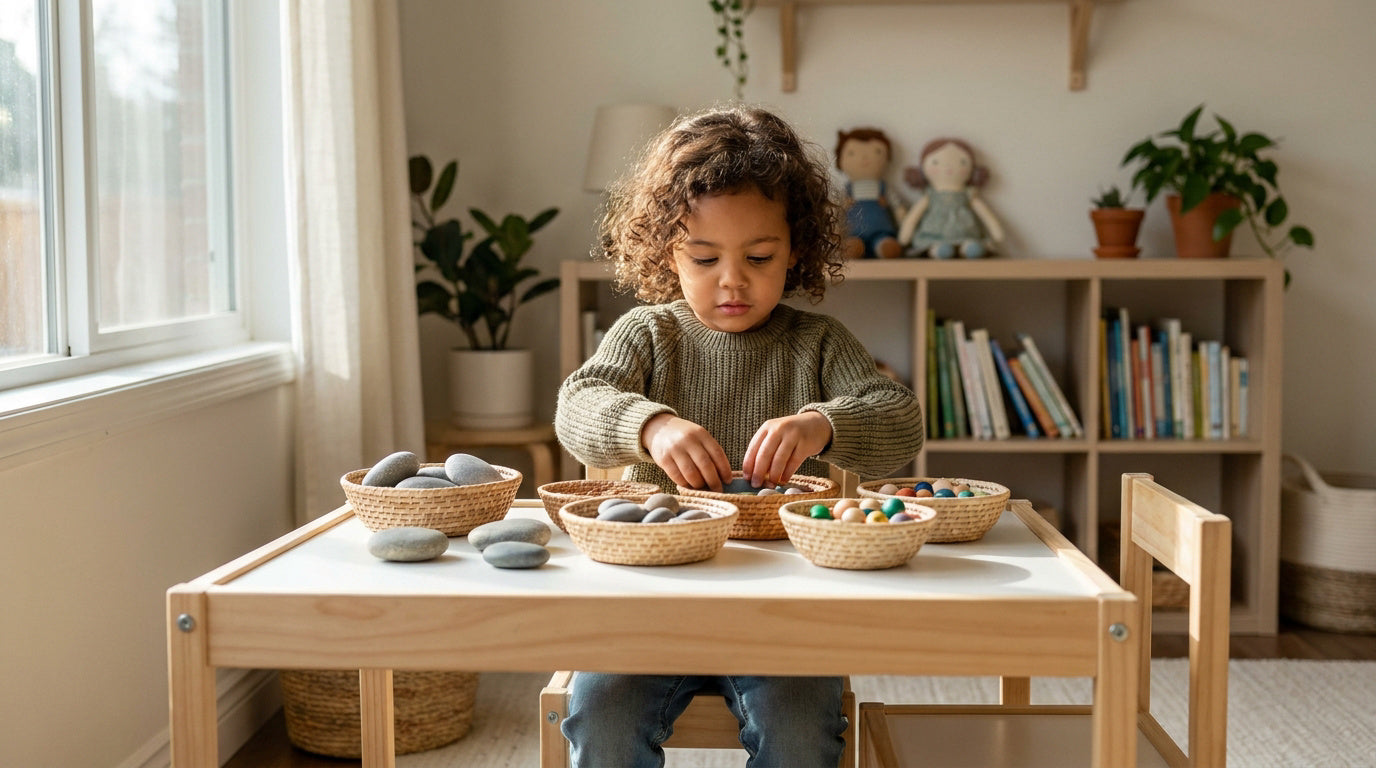
A play mat visually marks out the play space. A low shelf lets them choose their activity alone.
To channel the need to climb, it is better to offer a support designed for it. A climbing arch, from 18 months, offers an alternative to the living room furniture. On this subject, see also our article on the child who climbs everywhere.
No device replaces supervision: the layout reduces risks, it does not remove them.
Safety on the move
Plan a small travel kit: a few socket covers, a foam door stopper. Enough to quickly make a hotel room or a room at relatives' safe.
At the homes of people without equipment, do a quick tour on arrival and suggest simple adjustments: move a vase, wind up a cord, close a door.
Making a home safe does not mean turning it into a bunker, but removing the real dangers to leave the rest open. To go further, see our guide to setting up a Montessori bedroom.
FAQ
Can you do without a playpen?
Yes, by making an entire room safe rather than restricting the child to a few square metres: stair gates, secured furniture, protected sockets. The playpen remains useful occasionally, for the time of a shower for example, but it should not be the default mode.
How do you spot dangers when baby starts crawling?
Get down on all fours and go through each room at their height. You will see what escapes you standing up: small objects under furniture, cables, blind cords, corners at face height. It is the most effective method for anticipating.
Which accessories are really useful?
Shutter-type socket covers, magnetic locks inside cupboards, securing straps for tall furniture, stair gates. For tenants, there are no-drill solutions, adhesive or pressure-fit, effective on suitable surfaces.
How do you reconcile safety and independence?
By including the child rather than keeping them away. An observation tower lets them take part in the kitchen at your height. Toys on low shelves and a support designed for climbing channel their needs instead of forbidding them.
What precautions for windows and stairs?
Place no furniture under a window, and fit restrictors to air the room without opening fully. For stairs, a gate at the top and bottom, the top one always screw-fixed. Check regularly that the fixings have not worked loose.

Written by Charles CAIGNOL






Leave a comment
This site is protected by hCaptcha and the hCaptcha Privacy Policy and Terms of Service apply.