
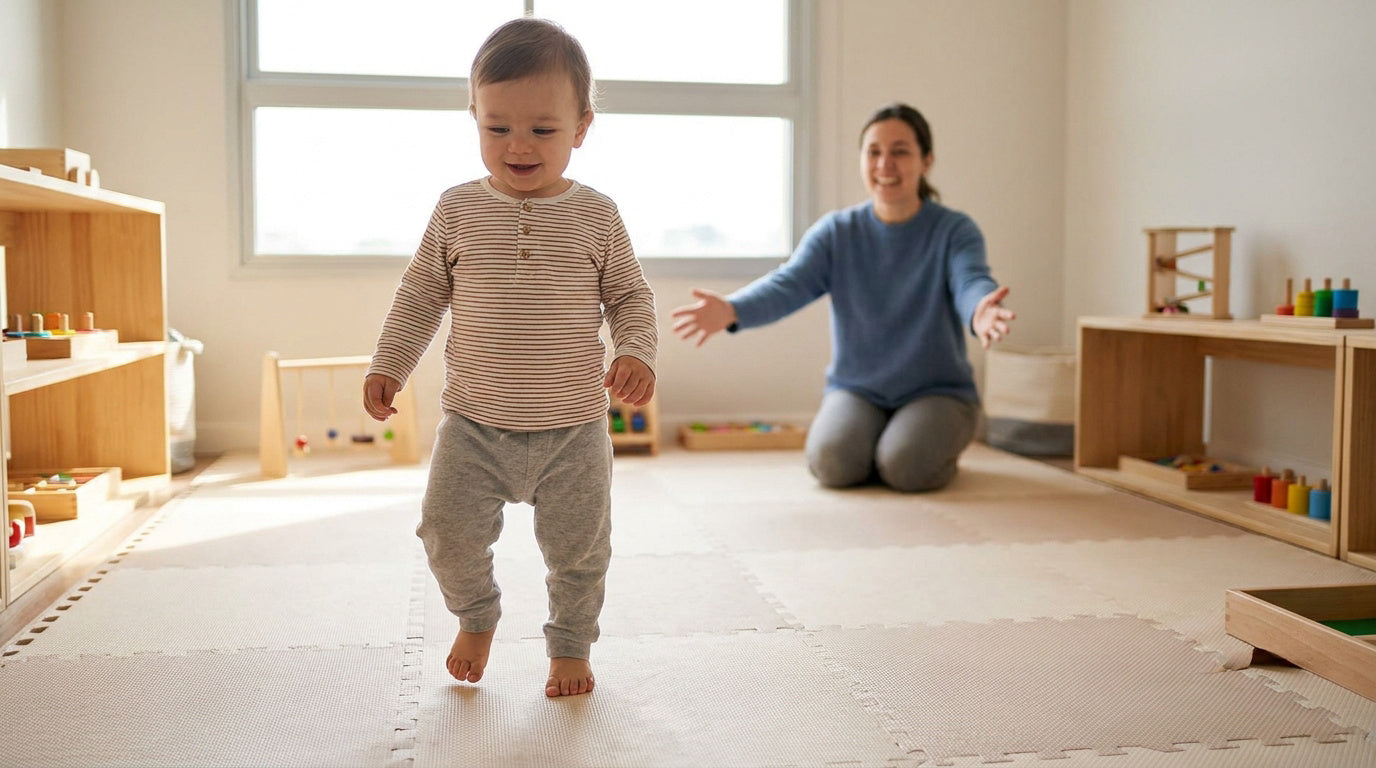
When do babies walk: the stages from 6 to 18 months
The key takeaway: independent walking generally happens between 10 and 18 months, and the 12-month mark is not a medical rule. A good share of children are not yet walking on their first birthday, and that is normal. Bare feet, a clear floor and stable supports help far more than any accessory.
Independent walking is generally acquired between 10 and 18 months. Yet we quickly get the impression that if the neighbour's child is already running at 11 months, ours is behind.
Let's take stock of the real stages of motor development, so you can support your child calmly without rushing the steps.
The age of walking: myths and reality
The 12-month mark is not a rule
Social pressure often sets the first birthday as a deadline. Neurological development, however, does not follow the calendar.
The window considered normal extends from about 10 to 18 months. A child who walks later is simply consolidating other skills before setting off: language, fine motor skills, or quite simply caution.
Avoid comparisons between children of the same age. They bring nothing, and create worry that is most often unfounded.
The signs that show they are getting ready
Watch the strength of the trunk: a child who sits up straight without support has the necessary foundation.
Standing with support is a major clue. They pull themselves up on a piece of furniture, hold on for a few seconds, test their balance.
Finally, look out for sideways movement, that "crab walk" along the sofa. It strengthens the hips and almost always precedes the first forward steps.
The motor stages before the first steps
Crawling and coordination
The alternating movement of arms and legs engages both hemispheres and builds cross coordination.
Crawling intensely strengthens the shoulders and hips, the joints that will soon carry the body's weight when standing.
Some children skip this stage and go straight to standing, with no particular consequence. Still encourage exploration on the floor: it is the best all-round training.
Pulling up to standing
Moving from sitting to kneeling, then standing, requires solid supports. A stable piece of furniture or a fixed bar allows this pulling up.
The child then discovers the feeling of weight on their heels and the soles of their feet. Static balance is acquired through repetition, a few seconds at a time.
Those moments when they let go with their hands without realising mark the true beginning of postural independence.
Why bare feet help balance
The sensors in the soles of the feet
The bare foot transmits the unevenness of the floor to the brain, which allows posture to be adjusted in real time.
The arch of the foot develops better without constraint: the muscles work, the foot spreads and offers a wider base.
Choosing soft slippers
If the floor is cold, favour a sole that bends completely and a shape that respects the width of the toes.
Avoid rigid soles that lock the ankle: the foot needs mobility to find its balance. Save closed shoes for outings.
Setting up a space that invites exploration
Supports at their height
Arrange stable support points where the child can catch themselves. Check that no furniture tips over, and fix to the wall any that could fall.
Clear the walkways, protect the corners. An uncluttered space encourages the child to set off.
A firm rug cushions without being soft: too plush, it destabilises instead of helping.
Furniture that supports standing
A support bar or a low, stable piece of furniture lets the child pull themselves up alone, which strengthens their sense of competence.
Later, once walking is acquired and the age has come, a climbing arch takes over for the next challenges: climbing up, over and across. It is intended from 18 months, so after this period of learning to walk.
In the same spirit, a learning tower encourages prolonged standing from 12 months, in the kitchen, while you prepare the meal.
Falls and delays: how to react
Keeping tumbles in perspective
Stay calm: your reaction guides theirs. If you panic, they will associate walking with something frightening.
Let them get up alone after a light fall, without rushing over. This is how they learn to manage their limits.
Value the attempt rather than the success: every try counts.
When to seek advice
The usual benchmark is around 18 months: if the child shows no desire to stand up, talk to your paediatrician. A check-up is in any case scheduled between 16 and 18 months.
Seek advice earlier in case of clear asymmetry (one leg visibly used less), unusual muscle tone, or if the child makes no progress at all for several months.
Your parental instinct counts: when in doubt, professional advice usually clears up the worry in a few minutes.
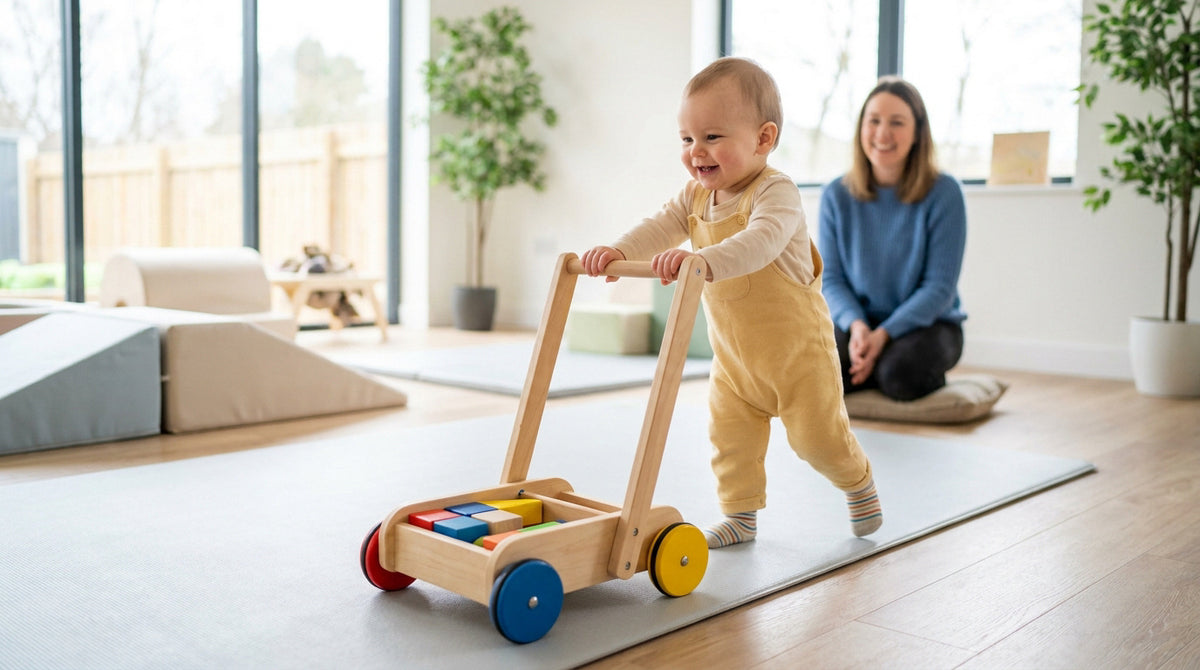
Walking is acquired between 10 and 18 months, each child at their own pace. To find out what really helps and what hinders, read our article on the walker wagon, the baby walker and free movement.
FAQ
Is there an age at which baby absolutely must walk?
No. The window considered normal extends from about 10 to 18 months, and a significant share of children are not yet walking on their first birthday. Neurological development does not follow the calendar: a child who takes their time is often consolidating other skills in parallel.
What signs show that my child is getting ready to walk?
They sit up straight without support, pull themselves up to standing by gripping furniture, and balance for a few seconds. The "crab walk" along the sofa is another classic sign: it strengthens the hips and almost always precedes the first steps.
Is crawling compulsory?
It is not strictly compulsory, but it is a very useful stage for cross coordination and strengthening the shoulders. Some children go straight to standing without this being a problem, as long as overall development remains harmonious.
Why leave baby barefoot?
The sole of the foot picks up the unevenness of the floor and allows posture to be adjusted in real time. The toes grip and the arch of the foot strengthens without the constraint of a rigid sole. If the floor is cold, opt for very soft slippers.
When should you seek advice?
Around 18 or 19 months if the child is not trying to stand up. Earlier in case of marked asymmetry between the two legs, unusual muscle tone, or no progress over several months. A check-up is scheduled between 16 and 18 months to take stock.

Written by Charles CAIGNOL






Leave a comment
This site is protected by hCaptcha and the hCaptcha Privacy Policy and Terms of Service apply.