
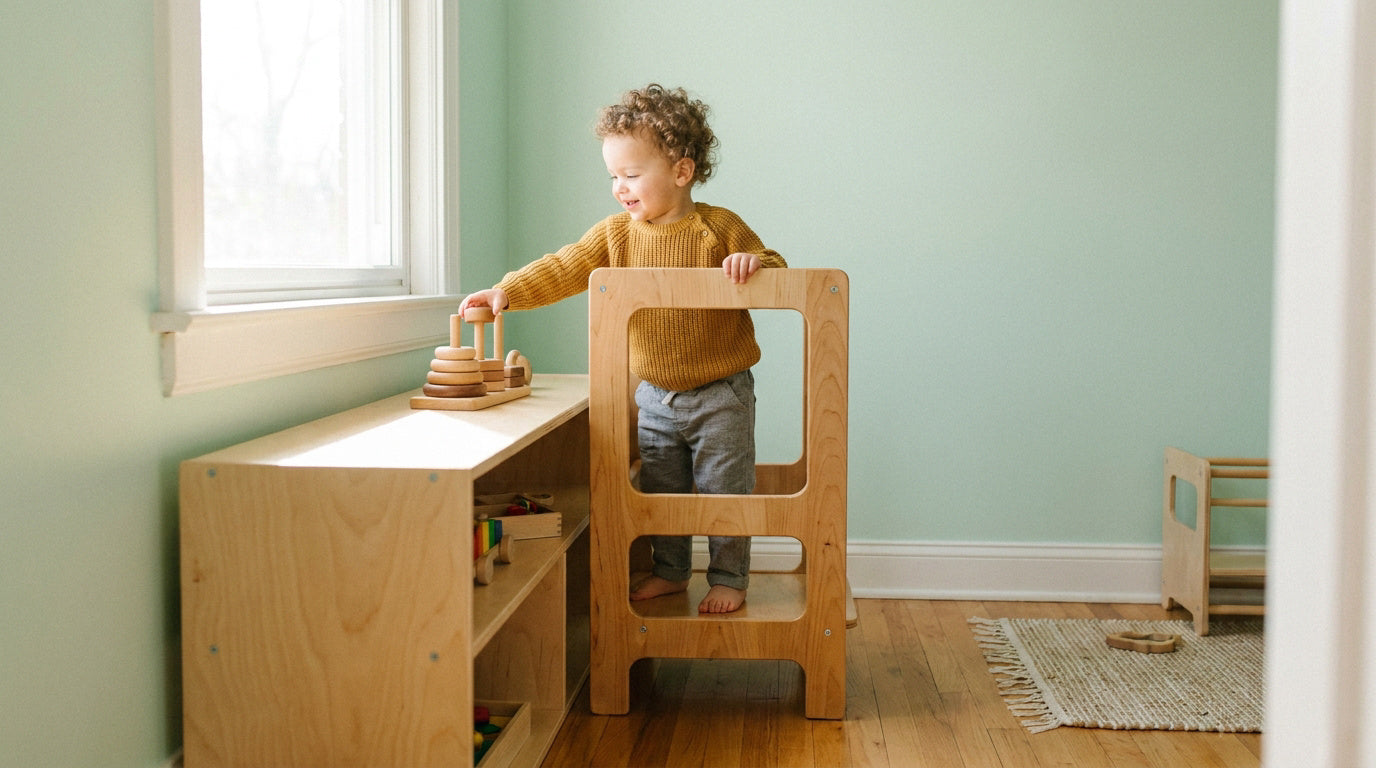
Montessori furniture: mistakes to avoid before buying
The key takeaway: most bad purchases come from three things. A piece of furniture bought too early or too late for the child's real age, insufficient stability, and a product that doesn't grow with the child and is only used for a few months. The checklist at the end of the article sums up everything you need to check.
Developmental furniture represents a real budget, and disappointments are common: one piece that stays in the cupboard, another that tips over, a third the child cannot use alone.
Here are the seven mistakes that come up most often, and how to avoid them before you confirm your basket.
1. Buying too early (or too late)
This is by far the most expensive mistake. A piece of furniture bought six months too early sits in a corner, and the enthusiasm has worn off by the time the child is ready.
Useful benchmarks: a learning tower becomes relevant around 12 months, when the child stands alone confidently. A climbing arch is more for 18 months and up, the age when they walk steadily and want to climb.
Be wary of the very low age labels displayed by some sellers: they widen the commercial target more than they describe real use. Trust your child's abilities, not the marketing pitch.
2. Neglecting certification
CE marking is compulsory: its absence should make you walk away immediately. It commits the manufacturer to complying with European regulations.
The EN 71 standard sets out the requirements: EN 71-1 for mechanical and physical properties, EN 71-3 for the migration of certain elements from materials and coatings.
Beware of handmade models sold on marketplaces: many are well made, but not all are tested. Ask for compliance before buying.
3. Choosing the wrong material
The distinction that matters is not "solid wood versus plywood", but "structural wood versus particleboard".
Solid wood and quality plywood, such as birch plywood, hold up very well: the latter is even more stable over large surfaces and does not split. That is why it is used in a lot of children's furniture.
Chipboard and low-grade MDF, on the other hand, swell with humidity and crumble at the edges. Avoid them for furniture used every day, especially in the kitchen.
As for finishes, a strong chemical smell when opening the box is a bad sign. Prefer water-based finishes or vegetable oils.
4. Underestimating stability
Furniture that is too light or has a narrow base tips over as soon as the child leans on one side. This is particularly critical for a tower, where the child is up high.
Check the width of the base, the presence of non-slip pads and the absence of play in the joints from assembly onwards. Shake the assembled structure: it must not wobble.
For a particularly lively child, a safety strap closes off the rear access of the tower. It limits the risk of falling backwards, without replacing your supervision.
5. Choosing furniture that doesn't grow with the child
Furniture that only does one thing rarely serves for more than a year or two. Think in terms of cost per year of use rather than the displayed price.
A tower that converts into a table and stool keeps serving when the child no longer needs to be up high. An arch becomes a rocker, a den and then a reading nook. Two accessories are sometimes enough to extend interest: a reversible ramp adds slide and climbing, wedges lock the rocker for quiet time.
Height-adjustable furniture also follows growth, which avoids buying again two years later.
6. Confusing decoration with ergonomics
A very photogenic piece of furniture that is too high is useless: if the child cannot climb onto it alone, they will call you every time, and the independence you were looking for disappears.
The decisive criterion is simple: can the child use it without you? Climb up, get down, reach, tidy away.
Another often overlooked point: very bright colours and busy patterns capture attention at the expense of the activity. Neutral tones blend better into your home and tire the child less.
7. Going DIY without the skills
Repurposing a step stool or building a structure yourself is possible, but requires real precautions: centre of gravity, strength of fixings under repeated load, absence of sharp edges.
A standard wood screw eventually loosens under a child's movements. Without a load test, it is hard to know the real strength of the build.
And an absolute rule: never remove a safety element to "adapt" a piece of furniture. Removing a tower's guard rail takes away precisely what prevents the fall.
The checklist before ordering
1. Does the stated age match my child's current abilities?
2. Are CE marking and the EN 71 standard mentioned?
3. Is the material specified (wood species, type of board)?
4. Is the base wide and the furniture stable once assembled?
5. Does the furniture evolve, by adjustment or conversion?
6. Will my child be able to use it alone?
7. Is the finish sanded, are the corners rounded?
8. Do I have room to install it and leave it accessible?
A good purchase can be recognised by a few things: the right age, verifiable stability and a use that evolves. To compare the solutions on the market, also read our comparison between a DIY tower and a certified tower.
FAQ
Should you choose furniture that is exactly the child's size?
Yes. Going bigger "so it lasts" is a false economy: if the child cannot climb up or reach alone, they get discouraged and the furniture loses its point. Prefer an adjustable model, which follows their growth without being unsuitable at the start.
How do you check that furniture is safe and healthy?
Check the CE marking and the mention of standards EN 71-1 and EN 71-3. Check that the material is specified and prefer water- or oil-based finishes. A persistent chemical smell when opening the box is a bad sign.
Do you need to buy a lot of furniture for a Montessori space?
No, it is even counterproductive: an overloaded space scatters attention. Better one or two versatile pieces and a low shelf. Toy rotation does the rest, with no extra purchase.
How do you care for wooden furniture?
A slightly damp cloth is enough day to day, without ever soaking the wood. Check that the screws are tight twice a year. A natural wax or oil revives the look of the wood and extends its life.
Is a foldable tower as stable as a fixed model?
A well-designed foldable tower offers comparable stability in the open position, provided it has a wide base, non-slip pads and a reliable locking system. Check that the mechanism locks firmly, and check it regularly.

Written by Charles CAIGNOL








Leave a comment
This site is protected by hCaptcha and the hCaptcha Privacy Policy and Terms of Service apply.