
Pretend play for babies: why it is essential for their development
Contents
- Developing communication through pretend play
- Problem-solving thinking and pretend play
- Social and emotional perception and pretend play
- Social behaviour and coordination in pretend play
- Following rules through pretend play
Developing communication through pretend play
Pretend play activates language learning from 8 to 12 months. By copying my gestures while I prepare meals, my baby began to link objects to verbs, forming his first simple sentences.
Imitation strengthens auditory and articulatory memory. By repeating the "meow" and "woof" of animal games, my daughter refined her pronunciation. At 2, she copies my intonation while playing "going shopping" with her cash register.
At 12 to 18 months, peekaboo games or copying sounds help structure language. At 2 to 3 years, a wooden play kitchen or a toy phone stimulate sentence building. My 2-year-old son now uses "please" during his games.
- Wooden play kitchen: realistic role play with wooden accessories from sustainable forests to enrich the vocabulary of everyday gestures from 18 months
- First musical toys: colourful maracas and xylophones to learn sounds and phonetic repetition by copying rhythms
- DIY tool box: wooden case with screws, hammer and spanners to link tool names and action verbs (hit, screw) from age 2
- Doll's doctor case: complete set for playing doctor with talking accessories (stethoscope, thermometer) and developing narrative language
- Make-up accessories: mirror, lipstick and brush to imitate parental care and broaden the vocabulary of emotions ("You have a lovely smile!")
- Picnic set: basket with fabric fruit and vegetables to name foods and build simple sentences ("I want the red apple")
When my 13-month-old baby started calling me "mummy" by imitating me, I saw his awareness of language emerge. A few weeks later, he was saying "mummy come" during our games, a linguistic leap made possible by constant imitation.
Get involved in pretend play by commenting on your everyday gestures. Gently repeat mispronounced words without correcting. Offer age-appropriate wooden accessories. And above all, let your child take the lead to build their linguistic confidence.
The Montessori method highlights the importance of imitation in language learning, encouraging children to explore realistic situations.
Problem-solving thinking and pretend play
Pretend play activates problem solving from 18 months. Watching my baby copy my gestures to open a drawer, I saw his analytical mind take shape, testing different approaches to succeed.
When my 2-year-old daughter wanted to help tidy up toys, she experimented with stacking, sorting, then organising. This trial and error, inspired by my own sorting methods, revealed her ability to adapt solutions.
Role play such as "fixing a car" or "looking after a doll" develops logic and anticipation. At 18 months, wooden tool boxes help understand cause and effect. At 2 to 3 years, play kitchens stimulate planning.
The last time my son wanted to build a tower that was too tall, he watched how I put the pieces together. By copying my stabilising gestures, he understood balance, a practical lesson in applied physics.
The Pikler triangle offers an ideal testing ground. By climbing and sliding, children learn to adjust their strength and posture to overcome physical obstacles, as I saw my daughter do with her scooter.
When the urge arises to block her path with a cushion, I turn it into a challenge: "How do you get past? Climb? Go around?" These mini-problems stimulate her creativity, exactly as when she watches me get around an obstacle in the kitchen.
Social and emotional perception and pretend play
Pretend play develops emotional intelligence from 12 to 18 months. Watching my 13-month-old baby comfort his doll, I saw his ability to understand emotions through observation being born. This key phase structures his future empathy.
Toddlers first imitate strong emotions such as joy or annoyance. When my 2-year-old daughter plays at "looking after" her soft toy, telling it "shh, it will be alright", she learns to name her own emotions through the other.
| Emotions | Related pretend play | Development goals |
|---|---|---|
| Joy | Imaginary party game, pretending to give a surprise gift | Encourage positive expression and sharing of emotions |
| Sadness | Comforting role (looking after a doll, consoling a friend) | Develop empathy and understanding of others' needs |
| Anger | "Controlled frustration" games (gently tapping a cushion) | Learn to express anger in a suitable, non-violent way |
| Fear | Hide and seek with imaginary monsters alongside an adult | Tame anxiety in a safe and reassuring setting |
| Surprise | Guessing games or hidden-object games | Stimulate curiosity and adaptation to unexpected changes |
| Disgust | Pretending to cook "weird" dishes or exploring textures | Identify sensory preferences and respect those of others |
By playing at "being mummy" with his doll, my 2-year-old son learned to identify the needs of others. This projection into a social role helps him develop his ability to put himself in someone else's shoes.
Caring games with dolls or the wooden Montessori arch stimulate emotional expression. Make-up accessories with a mirror also make it possible to discuss emotions in front of the reflection of one's expressions.
The Montessori arch offers a safe space to regulate their emotions when facing physical or social challenges.
When my little one expresses anger in play, I validate his feelings by giving him the words for his emotions.
Sensory activities at the sink (in French) strengthen emotional expression. By playing at "doing the dishes", children verbalise their states ("I like the warm water!") in an interactive setting.
Social behaviour and coordination in pretend play
Pretend play introduces social codes from 18 to 24 months. Watching my children play doctor or family, I saw their understanding of exchanges, sharing and cooperation being born.
Turn-taking is learned gradually. At 2 to 3 years, my son took in the concept of "waiting your turn" by imitating our habits at the table. Cooking or building games in pairs made this collective awareness easier.
The roles of "mummy", "daddy", "doctor" or "firefighter" emerge around age 2. My 2-year-old daughter alternates with her brother between "chef" and "waiter" at the play kitchen, exploring different social dynamics.
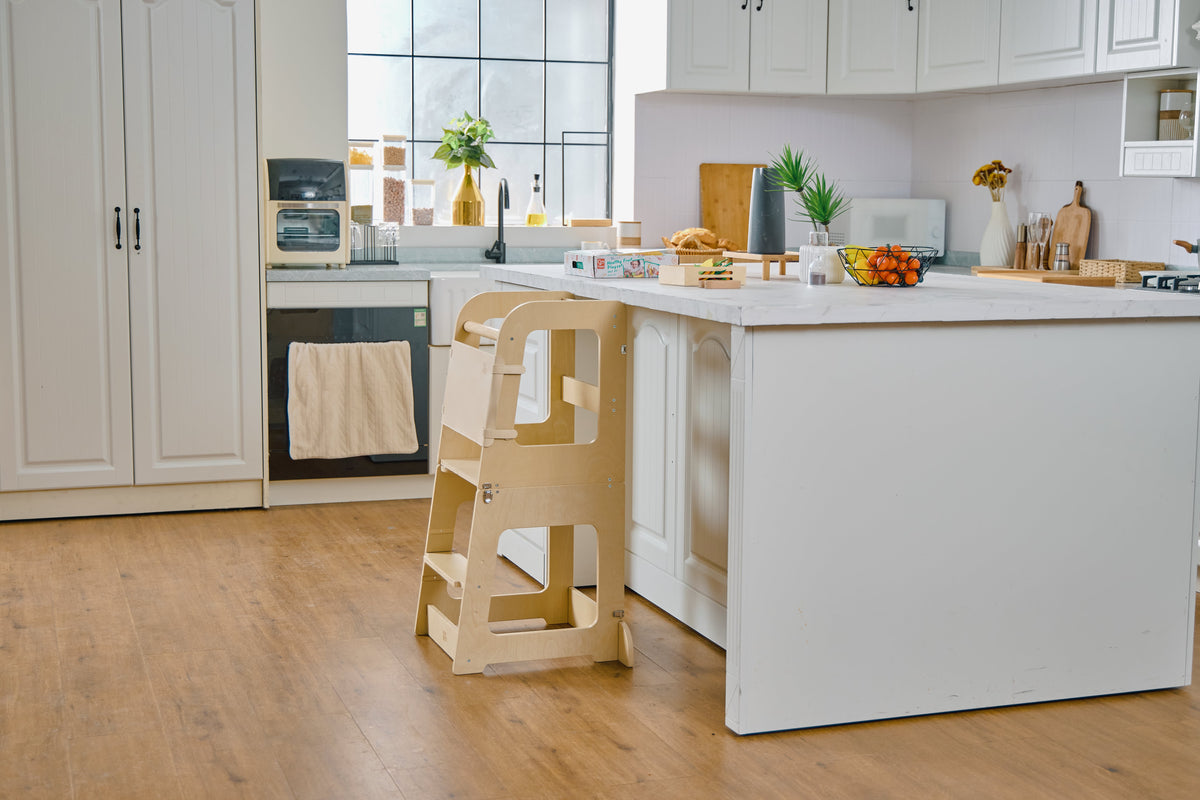
The Montessori tower is ideal for collaborative games. By copying my gestures to climb steps together, my children learned to coordinate their movements and to wait.
When they each played on their own, I guided them towards games with a shared goal such as "building a den". Today, they share out the tasks and voice their ideas in tandem.
For a shy child, I favour games for two with defined roles. When my son hesitated to share, inventing a "market game" with two stallholders encouraged his openness without pressure.
Following rules through pretend play
Pretend play introduces social rules from 18 to 24 months. Watching my son copy my tidying habits, I saw his understanding of "in its place" and "each in turn" being born, key concepts for structuring his behaviour.
Rules are absorbed through repetition and observation. When my 2-year-old daughter wanted to play "putting away the shopping", she gradually took in order by repeating my gestures, testing different solutions until she found the effective method.
Sharing or safety rules are learned more easily. Wooden cooking games or doll-care games teach gentle handling of objects. Complex social norms require more guidance and repeated real-life practice.
For a 2-year-old, a wooden cash register is ideal: by re-enacting purchases, they learn to wait their turn and respect the queue. At 3, role play with more elaborate scenarios reinforces this learning.
When my little one wanted to help me cook, he first wanted to touch the hot utensils. By repeating "careful, it's hot" while showing him a toy version, he understood the safety limit through guided experience.
To help rules sink in, I offer games with simple challenges: "put the blocks in the box before starting again" or "wait until I say it's your turn". This concrete approach makes the norms visible and tangible for the child.
Pretend play is much more than simple fun: it shapes your baby's communication and emotional intelligence. By copying your gestures, my 2-year-old learned to name his emotions and to cooperate. For moments rich in meaning, try simple games such as a wooden play kitchen or DIY accessories, Teedum tools designed to nurture imagination and social skills from age 1. Ready to turn every moment into a learning opportunity?
FAQ
How can I encourage imitation in a shy child?
Encouraging imitation in a shy child calls for a gentle, patient approach. Start with simple, non-threatening games where they can observe and take part at their own pace. Imitate their own actions or sounds so they feel seen and understood, using familiar toys to make interaction easier.
Avoid forcing or criticising them. Imitation must remain a positive and fun experience. Be a model yourself by imitating others and commenting on your actions. Positively reinforce their attempts, even imperfect ones, with words of encouragement and plenty of patience.
How can pretend play be used to manage anger?
Pretend play offers a safe space to help children understand and manage their anger. Encourage your child to mime different emotions, including anger, to better identify and express them. Swap roles, guess the mimed emotion, and discuss together the situations that trigger them and the possible solutions.
By replaying scenes from everyday life, the child can experience different emotions and social interactions at their own pace. Set up varied scenarios, such as playing restaurant or doctor's surgery, to develop their empathy and let them verbalise their emotions without real consequences.
What are the risks of a lack of pretend play?
A lack of play, including pretend play, can have consequences for a child's development. Play contributes positively to human development in all its dimensions: physical, psychomotor, cognitive, social, affective and emotional. It is an essential factor in psychological balance.
Pretend play allows the child to repeat behaviours, simulate situations and gradually integrate into the adult world. A lack of pretend play can therefore potentially hinder these aspects of development, limiting their ability to understand and interact with their social environment.

Written by Charles CAIGNOL






Leave a comment
This site is protected by hCaptcha and the hCaptcha Privacy Policy and Terms of Service apply.