10 Sensory Activities for Children to Do in the Sink.
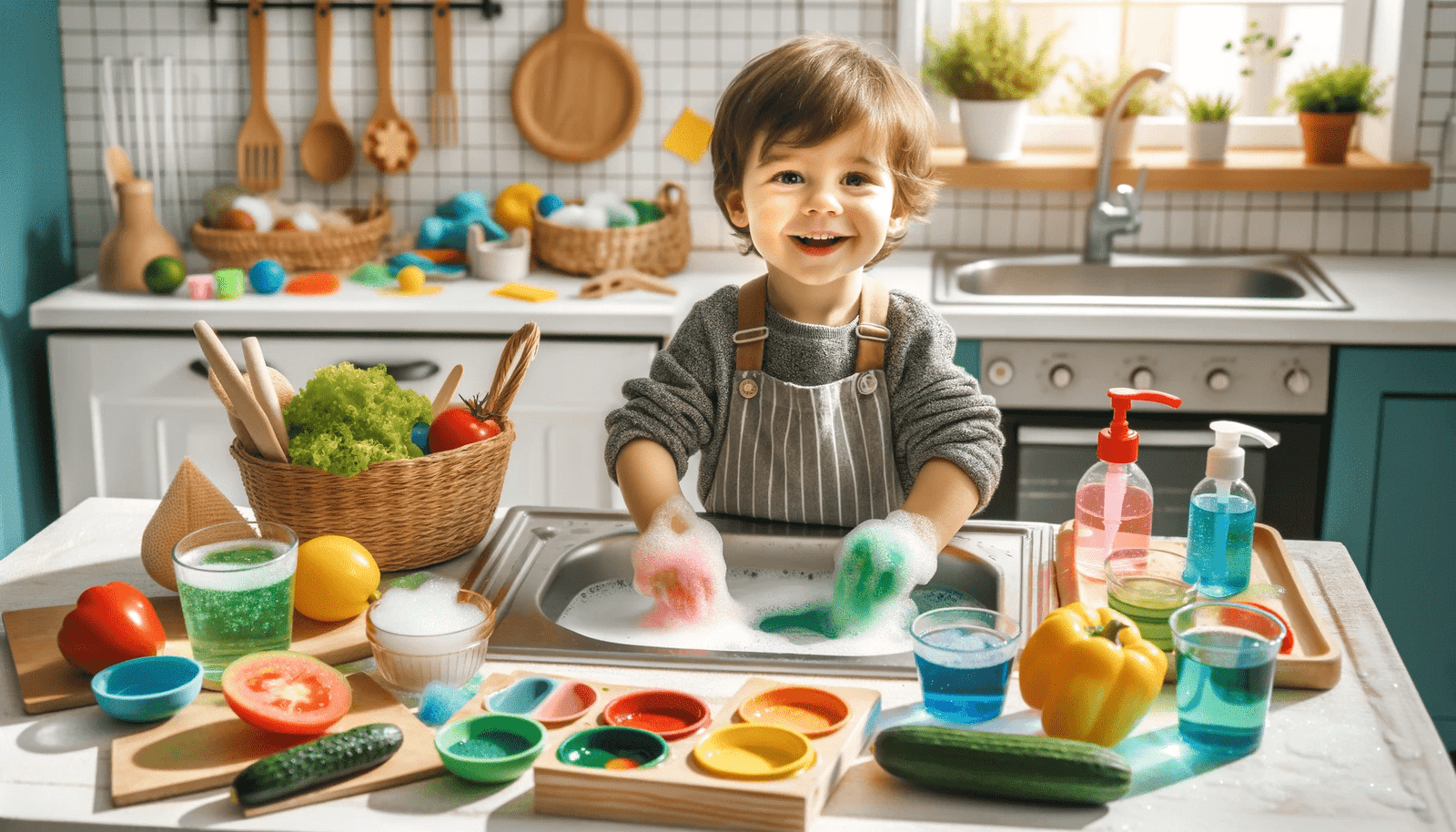
Sensory activities for toddlers are fun! But they can also be messy. Doing toddler activities in the kitchen sink keeps your child entertained while you get on with preparing the meal, without much cleaning up afterwards.
Setting up the sensory activity for your children
Start by moving away anything that could break or hurt your child. Then place a Montessori tower in front of the sink. If you do not have a Montessori tower yet, you can use a solid, stable chair or step stool, but in that case, stay close by for your child's safety.
Also remember to put an apron on your child to protect their clothes. Then invite your child to join in the activity.
Let's go!
Here are a few sensory activities for toddlers. Each activity is fun and engaging, and will help your child develop important skills. If your child is not interested, try again a little later or another day; there is no point forcing them, it would be counterproductive.
1 - Pour, float and drain
Materials:
Ask your child to gather a variety of objects from around the house. You can give them a basket or a bucket to make carrying the objects easier.
Choose a variety of objects that are safe to put in water, such as coins, a sponge, pebbles, leaves, plastic toys, corks, spoons, sponges, small balls. You will also need a slotted spoon and a towel.
Instructions:
Fill the sink with water. Invite your child to drop the objects into the sink and observe which ones sink and which ones float. Then your child can remove the floating objects with the slotted spoon. Encourage your child to keep experimenting with the objects available to them.

2 - Icy rescue
Materials:
Prepare ice cubes in advance. You can dye the ice cube water with food colouring. Add plastic figurines to the water so that they freeze inside the block of ice.
Start by partially freezing water in an ice cube tray. Then place figurines in the tray and cover them with water before freezing again to create ice cubes with the toys inside.
You will also need warm water, salt and spoons.
Instructions:
Place the ice cubes in the sink and let your child retrieve them to find the toys inside. Give your child what they need to melt the ice cubes, inviting them to use salt, warm water and their hands protected by a tea towel to melt the ice and discover the toys.
In this activity, toddlers improve their fine motor skills and hand-eye coordination while strengthening their concentration. It is also an enriching, playful sensory experience that gets children excited.
3 - Washing vegetables
Materials:
Root vegetables such as potatoes and carrots, and a small brush or a scouring sponge.
Instructions:
Show your child how to wash the root vegetables with water and the brush. This practical activity inspired by the Montessori method encourages independence and confidence.

4 - Discovering colours
Materials:
Five plastic cups or small white plates, food colouring.
Instructions:
Prepare blue, yellow and red coloured water. Put a pipette or a spoon in each cup. Then encourage your child to create new colours by mixing the colours in empty cups.
Doing this experiment in the sink limits the mess. A fun variation is to add shaving foam to the sink so the child can "paint" with the colours. Toddlers will love the feel of the foam between their fingers.
5 - Bubbles galore
Materials:
Liquid soap, whisk, funnels or slotted spoon
Instructions:
Fill the sink halfway with water. Add washing-up liquid and show your child how to make bubbles with a whisk. Invite your child to play with the bubbles using their fingers, the whisk, funnels, etc.
This activity may seem simple, but it teaches them the notions of cause and effect and quantities, while letting them discover new textures.

6 - Magic fishing
Materials:
A toy fishing rod with a magnet on the end, or make your own with a stick, a string and a magnet. You will also need magnetic objects. A towel.
Instructions:
Put the magnetic objects in the sink and partially fill it with water. Then invite your little angler to go fishing. Watch your child have fun "catching" the objects and show them how to place them on the towel to dry.
This sensory activity for toddlers stimulates children's attention and introduces them to magnets and magnetic fields.
7 - Landforms
Materials:
Modelling clay or clay, plastic trays, plastic figurines, blue food colouring, small jug.
Instructions:
Use modelling clay with your child to create a landform, such as a lake, on a small tray. Then ask your child to pour blue-coloured water into the lake.
Finally, invite your toddler to place the figurines around and on the lake.
This sensory activity introduces toddlers to landforms such as lakes, islands and rivers.

8 - Sorting colours
Materials:
Plastic bottle caps or balls of different colours, a bowl for each colour, and a slotted spoon or a small sieve.
Instructions:
Fill the sink halfway with water and float the caps or balls. Then invite your child to remove the balls or caps one by one and sort them by colour.
This activity is ideal for helping young children start to categorise objects by colour, developing their sorting and colour recognition skills.
9 - Treasure hunt in the foam
Materials:
Non-sharp, water-resistant objects (small toys, beads, shells), food colouring, water, liquid soap
Instructions:
Fill the sink with water and soap; you can add a few drops of food colouring to colour the water. Then scatter the objects in the coloured, soapy water. Ask the child to search for and retrieve the objects with their hands.
This activity stimulates fine motor skills and sensory discovery, while offering a fun tactile search challenge in a visually intriguing environment.

10 - Pouring
Materials:
Glasses, cups and containers of various sizes and food colouring (optional)
Instructions:
Fill one of the containers with water. Add a few drops of food colouring if you wish. Show your child how to pour the water from one container to another, then let them do it.
Young children often struggle to understand that the quantity of a liquid stays the same when it is poured into containers of different shapes and sizes.
This phenomenon is known as "non-conservation of liquids" in developmental psychology. It is due to the preoperational stage of cognitive development according to Jean Piaget's theory, where children aged around 2 to 7 struggle to understand conservation and think the quantity changes with appearance.
This simple game will help them progress on this point. The food colouring will help make the water more visible for your children.
Subscribe to our newsletter to discover more educational tips.

Written by Charles CAIGNOL





Leave a comment
This site is protected by hCaptcha and the hCaptcha Privacy Policy and Terms of Service apply.