
Article: Toy kitchen or real kitchen: which should you choose?
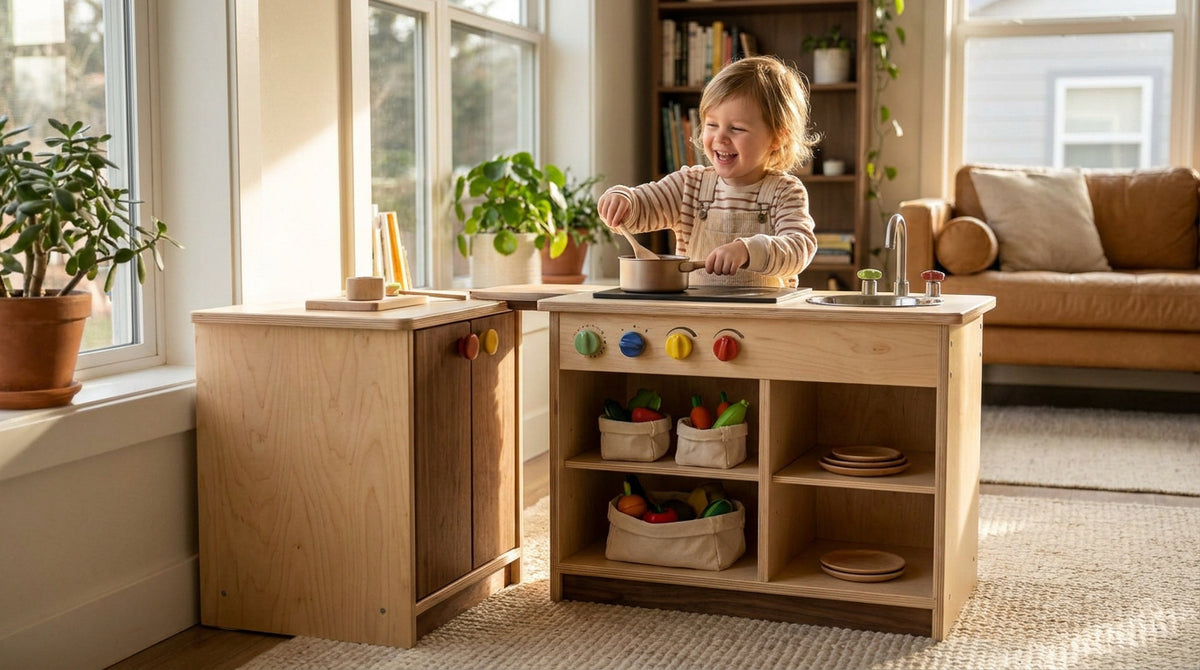
Toy kitchen or real kitchen: which should you choose?
The key takeaway: behind "wooden kitchen for children" lie two different needs. The play kitchen feeds symbolic play, especially from age 2 or 3. Taking part in the real kitchen develops independence and fine motor skills, from 12 months with a learning tower. The two are complementary, not competing.
When looking for a wooden kitchen for a child, families are actually looking for two very different things. Some want a play space where the child invents their own scenarios. Others mainly want them to stop tugging at their trousers while they make dinner.
These two needs do not call for the same answer. Let's take an honest look at what each option brings, at what age, and at what cost.
Two needs behind the same search
Playing at cooking is symbolic play: the child re-enacts what they have observed, invents stories, serves imaginary customers. It is independent play, done without you.
Cooking for real is practical life: pouring, mixing, washing, cutting soft foods. It is a supported activity, done with you.
The first develops language and imagination. The second develops fine motor skills, confidence and the relationship with food. Neither replaces the other.
What the play kitchen brings
Symbolic play enriches vocabulary: the child names the foods, the utensils, the actions. They reproduce the social codes they observe and structure their thinking by re-enacting them.
Handling small objects refines precision of movement. Velcro fruit and vegetables, for example, require real coordination effort to be "cut".
At what age? Symbolic play really sets in around age 2 and reaches its full extent between 3 and 5. Before 2, the child mainly explores the doors and knobs, which has its value but remains far from role play.
What to check: the EN 71-3 standard on paints and varnishes, rounded corners, careful sanding, and a base wide enough that a child leaning on the oven door does not tip the unit over.
One last tip: favour simple accessories, without electronic sounds. The less the toy does, the more the child invents.
What taking part in the real kitchen brings
Here, the child does not simulate: they act. They pour the flour, mix the batter, wash the vegetables, cut a banana. The result gets eaten, and that difference changes everything from the child's point of view.
The benefits are concrete: better acceptance of foods, fine motor skills exercised on real gestures, and a feeling of contributing to family life that feeds self-confidence.
At what age? From 12 months, as soon as the child stands alone confidently. That is much earlier than symbolic play.
The sticking point: height. An adult worktop is out of reach, and a kitchen chair offers no protection against falls. That is exactly what the 2-in-1 Montessori tower solves: the child is at your height, surrounded by a guard rail, and the step adjusts to three levels to follow their growth.
For cutting, a wooden knife lets them slice soft foods such as banana or cucumber. Its blade is not sharp, which greatly limits the risk of cuts, but an adult's presence remains necessary.
Comparison: space, budget, length of use
Footprint. A play kitchen is an extra piece of furniture, often bulky, dedicated to a single use. A learning tower is used in the existing kitchen and, if convertible or foldable, is stored away or changes function.
Budget. Both are in comparable price ranges depending on quality. The difference lies in the length of use.
Length of use. The play kitchen covers roughly 2 to 6 years, with a peak between 3 and 5. The tower covers 1 to 6 years, and turns into a table as the child grows. If you have to choose only one and your child is under 2, the tower serves earlier and for longer.
Combining them without cluttering the house
Many families end up with both, and that makes sense: the tower for shared moments, the play kitchen for independent play when you are not available.
If space is short, two options: wall-mounted or compact kitchen models, which free up the floor, and the foldable tower, which stores flat in seconds between uses.
Store utensils at child height in both cases: that is what lets the child choose their activity alone, and tidy up afterwards.
Points to watch, in both cases
For pretend play: stability of the unit, non-toxic finishes, no small detachable parts before age 3.
For the real kitchen: keep the child away from the hob and oven when in use, store knives and cleaning products out of reach, and stay present. No equipment replaces adult supervision.
Play kitchen or real kitchen: the right answer depends on your child's age and what you are looking for. Before age 2, real participation has a head start. Discover the 2-in-1 Montessori tower, convertible into a table and stool, CE certified.
FAQ
Does a wooden kitchen for children allow real cooking?
No, it is a pretend-play toy: it is not designed to prepare real food or to heat anything. It is used to re-enact kitchen scenes. If you want your child to really take part in meals, what you need is a learning tower, to put them safely at worktop height.
From what age is a play kitchen worthwhile?
Symbolic play develops mainly from age 2 and peaks between 3 and 5. Before 2, the child handles the doors and knobs without building a real scenario. For a toddler, taking part in the real kitchen is generally richer.
From what age can a child take part in the real kitchen?
From around 12 months, when they stand alone confidently. Start with simple gestures: pouring, mixing, washing vegetables. Cutting soft foods with a wooden knife comes a little later, around 18 months to 3 years depending on the child, and always under supervision.
How do you check that a wooden kitchen is safe and healthy?
Check compliance with the EN 71-3 standard, which governs the migration of certain elements in toy materials, including paints and varnishes. Also check the finish: rounded corners, smooth sanding, no strong solvent smell when opening the box.
How do you fit all this into a small home?
Favour a single well-chosen item rather than two pieces of furniture. Wall-mounted or compact kitchens free up the floor, and a foldable tower stores flat between uses. Store utensils at child height so they can access their activity alone.

Written by Charles CAIGNOL






Leave a comment
This site is protected by hCaptcha and the hCaptcha Privacy Policy and Terms of Service apply.