
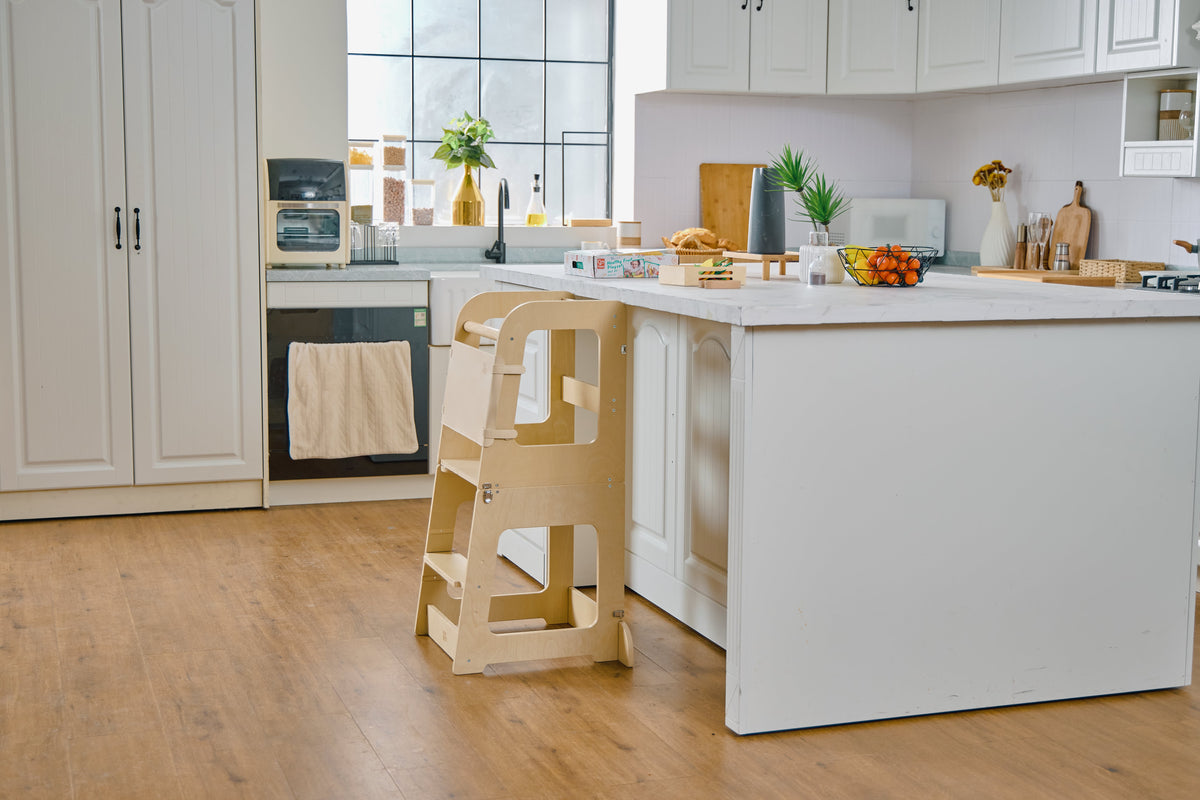
Montessori observation tower: how to choose the right one?
Contents
- Understanding the Montessori observation tower and its benefits for the child
- The important criteria for choosing a safe observation tower
- Safe use of the observation tower explained by a Montessori teacher
- The different observation tower models and their specific features
Understanding the Montessori observation tower and its benefits for the child
What is a Montessori observation tower and at what age to introduce it
Designed for toddlers, the Montessori observation tower is a piece of furniture that lets the child reach the worktop safely. Inspired by the Montessori approach, it encourages independence by giving the child a space at their height to observe and take part in everyday activities.
The first attempts at using it generally happen around 12 to 15 months, when the child walks independently. The adult watches for signs of initiative such as attempts to climb a chair. A gradual introduction with support keeps the child safe as they discover it.
The educational benefits of the observation tower for development
By letting the child reach the worktops, the tower stimulates their independence and self-confidence. Daily use strengthens motor development, improves listening to instructions and encourages personal growth. The child becomes aware of their abilities and of their place in the environment.
| Area of development | Impact of the observation tower | Concrete examples |
|---|---|---|
| Independence and self-confidence | Lets the child complete simple tasks entirely on their own | Preparing their snacks or helping in the kitchen without depending on parents |
| Curiosity and spontaneous learning | Stimulates active exploration and learning through experience | Observing cooking gestures that become practical life lessons |
| Ergonomics and functional design | Adapts the environment to the child's size for a natural posture | Easy access to the worktop at a suitable height from 12 months |
| Mobility and space saving | Foldable models that make storage easy in small spaces | Footprint reduced to 15% of its unfolded surface on advanced models |
| Safety and durability | Stable structure with stabilisers and hard-wearing materials | Certified solid wood from sustainably managed forests, with no toxic products |
| Adaptability and longevity | Adjustable height to follow the child's growth | Extended use from 1 to 6 years thanks to 3 adjustment levels |
Everyday activities made easier by the observation tower
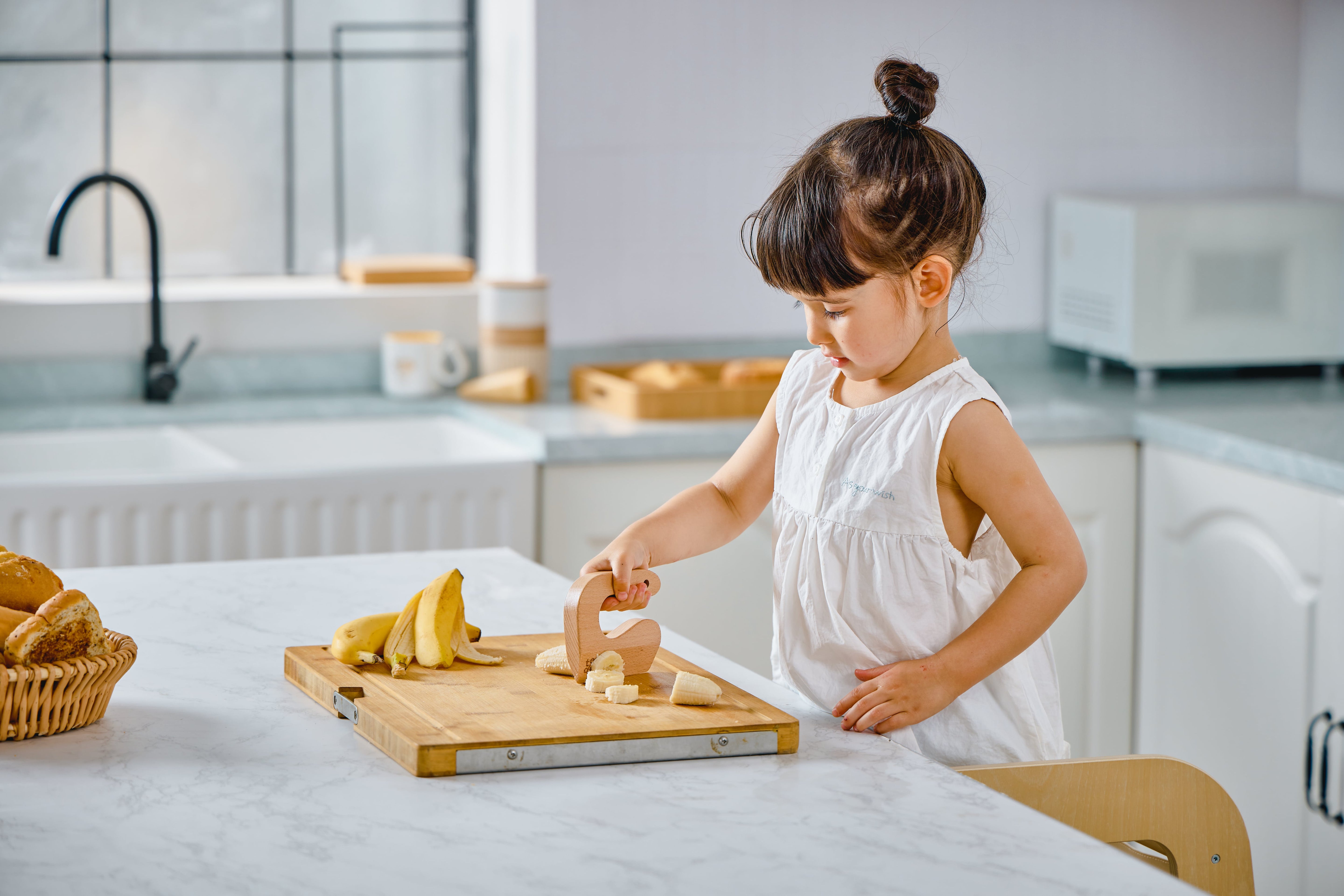
As soon as they can stand, the child can take part in simple preparations. Washing fruit, pouring dry ingredients from one container to another or mixing batters are all opportunities to learn while having fun. These tasks develop fine motor skills and awaken the senses through sensory experiences.
- Use the tower in the bathroom for learning personal hygiene (washing hands, brushing teeth)
- Turn the tower into a creative space with a built-in blackboard for drawing and trying out letters
- Make the observation tower part of the snack-time ritual by letting the child prepare their light meals
- Adapt the tower to sensory exploration by setting up varied textures or tactile containers on it
- Support independence in the bedroom by placing clothes within reach for learning to get dressed
Discover here the key principles of the Montessori approach, which inspire the use of the observation tower.
The important criteria for choosing a safe observation tower
Buying an observation tower calls for particular attention to hard-wearing materials, the stability of the model and rounded edges. Favour options with an anti-tipping system and a non-toxic finish. Discover Teedum's ethical and safety commitments, key criteria for choosing a suitable tower.
- Natural wood from sustainably managed forests for its sturdiness and ecological credentials
- Choose a Montessori observation tower with an anti-tipping system and a widened base guaranteeing stability
- Prefer models with adjustable heights to accompany the child from walking up to age 6
- Check the quality of the finish, with rounded edges and a certified non-toxic coating
- Opt for a foldable Montessori tower if space is limited, without compromising child safety
Safe use of the observation tower explained by a Montessori teacher
The fundamental safety rules to establish with your child
Rules must be simple and repeated regularly. For example: "We only climb up when an adult is present" or "We don't touch hot pans". These clear instructions, combined with concrete gestures, keep the child safe while strengthening their confidence.
Effective communication techniques for explaining safety to children
For an 18-month-old, a sentence such as "The tower is your castle, but the knives are my tools" is enough to set limits. With a 3-year-old, you can explain: "If you want to get a glass, I'll help you put it in a basket down below, so we avoid accidents". Positive language and metaphors help them understand risks without anxiety.
Safely arranging the environment around the tower
Place the tower away from the hob and keep sharp utensils out of reach. Use socket covers and store cleaning products up high.
To organise the space, put heavy utensils down low and fragile objects up high. A metal tub for fruit to wash or a bowl for breakable eggs makes tasks fun and reduces risks. I love using transparent containers so that my 13-month-old can easily identify objects.
Supervision adapted to the child's age and abilities
At 15 months, I stay within arm's reach but let my eldest experiment. At 2, supervision from a distance is enough if the rules are well established. The important thing is to follow the child's pace: when they climb up alone without wobbling and pick up a dropped object without panicking, it is a sign they are ready for more independence.
My experience shows that every child progresses at their own pace. My youngest, more daring, needed to go over the rules several times, while my eldest, very observant, took in the steps more quickly. What matters is to celebrate every success without forgetting that safety is continuous learning.
Progressive learning techniques for independent use
The Montessori method provides for a staged progression: first holding the rungs with an adult alongside, then climbing up and down with support, before reaching independence.
| Age | Skills acquired | Suitable activities |
|---|---|---|
| 12-18 months | Balance when standing | Carrying light objects |
| 18-24 months | Controlled climbing up and down | Pouring cereals from one container to another |
| 24-36 months | Precise handling | Preparing simple snacks |
The different observation tower models and their specific features
Wooden observation towers: advantages and features
Natural wood towers are appreciated for their sturdiness and ecological credentials. Coming from sustainable forests, they offer stability and a warm look. Their non-toxic finish reassures parents concerned about their child's health.
The choice of wood varies between beech, oak or bamboo depending on the sturdiness sought. Favour a brand such as Teedum, which guarantees clear traceability of materials and impeccable manufacturing quality.
Foldable and adjustable models: optimising space and length of use
Foldable towers open and store away in the blink of an eye. Their stable structure suits small spaces without sacrificing safety.
Adjustable towers accompany the child from 1 to 6 years thanks to adjustable height levels. Convertible into a stool or desk, they make the investment worthwhile. My 4-year-old son still uses ours as a drawing seat after being our kitchen helper at 18 months.
The Montessori observation tower reveals its full potential when safety, independence and development come together. By choosing a natural wood, adjustable model, you give your child a space to explore, grow and take part in everyday activities. At Teedum, our adjustable observation tower embodies this philosophy: a tool for nurturing curiosity and confidence, step by step, in every shared moment. Tomorrow, they will surprise you with their independence... Because learning begins where the child feels free.
FAQ
When should you start using the observation tower?
Using the observation tower can be considered as soon as your child stands and walks independently, generally around 12 to 15 months. It is a wonderful tool for letting them be at table or worktop height to observe gestures in detail, or to easily handle utensils and ingredients.
From 18 months, they can start taking part in simple activities such as washing fruit or vegetables, or even learning to cut them with a suitable knife, always under supervision. The idea is to involve them gradually and safely in everyday activities.
Is an observation tower useful?
Absolutely! A Montessori observation tower is a useful and worthwhile investment, for the child as much as for the parents. It lets the child take part safely in activities happening at adult height, avoiding the frustration of not seeing what is going on.
It also encourages independence, letting them complete certain tasks themselves, such as tidying their things, washing their hands or helping to prepare meals. What's more, it develops their motor skills and sparks their curiosity by letting them discover their environment at adult height.

Written by Charles CAIGNOL






Leave a comment
This site is protected by hCaptcha and the hCaptcha Privacy Policy and Terms of Service apply.