
What Is a Pikler Triangle? The Best Wooden Toy for Developing Children's Motor Skills
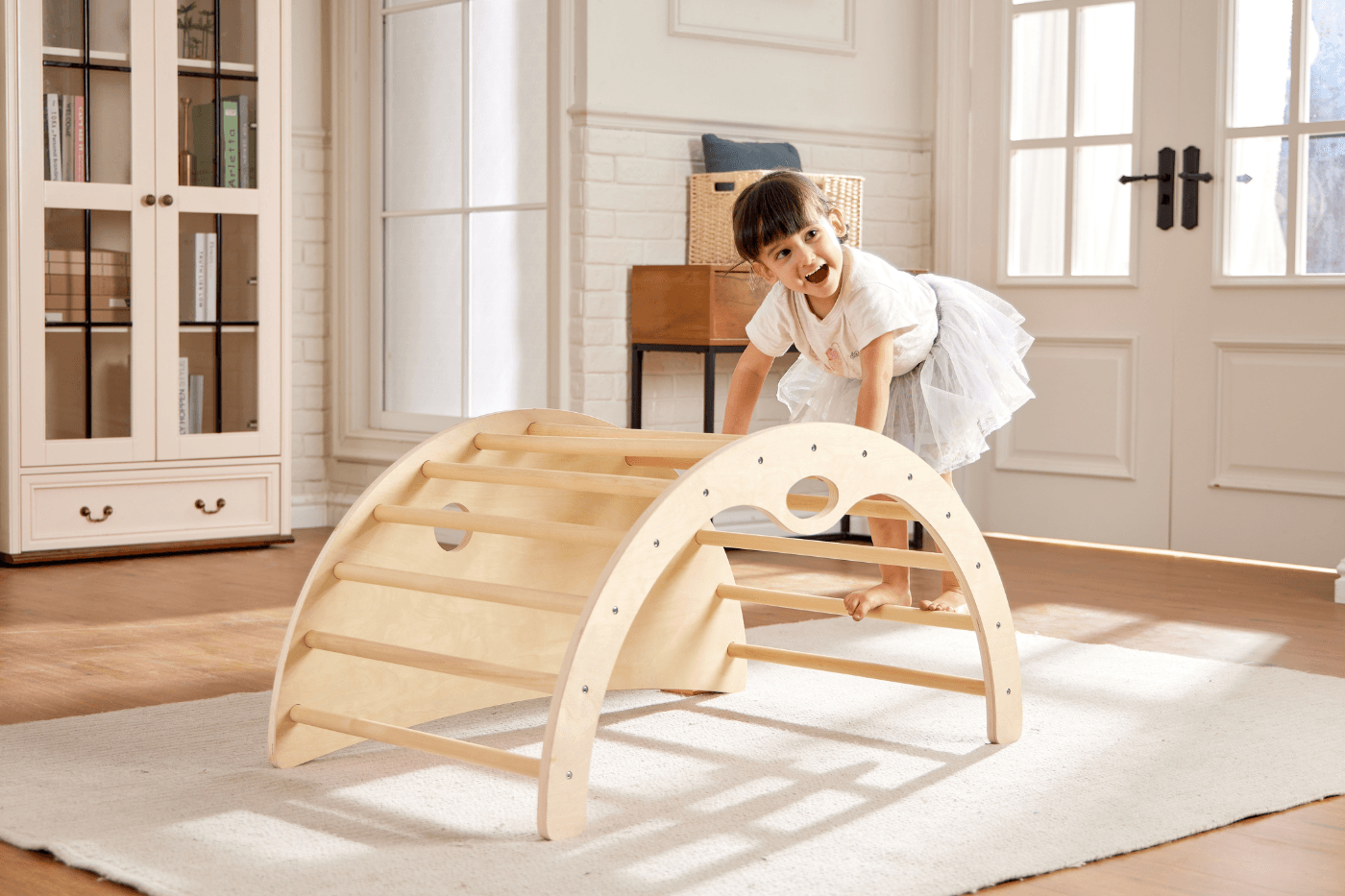
Imagine your 9-month-old baby moving along the sofa, trying to grip the soft cushions to keep their balance. These cushions, too soft, offer a difficult, unstable hold. By contrast, the rungs of a Pikler triangle provide a solid grip suited to little hands. Our Montessori arch, inspired by the best Pikler triangle, is specifically designed to stimulate gross motor skills and encourage physical exercise in children.
Infants and toddlers are naturally motivated to develop their motor skills. Their desire for independence instinctively drives them to pull themselves up to standing. Even before they have the balance needed to stand without support, they crawl on and around low objects, then gradually move along furniture, wobbling as they go.
These spontaneous activities are essential: they let children gradually strengthen and master their muscles and movements. The Pikler triangle, with its suitable wooden structure, perfectly supports children through this crucial phase of motor development and well beyond.
In this article, we answer the fundamental questions: "What is a Pikler triangle?", "Is this toy really safe?", and we explore the many benefits it can bring to your child's development.
What is a Pikler triangle?

The Pikler triangle, or Pikler climber, was created by Hungarian paediatrician Dr Emmi Pikler. She designed the climbing structure to support the development of gross motor skills.
This toy, designed in the shape of a triangle or a climbing arch, has several rungs that children can grab or climb. Its wide base and lower rungs offer ideal support to toddlers taking their first steps. This structure helps them develop their balance: they start by holding on to the lowest rung, then gradually manage to pull themselves fully upright.
The Pikler triangle is an excellent toy for babies. Climbing triangles help babies develop their gross motor skills independently. They use their own impulses to strengthen their muscles. In doing so, babies and toddlers develop an understanding of how their body moves and what they can and cannot yet do.
Is the Pikler triangle safe?
The Pikler triangle is ideal equipment for encouraging the independent development of children's motor skills. Its design, with a wide base and a sturdy structure, guarantees optimal stability, preventing any tipping even when children climb on it. The Teedum model meets the strictest safety standards and uses non-toxic materials.
Made from wood from sustainable forestry, each triangle is meticulously sanded to offer a smooth, splinter-free surface.
Using a Pikler triangle lets children naturally develop their body awareness, muscle strength and coordination. This type of Montessori equipment gradually teaches them to assess risks and recognise their own physical limits. Potential falls from this structure generally remain without serious consequences.
For optimal, safe use:
- Parental supervision is essential, but without excessive intervention
- Too much help can paradoxically increase risks by preventing the child from learning to recognise their limits
- Overprotection can lead the child to expect to be rescued every time
To create a safe environment:
- Place the triangle on a soft surface (carpet or play mat)
- Keep a clear space around the structure
- Keep an attentive watch while encouraging independent exploration

From what age is it advisable to use the Pikler triangle?
The ideal time to introduce the Pikler triangle to your child is when they show a natural interest in climbing. This period often coincides with their first attempts at crawling and actively exploring their home environment.
Designed specifically for this crucial phase of development, the Pikler triangle offers a safe alternative to the household furniture that children spontaneously try to climb, such as sofas, chairs, shelves or worktops.
Its usefulness extends well beyond early childhood, remaining appealing until around age 6. For older children, the Pikler triangle becomes a support for imaginative play with multiple possibilities:
- It can turn into a tent simply by placing a blanket over it
- It can become a mountain to conquer in their imaginary adventures
This versatility makes it a lasting investment that accompanies the child through different stages of their development.

You can place your Pikler triangle set in the playroom, the child's bedroom or the living room.
How to support gross motor development with the Pikler triangle?
Let your child initiate their own movements so they naturally discover their body's abilities and the consequences of their actions. By acting independently, they only engage in activities that truly match their level of development. Their progression to greater heights will naturally follow the evolution of their abilities and coordination. Your role as a parent is essentially to observe and reassure, without ever pushing the child beyond their comfort zone.
Infants, although vulnerable and apparently without control over their body at birth, have remarkable innate abilities that support their evolution from dependent baby to independent toddler able to walk and communicate.
When babies develop their gross motor skills without direct adult intervention (such as being placed in a sitting or standing position), they gain an intuitive understanding of the possibilities and limits of their own body. To encourage this independent motor development, create an environment that is both stimulating and welcoming. Give your baby opportunities to stretch towards interesting objects, to move by themselves towards a desired toy, and to explore their bodily abilities without adult intervention.
Our Montessori arch is an excellent choice for parents wishing to support this self-directed learning. An organised space that is rich in opportunities for exploration naturally stimulates the child's curiosity and physical activity. To encourage physical activity more broadly, consider regular walks, toys that encourage movement, and time dedicated to outdoor activities. Children are naturally drawn to movement and exploration: they simply need space to express it. Bringing a Pikler triangle into your home is an excellent way to promote active play and physical development.
How do you plan to use your Pikler triangle?
Share your experiences with us on social media, we would love to see them!
The Teedum alternative to the Pikler triangle: our wooden Montessori arch converts into a rocker, den, climber and desk. Cushion included, CE-EN71 certified, free delivery in France. Discover the Montessori arch →

Written by Charles CAIGNOL







Leave a comment
This site is protected by hCaptcha and the hCaptcha Privacy Policy and Terms of Service apply.