
Setting up a Montessori bedroom: the complete guide by age
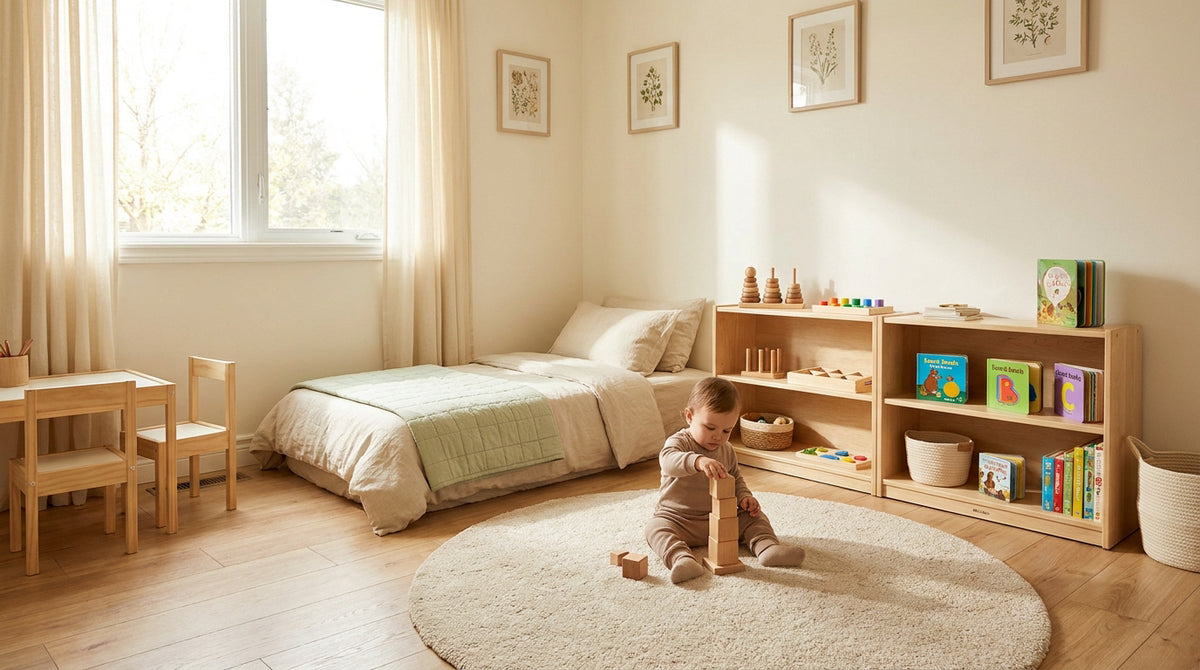
The key takeaway: a Montessori bedroom rests on a low, uncluttered environment that evolves with the child. Four zones structure the space: sleep, discovery, movement and getting dressed. The contents of each zone change with age, but the principle stays the same: whatever the child can reach, they can do alone.
More and more parents are abandoning traditional furniture to create a space where the child acts for themselves. But you still need to know what to install, and when.
Here is how to structure the bedroom age by age, without falling into over-stimulation or buying everything again every six months.
The four zones of a Montessori bedroom
Sleep: an age-appropriate bed, in a calm, uncluttered space.
Discovery and movement: a firm mat, free space on the floor, and supports for pulling up when the time comes.
Storage: low shelves where the child sees and reaches what they want.
Getting dressed: a wardrobe rail or baskets at their height.
The common principle: everything within their reach must be usable without you.
The sleep zone, age by age
Before age 1: caution first
For an infant's bed, follow the official French recommendations: sleeping on the back, a firm mattress cut to the exact dimensions of the bed, a sleeping bag rather than a blanket, and no bumper, pillow or bulky soft toy.
A floor bed is possible before age 1, but it requires a fully secured bedroom and does not exempt you from any of these rules. When in doubt, talk to your paediatrician: this is the only topic in this article where improvisation has no place.
From 18 months to 3 years: the usual time for the floor bed
This is the period when most families take the plunge: the child walks confidently, understands simple instructions, and can get in and out alone.
A mattress on the floor then lets them get up when they need to, without calling. Place it on a very low slatted base rather than directly on the floor: condensation underneath encourages mould and dust mites.
We detail this transition, the signs to watch for and how to make the room safe in our dedicated article on the Montessori floor bed.
The discovery and movement zone
The first months
A firm mat on the floor, an unbreakable mirror fixed horizontally at mat level, and a hanging mobile are enough. The child observes, moves, discovers their reflection.
Alternate mobiles over the weeks rather than accumulating them: a single element at a time holds attention much better.
When they pull up
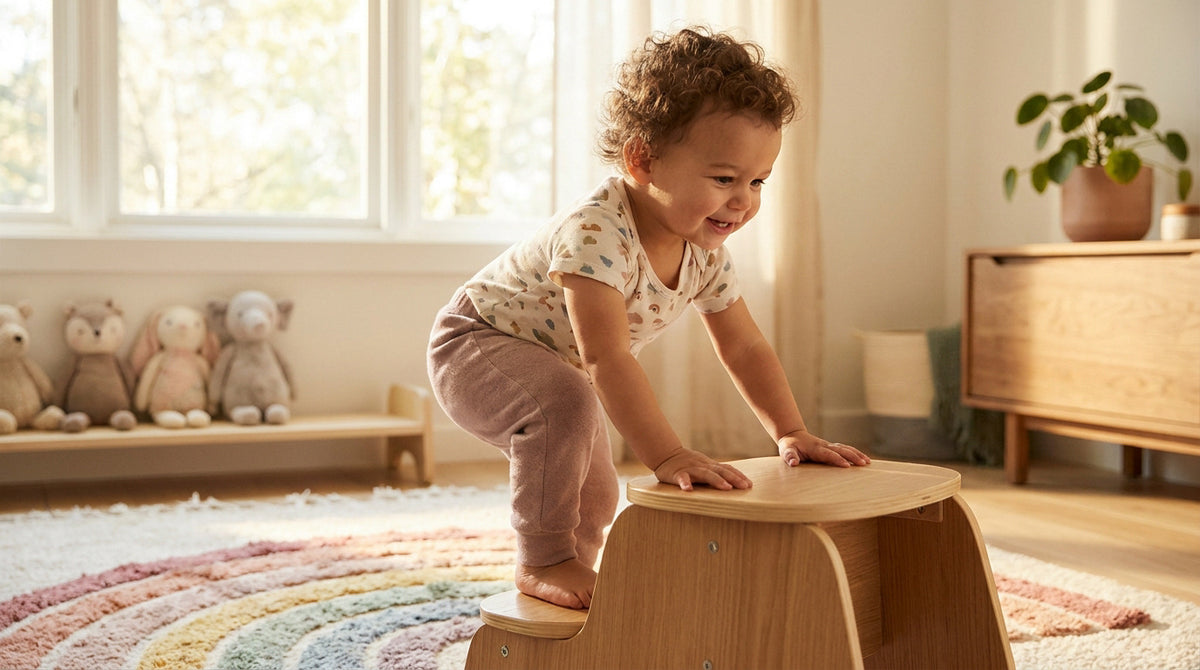
A bar fixed to the wall, or simply a low, stable piece of furniture, gives them a support for pulling up. At this stage, free floor space matters most: clear it, remove obstacles.
From 18 months: climbing
This is the age when a climbing arch comes into its own. A structure to climb first, then a rocker once turned over, a den under a sheet, and finally a reading nook. It can be used until age 6.
The reversible ramp adds a slide side and a climbing side when the challenges become too easy. The wedges lock the rocking to turn the arch into a stable seat, handy for quiet time.
Set it all up on a thick mat, clear the space around it, and check that the fixings are tight regularly.
Independence beyond the bedroom
Taking part in home life
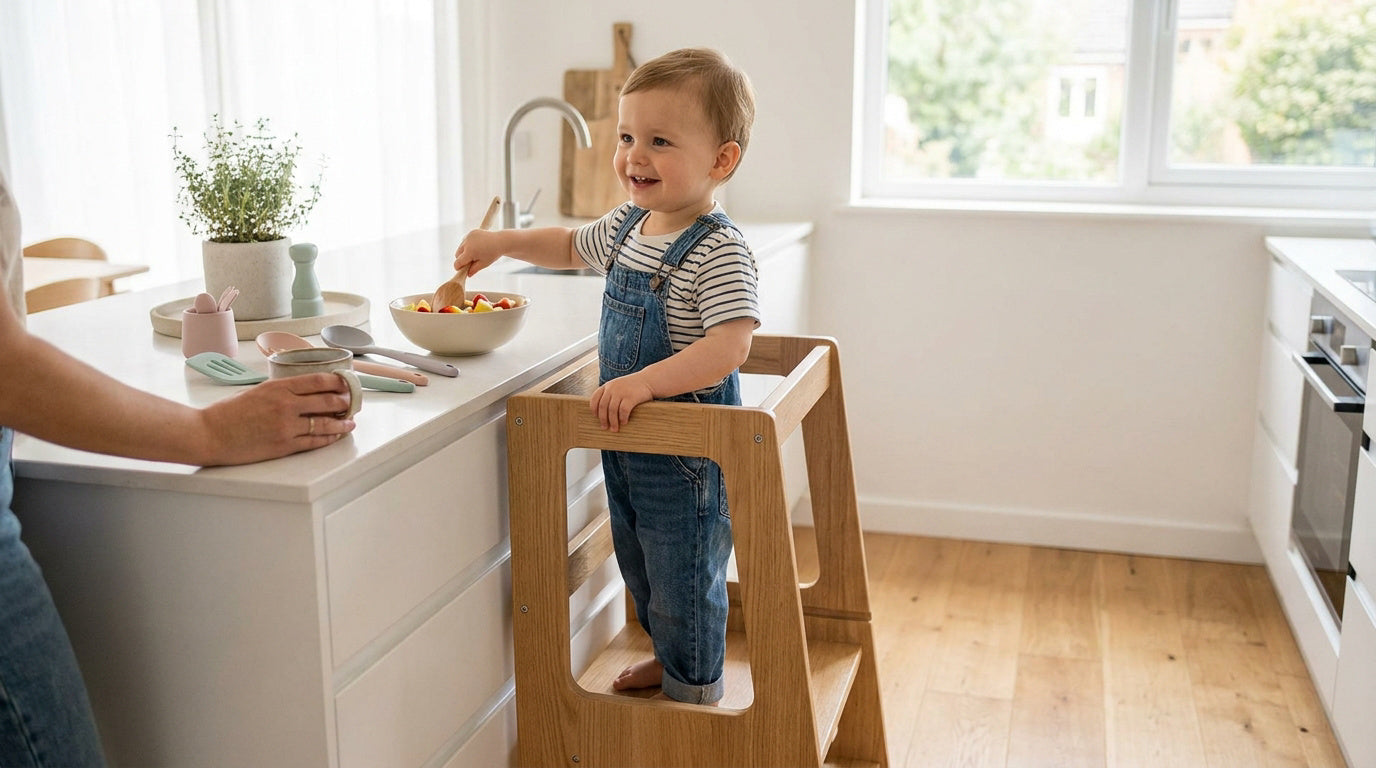
The kitchen is the natural extension of the bedroom. A learning tower puts the child at worktop height from 12 months, surrounded by a guard rail.
For a very lively child, a safety strap closes off the rear access. It reduces the risk of falling backwards without replacing your presence.
Later, a wooden knife lets them cut soft foods. As its blade is not sharp, the risk of cuts is greatly reduced, but stay present.
Getting dressed alone
A low wardrobe rail and open baskets for small items are enough. The child reaches their clothes without help.
Limit the choice: offer two outfits suited to the weather. Too many options paralyse, two allow real judgement to be exercised.
This layout also makes potty training easier, where quick access to clothes counts a lot.
Evolving the space
Toy rotation
Leave only a small selection visible on the low shelves, about eight objects, and store the rest out of sight.
Change the selection every two or three weeks. A toy reintroduced after a break regains all its interest, without any extra purchase.
Since every object has a precise place, tidying up also becomes much easier to ask for.
Reading nook and small spaces
Display books face-out on narrow shelves: a visible cover is inviting, unlike a spine lined up among twenty others.
In an attic bedroom, use the eaves for low storage. A small desk and a chair their size complete the space around age 3, when seated activities get longer.
Setting up a Montessori bedroom does not mean buying everything again: it is mainly about lowering, clearing and sorting. The rest is added as the ages go by.
FAQ
Why a floor bed rather than a cot?
The floor bed removes the barrier between the child and their room: they get up and go to bed alone, which supports their independence. The transition most often happens between 18 months and 3 years. Before age 1, safe sleeping recommendations take priority: firm mattress, sleeping bag, no objects in the bed.
What is the floor-level mirror for?
Placed horizontally along the mat, it lets the baby observe their own movements and gradually build their body map. Combined with a bar fixed to the wall, it also encourages the first attempts at pulling up. Choose an unbreakable model, firmly fixed.
How do you set up toy rotation?
Leave about eight toys visible on low shelves and store the rest in boxes out of sight. Change the selection every two or three weeks. Fewer visible objects means less scattering and longer play times.
What are the advantages of a convertible observation tower?
It puts the child at your height from 12 months, in the kitchen or bathroom, with a guard rail that a stool does not offer. The convertible model then turns into a table with a stool, which extends its use by several years.
How do you organise an accessible wardrobe?
A low rail or open shelves, baskets for small items, and above all a limited choice: two outfits offered rather than the whole wardrobe. The child decides without getting lost, and saves time in the morning.

Written by Charles CAIGNOL






Leave a comment
This site is protected by hCaptcha and the hCaptcha Privacy Policy and Terms of Service apply.