
Free Movement: The Complete Guide to Your Children's Natural Development
Definition and origin of free movement
Free movement has its roots in the work of paediatrician Emmi Pikler and educator Maria Montessori. This pioneer highlighted the importance of letting the child develop at their own pace, without adult intervention. This method focuses on trust in the child's natural motor abilities, allowing them to discover the world around them independently.
The concept of free movement is crucial for the child's overall development. It encourages fine and gross motor skills, cognitive development and emotional well-being. By allowing the child to move freely, without restrictions, they develop a better awareness of their body, greater self-confidence and more independence.
The foundations of free movement:
The work of Emmi Pikler and Maria Montessori
Emmi Pikler and Maria Montessori, although different in their approaches, share a common vision of the importance of free movement. Pikler insisted on the importance of not placing the child in positions they cannot reach on their own, while Montessori emphasised a prepared environment suited to the child's needs.

"Free movement means giving free rein to all of the child's spontaneous movements without teaching them any movement whatsoever."
Emmi PIKLER, Paediatrician
Psychomotricity in child development
Psychomotricity, a central element of free movement, is the study of the relationship between movement and the psyche. This relationship is fundamental to understanding how children learn and develop through movement and interaction with their environment.
Respecting the child's natural pace
Every child develops at their own pace. Free movement respects this individual pace, allowing the child to explore their abilities without pressure or preconceived expectations.
A safe and stimulating environment
An environment suited to free movement is both safe and stimulating. It must allow the child to move freely and explore without unnecessary risks, while offering varied stimuli to encourage their development.
Active observation is a key component of free movement. It involves the adult carefully observing the child without intervening in their play, except in case of danger. This observation helps to better understand the child's needs and skills.
Putting free movement into practice:
It is essential not to place your baby in a posture they cannot adopt on their own, such as sitting them up or standing them up. Every phase of motor development is crucial for strengthening their muscles.
Arranging the space
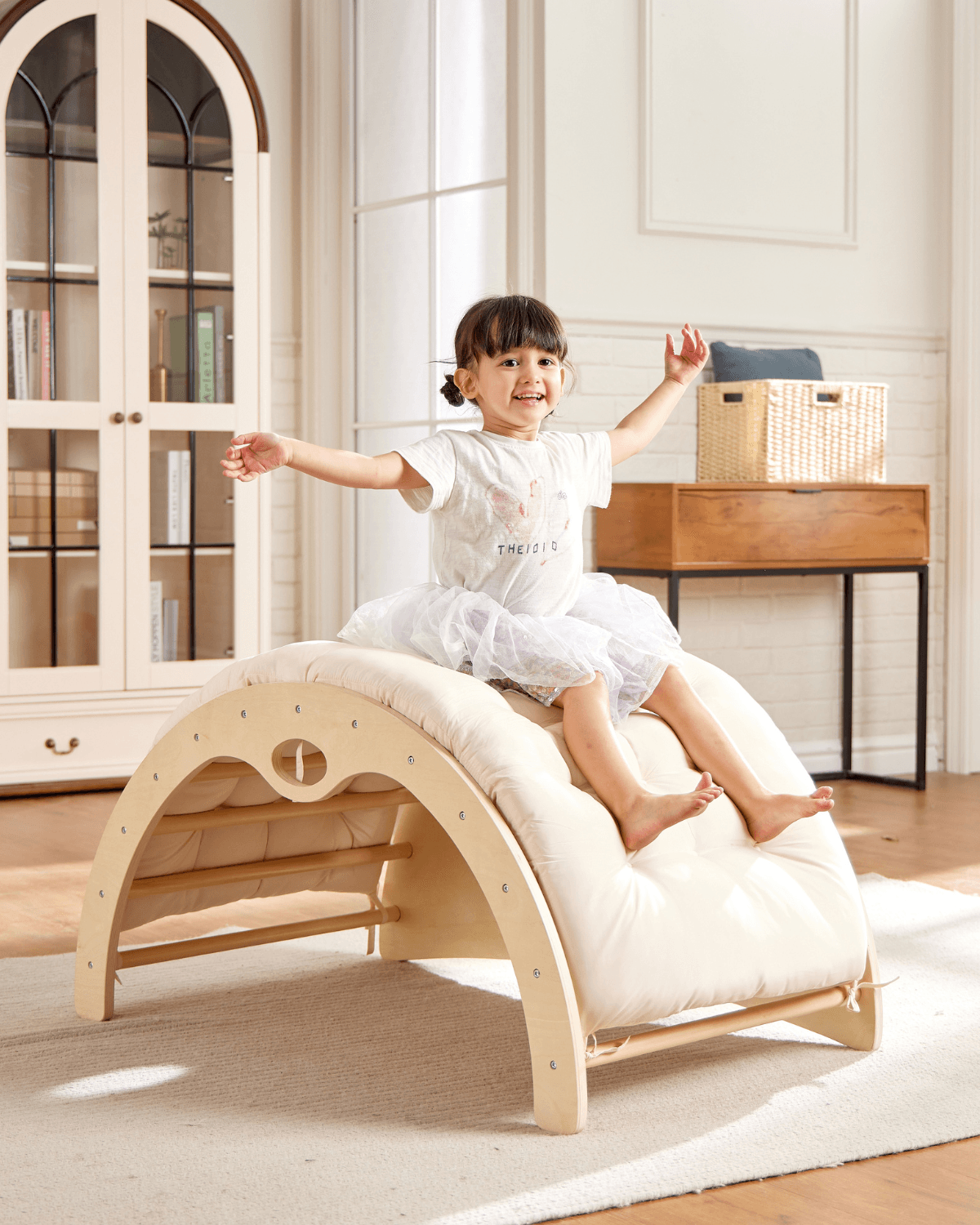
To practise free movement, it is important to set up a space that is safe, accessible and rich in opportunities for exploration. This can include floor mats, objects with different textures and safe furniture for climbing such as the Montessori arch.
The toys and materials used in a free movement environment must be suited to the child's age and encourage active exploration. It is better to choose simple wooden objects that stimulate creativity rather than overly complex plastic toys that stimulate too many senses.
The adult plays a supporting role in free movement. Rather than directing or teaching, the adult should encourage the child, acknowledge their successes and ensure their safety.
What can we do as parents?
- Actively observe our child without doing things for them.
- Make their environment safe so they can move around it freely.
- Set up a suitable floor space, without restricting them in devices such as bouncers or baby walkers.
- Choose clothes and shoes that do not limit their movements.
- Let the child explore their environment so they discover their sensations and limits.
- Offer an environment rich in sensory and motor experiences.
- Respect their pace, including any pauses and regressions.
- Avoid placing them in positions they have not reached on their own.
- Support the child in their discoveries, encouraging their initiatives and trusting them.
Free movement and independence
By allowing the child to move around and explore freely, free movement encourages their independence and autonomy. It also develops their ability to make decisions and solve problems creatively.
Succeeding at the small challenges encountered during independent exploration builds the child's self-confidence. They learn to trust themselves and to feel competent in their abilities.
It is sometimes wrongly believed that free movement simply means leaving the child to fend for themselves.
In fact, free movement aims to encourage the child to act on their own as much as possible, intervening only when it is essential to help their development.
Paula's story
When I discovered free movement, I was a little sceptical about how I could bring it into the life of my little Maxime. I was so used to seeing him in his bouncer or playing in his playpen that the idea of letting him free made me nervous. But after reading about the benefits of this approach, I decided to give it a try.
I started by making his play area safe. I removed anything that could be a danger to him and set up a soft mat so he could wriggle around safely. Then I found the Teedum wooden arch. It was exactly what we needed to get started. Not only was it safe, it was also designed to stimulate Maxime's curiosity.
I was amazed at how fascinated he was by the shapes and textures. He spent long moments observing, touching and even tasting the different parts of the arch. It was as if a new world was opening up to him. Over the weeks, I noticed incredible progress. Not only did he start rolling over to reach the arch, he also developed his coordination and balance much faster than I would have imagined.
I learned to observe rather than intervene. And when I see him solve a little "problem" on his own, the pride in his eyes is my greatest reward.
Conclusion
Emmi Pikler said it well: carefully observing your baby is essential to understand them and adapt stimulation to their needs.
In conclusion, what matters is not knowing at what age a child walks, but ensuring the quality of their walking. That is the whole ambition of free movement.
Answers to your questions about free movement:
To encourage free movement in babies, create a safe environment by removing obstacles. Offer comfortable floor mats and simple toys, and encourage exploration. Avoid putting them in restrictive devices such as playpens. Encourage self-confidence by letting them explore and learn at their own pace, encouraging them to crawl, roll and move around freely.
Free movement encourages motor development and independence, but requires constant supervision. A playpen offers a safe space to play, but limits freedom of movement. A combination of the two can be ideal for encouraging independent exploration while ensuring safety. Adapt your choice to your child's needs and your lifestyle.
Is free movement suitable for all ages?
Free movement is particularly suited to infants and toddlers, generally from 0 to 2 years. During this crucial period of development, babies begin to explore their body and their environment. It allows them to develop fundamental motor skills, such as head control, turning over, crawling, rolling and finally walking.
How does free movement influence the child's cognitive development?
Free movement plays a key role in the child's cognitive development. It encourages exploration and active learning by allowing the child to discover their environment on their own. This strengthens spatial understanding, problem solving, creativity and independence, contributing to more complete cognitive development.
What is the parents' role in free movement?
The parents' role in free movement is essential. First of all, they must create a safe environment by removing obstacles and providing adequate supervision. Parents should also encourage independence by allowing children to move around freely, without too much intervention. This fosters the development of self-confidence and autonomy.
Which mat for free movement?
To encourage children's free movement, choose a mat that offers adequate padding to protect against falls and bumps. Opt for a model with a non-slip base to prevent sliding. It should be easy to clean, especially for frequent spills. Make sure the materials used are non-toxic.
The size of the mat should match the play area. It can be small for a specific room or larger for a playroom. A textured surface can add an interesting sensory dimension.
Which furniture encourages free movement?
Besides the Montessori arch, other tools can enrich the child's learning environment to encourage free movement:
- Floor mats: They offer a safe surface for crawling, rolling and exploring.
- Sensory materials: Objects varied in texture, shape and weight, such as sensory balls, fabric cubes and simple musical instruments, to stimulate the senses.
- Building modules: Foam or wooden blocks to encourage creativity and problem solving.
- Balance elements: Balance boards or cushions to develop coordination and balance.
- Ramps and tunnels: Encourage the development of gross motor skills and spatial awareness.
These tools create a stimulating environment for free movement, but require supervision to ensure safety while letting children explore at their own pace.

Written by Charles CAIGNOL






Leave a comment
This site is protected by hCaptcha and the hCaptcha Privacy Policy and Terms of Service apply.