
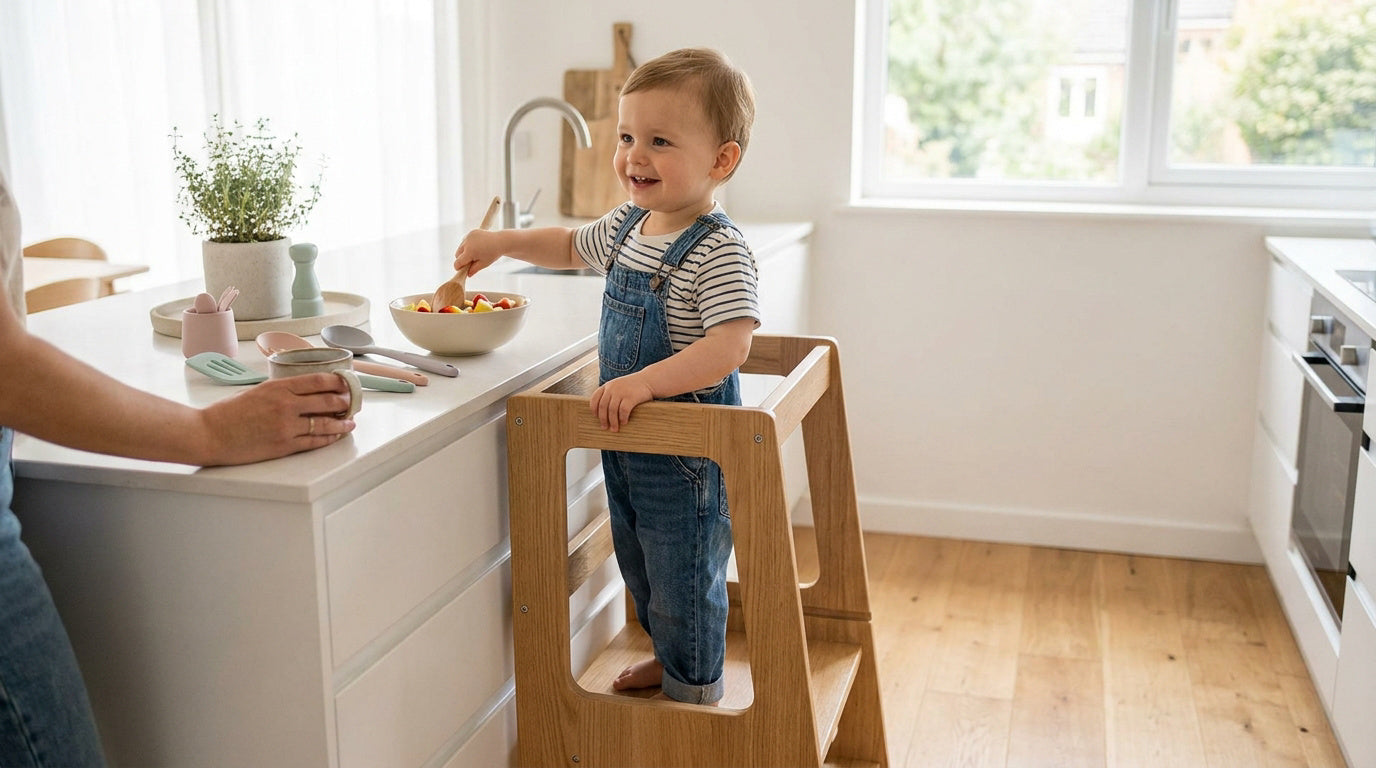
Learning tower: at what age should you really start?
The key takeaway: a learning tower becomes relevant around 12 months, as soon as your child can stand steadily. But age matters less than the signs: standing without help, climbing on chairs, trying to see what is happening up high. It then supports the child until age 5 or 6.
Around 12 months, many children start standing on tiptoe to see what is happening on the worktop. You end up cooking with one hand while holding your child with the other: exhausting, and not very safe.
Here is how to know if the time has come, and what to check before you start.
Age: a guide, not a rule
The usual window: 12 to 18 months
Most children are ready between 12 and 18 months. At this stage, the legs support the body's weight and the child can stand without support.
Some will be ready earlier, others later. That is normal: go by what your child does rather than their age on the calendar.
What it changes for them
At worktop height, the child goes from spectator to participant. They watch your gestures up close, then reproduce them.
This participation feeds self-esteem: they feel useful, and they really are. To go further, see our article on the Montessori approach and how to put it into practice.
The 4 signs they are ready
1. They stand alone, without support
This is the basic condition. Their footing must be stable and their legs strong enough to hold for several minutes.
2. They already climb on chairs
Repeated attempts to climb a chair or stool are the clearest signal: they want to see what is happening up high, and they will do it anyway. Better that it happens on a support designed for it.
3. They know how to get back down
Watch whether they can get down from a small step without falling. Climbing up is instinctive, getting down is learned, and that is where most falls happen.
4. They are interested in what you are doing
They reach out towards the sink, follow your gestures, ask to take part. Imitation is the main driver at this age.
Which model for your situation
The convertible model
The 2-in-1 tower turns into a table with a stool, which extends its use well beyond the kitchen phase. One piece of furniture for two functions, welcome when space is tight.
The structure is made of birch wood and meets the CE-EN71 standard. The step adjusts to three heights to follow the child's growth: their feet must always rest flat.
A vegan leather guard is included: it closes off the rear access and limits the risk of falling backwards for the youngest.
The foldable model
If your kitchen is narrow, the foldable tower folds flat and stores behind a door between uses.
Once unfolded, its wide base ensures stability. Always check that the mechanism is properly locked before putting your child in it.
It also offers three adjustment levels, so the platform follows growth.
Additional safety
For a particularly lively child, a safety strap attaches with velcro and closes off the rear access. It reduces the risk of falling, without replacing your presence.
To go further into the selection criteria, see our guide on how to choose an observation tower.
Setting up the tower safely
Location
Place the tower away from the hob and oven: burns are the main risk in the kitchen.
Clear the surroundings: knives, food processors, cleaning products and appliance cables must be out of reach, including from the height of the tower.
Check that the floor at the foot of the tower is dry and not slippery.
Your role
Stay present during the activity. No equipment, however well designed, replaces adult supervision.
Set simple, consistent rules: we climb up when an adult is there, we don't touch the hob. Explain why rather than forbidding without reason, as we detail in our article on saying no with kindness.
Progress, age by age
12 to 18 months: the child observes and handles simple objects. Washing vegetables, pouring from one container to another, stirring a mixture.
18 months to 3 years: they climb up and down alone, take an active part, start cutting soft foods with a wooden knife. See our guide in 3 steps for learning to use a knife.
3 to 6 years: they follow a simple recipe, measure, crack an egg. The tower sometimes becomes unnecessary depending on their height, or converts into a table.
Until what age?
Most children use their tower until age 5 or 6, thanks to the height adjustment. Beyond that, a simple step stool is usually enough.
This is also when a convertible model makes complete sense: instead of ending up in the attic, it becomes a drawing table or a stool.
So the right question is not "what age" but "what can my child do today". If they can stand and climb everywhere, the time has come. Discover the 2-in-1 tower, adjustable to three heights and CE-EN71 certified.
FAQ
From what age can you use an observation tower?
Generally between 12 and 18 months, as soon as the child stands confidently and walks well. Some are ready a little earlier, others later: their footing and their desire to take part decide, not the date.
How do you know if they are physically ready?
Four signs: they stand without help, they already climb on chairs, they can get down from a small step without falling, and they show a clear interest in what you do in the kitchen. The ability to get back down is often the last one acquired.
Until what age is a learning tower useful?
Until age 5 or 6 on average, thanks to adjustable platforms that follow growth. After that, a classic step stool is enough. A convertible model extends its use by becoming a table or stool.
What safety habits in the kitchen?
Place the tower away from the hob and oven, keep knives, food processors and cleaning products out of the accessible area, and check that the floor is dry. On a foldable model, check the locking before each use. Your presence remains essential.
Why not just a stool?
A stool offers no side protection: a child who leans or turns around can fall. The tower surrounds them with a guard rail while letting them climb up and down alone, which changes everything for their independence and for your peace of mind.

Written by Charles CAIGNOL






Leave a comment
This site is protected by hCaptcha and the hCaptcha Privacy Policy and Terms of Service apply.