
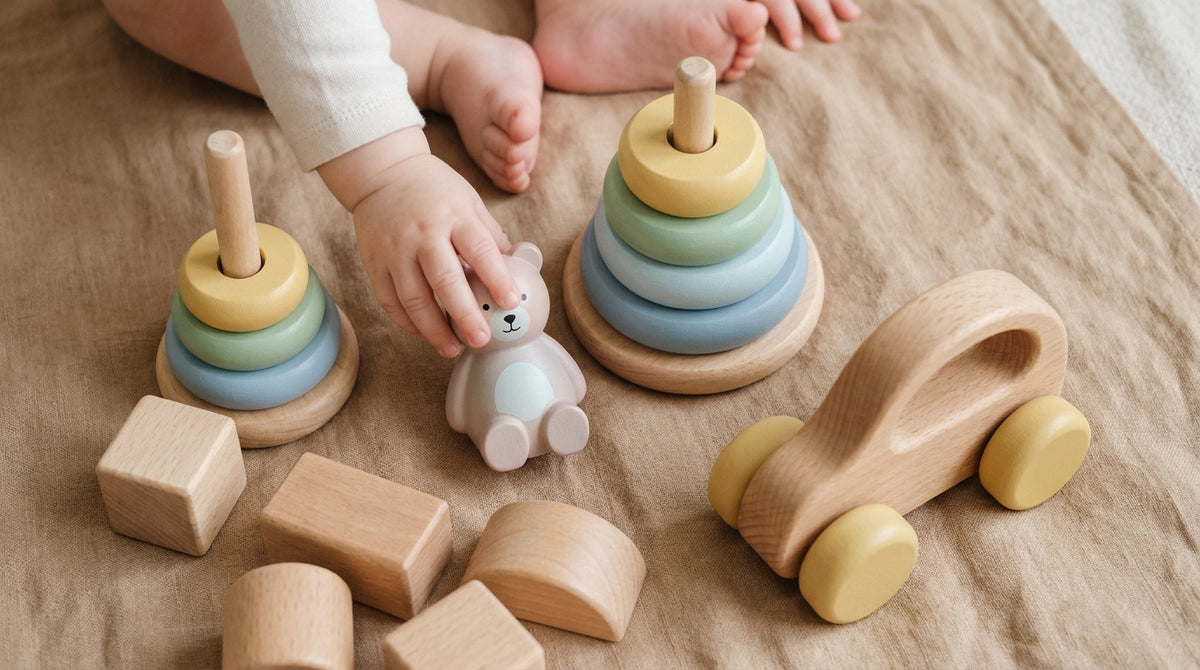
Choosing a wooden toy for your baby: how to spot quality
The key takeaway: not all "wooden toys" are equal. Solid wood or quality plywood hold up very well; chipboard and low-grade MDF, much less so. Check the CE marking and the EN 71-3 standard, and rely on three concrete clues: the smell, the finish and how well the joints hold.
Wood has a good reputation, and deservedly so: it withstands knocks, develops a patina, can be repaired and passed on. But between the formaldehyde glues in some boards and dubious varnishes, the "wooden" label guarantees nothing on its own.
Here is how to recognise a good product in a few seconds, without being an expert.
Why wood remains a good choice
An object that lasts
Unlike entry-level plastic that cracks, wood takes falls in its stride. Light sanding erases marks of use, which extends its life by several years.
This lifespan changes the economic calculation: an object kept for four years and then passed on costs less per use than three replaced toys.
Better sensory feedback
Wood has weight, temperature and texture. This information helps the child measure their strength and build their perception of objects.
With no imposed lights or sounds, it is the child who leads the play. The scenario comes from them, not from the object.
Understanding materials: not all "wood" is equal
This is the most misunderstood point, so let's clarify.
Solid wood (beech, lime, maple) is dense, splinter-free if well sanded, and very strong. Ideal for small pieces that are handled and put in the mouth.
Quality plywood, particularly birch plywood, is made of thin cross-laminated layers of wood glued together. Well made, with compliant glues, it is an excellent material: more stable than solid wood over large surfaces, it does not split and withstands stress very well. That is why it is widely used in children's furniture, including for our arches and our towers.
Chipboard and low-grade MDF, on the other hand, are boards of compressed particles or fibres. They swell with humidity, crumble at the edges and rely on a high proportion of glue. Avoid them for intensive use by a child.
The useful distinction is therefore not "solid wood versus plywood", but "quality structural wood versus particleboard".
Spotting a bad product at a glance
The smell
When opening the box, a sharp chemical smell should alert you: it may signal glues or varnishes that release volatile compounds. Properly finished wood smells of wood, or almost nothing.
The finish
Run your hand over it: the surface must be smooth, with no splinters or sharp edges. Visible glue smears or chips on the edges betray sloppy machining.
Test the paint with a fingernail: it must not flake. Oil- or water-based finishes are preferable to thick varnishes.
The joints
Pull firmly on the glued or screwed parts: nothing must move. Before age 3, a small part that comes off presents a choking risk.
Shake the assembled object: play in the joints straight out of the box will not improve with time.
The standards and labels to know
What concerns safety
CE marking is not a quality label: it is a declaration by the manufacturer attesting that it complies with European regulations. It is compulsory, so its absence is a deal-breaker.
The EN 71 standard sets out these requirements. Part EN 71-3 governs the migration of certain elements, including heavy metals, from materials and coatings. It is the reference when the child puts the object in their mouth.
The DIN 53160 standard concerns colour fastness to saliva and perspiration: useful for teething objects.
What concerns the environment
FSC and PEFC attest to responsible forest management and the traceability of the wood. These are environmental criteria, not to be confused with a health guarantee: FSC-certified wood with a poor varnish is still poorly varnished.
These certifications have a cost for the manufacturer, which partly explains the price gap with a product of opaque origin.
Choosing by age
From 0 to 12 months: grasping
Light rattles, teething rings, textured balls. The shapes must be easy to grasp, with no small parts, and withstand being chewed.
From 1 to 3 years: handling and moving
Stacking blocks, shape sorters, puzzles with large knobs for fine motor skills. For gross motor skills, a climbing structure such as a climbing arch takes over from 18 months.
From 3 to 6 years: building and imitating
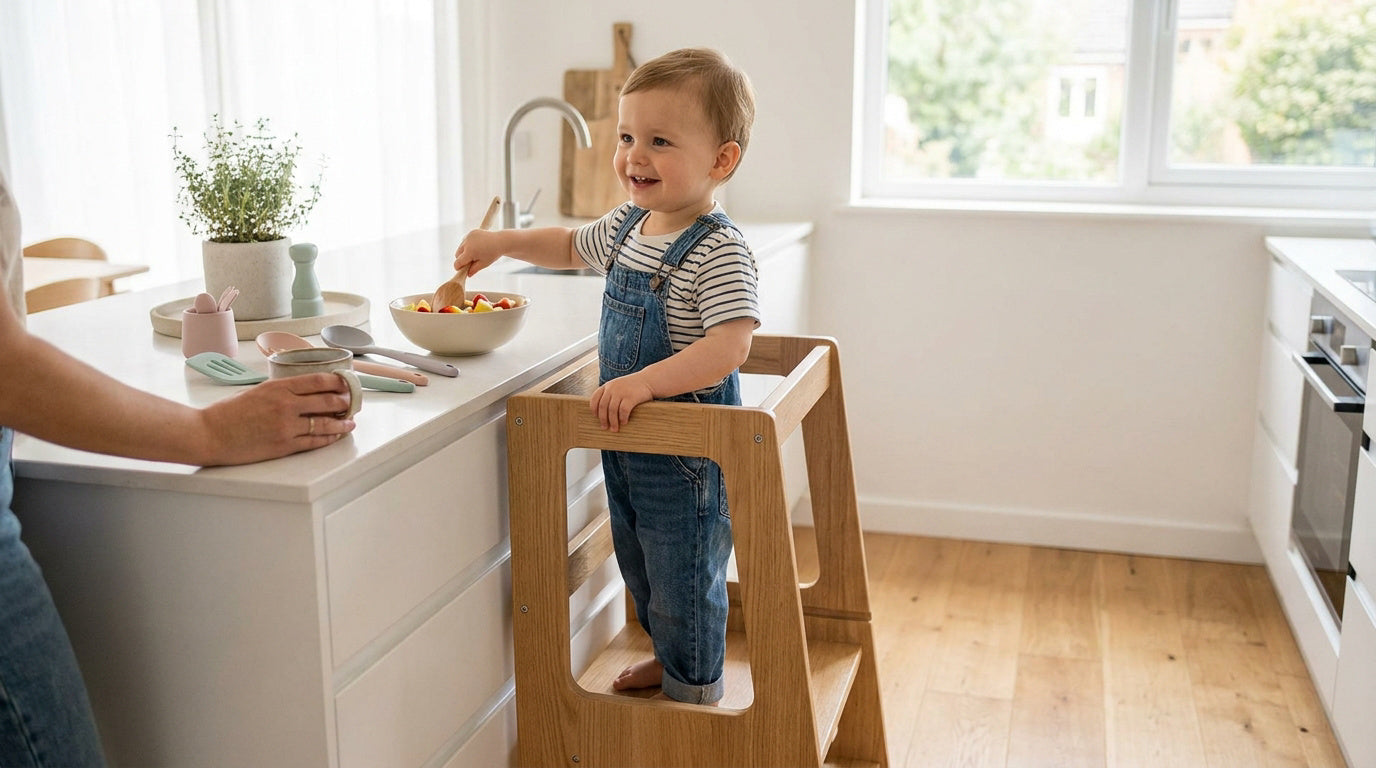
Construction sets, practical life materials, suitable utensils such as a wooden knife to take part in the kitchen.
Caring for wood
Never soak a wooden toy: it swells, splits and can go mouldy. A slightly damp cloth, then wiping dry immediately, is enough.
If the surface becomes rough, fine sanding followed by a vegetable oil restores its smoothness. That is the whole advantage of a repairable material.
Periodically check that the screws on furniture are tight: that is what preserves stability over time.
A good wooden toy can be recognised by three things: no suspicious smell, a smooth finish, joints that do not move. The rest is marketing. Discover our wooden furniture, CE-EN71 certified.
FAQ
Solid wood or plywood: which to choose?
Both are suitable, if they are of good quality. Solid wood is ideal for small pieces that are handled. Birch plywood, made of cross-laminated glued layers, is more stable over large surfaces and does not split, which makes it an excellent material for furniture. What to avoid is chipboard and low-grade MDF.
How do you spot a poor-quality wooden toy?
Three clues: a strong chemical smell when unpacking, a rough finish with splinters or glue smears, and joints that move when you pull on them. Paint that flakes under a fingernail is also a bad sign.
Which certifications should you check?
CE marking is compulsory. The EN 71-3 standard governs the migration of heavy metals from materials and coatings, which matters when the child puts the object in their mouth. DIN 53160 concerns colour fastness to saliva. FSC and PEFC relate to the origin of the wood, not its non-toxicity.
How do you care for wooden toys?
Never soak them in water. A slightly damp cloth and immediate wiping dry are enough. If the wood becomes rough, fine sanding followed by a vegetable oil renews it. On furniture, check that the screws are tight twice a year.
Which wooden toy for which age?
Before age 1: rattles, teething rings, simple shapes to grasp. From 1 to 3: blocks, shape sorters, puzzles with large knobs, and a climbing structure from 18 months. From 3 to 6: construction sets and practical life materials.

Written by Charles CAIGNOL






Leave a comment
This site is protected by hCaptcha and the hCaptcha Privacy Policy and Terms of Service apply.