
Learning to read: the ideal age and a guide for your child
- At what age does learning to read begin?
- The stages of reading development in children
- Creating a reading-friendly environment at home
- Supporting reading difficulties
At what age does learning to read begin?
Education systems vary from country to country: in France, formal learning often starts at age 5 in nursery school, while in the United States or the United Kingdom it can begin as early as 4. These benchmarks remain indicative, however, because every child progresses at their own pace, with the first signs of interest in written words appearing from a very young age.
My 2-year-old eldest surprises me by pointing to the letters of his first name on book covers. It is a reminder that learning to read is neither linear nor standardised. Some children decode on their own at 4, others wait until 7. What matters is to support without pressure, by observing their attempts and their natural curiosity for the written word.
The stages of reading development in children
From birth to 3 years: awakening to written language
The first interactions with books begin early: my 13-month-old baby loves grabbing board books and chewing on them, while my eldest, at 2, turns the pages with concentration. These simple gestures mark the beginning of a sensory discovery of the written word.
- Handling books: The child explores books by touch, shakes them, nibbles them or throws them to discover this object.
- Interest in pictures: The child observes the colourful illustrations and may point to the ones that attract them.
- Reaction to reading: The child smiles, babbles or wriggles while listening to stories read aloud.
- Emerging comprehension: The child recognises simple words linked to pictures (e.g. "dog" on an illustration).
- Active imitation: The child reproduces the animal sounds from the book or mimes gestures related to the story.
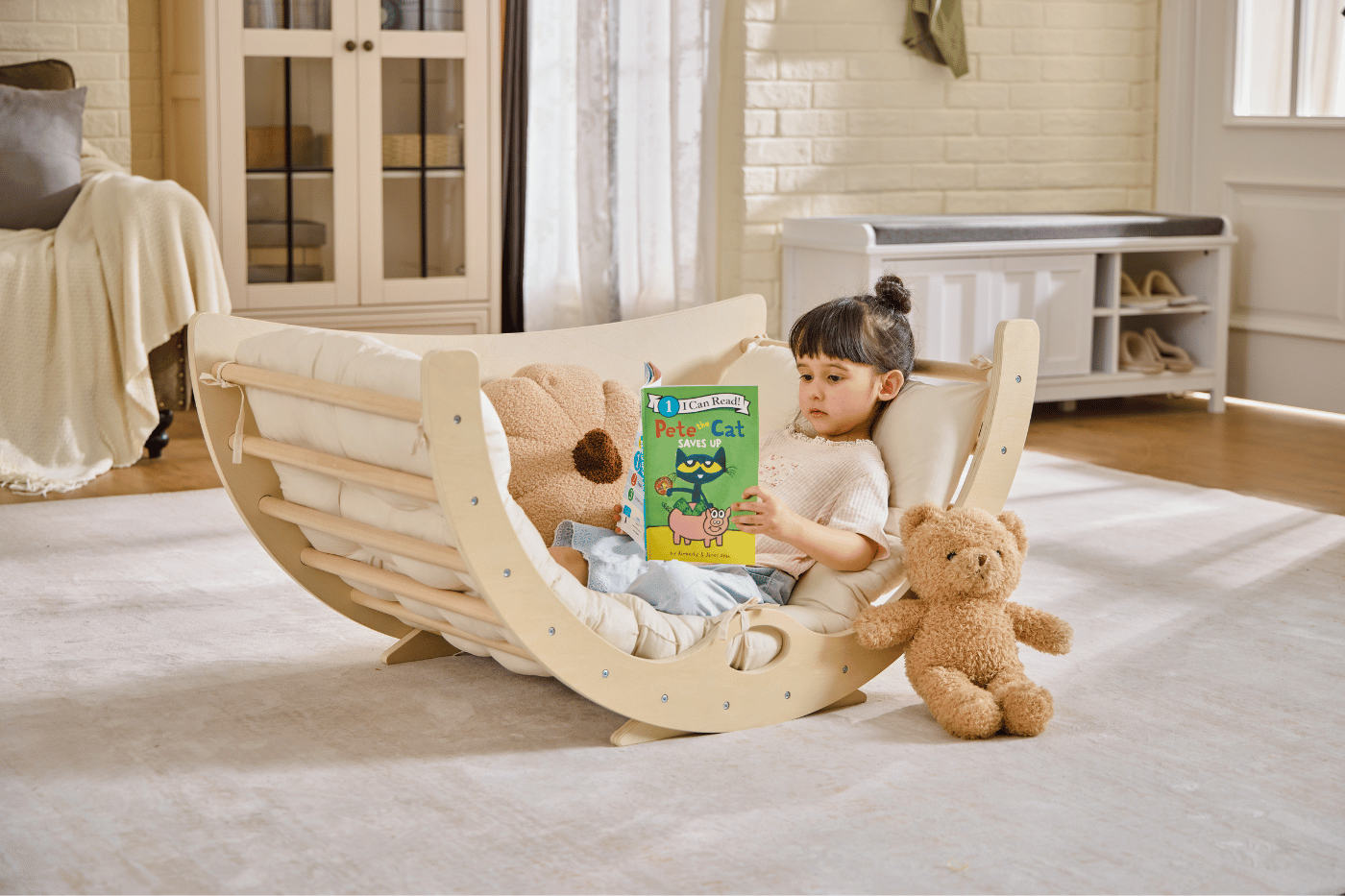
Offering suitable books is important. Shared reading builds vocabulary and creates happy memories around stories. A wooden Montessori arch can create an ideal environment during these moments.
For the youngest, awakening happens through play. I often include fabric books or textured edges in our routines.
From 3 to 5 years: phonological awareness and the alphabet
At this age, my eldest starts playing with sounds. He recognises rhymes and identifies the first letters, often the one from his first name. Phonological awareness becomes an invisible but fundamental tool for decoding later on.
| Age | Phonological awareness skills | Knowledge of the letters of the alphabet |
|---|---|---|
| 3 years | Recognises simple rhymes, identifies the initial sounds of familiar words | Identifies 1 to 5 capital letters, often those of their first name |
| 4 years | Splits words into syllables, compares similar sounds | Recognises 6 to 10 letters, links some of them to their sounds |
| 5 years | Identifies individual sounds in words, begins to manipulate phonemes | Knows most capital letters and a few lowercase ones |
To make this learning easier, sensory activities are ideal. With my children, we use Montessori sandpaper letters to link touch and sound, or sound games with everyday objects. Inspired by the Montessori method, these activities make the abstract concrete.
My eldest shows curiosity about letters, but I am careful not to push him. When he spots an "A" in the street, I simply name it. The key is to nurture his interest gently, through play, without chasing performance.
From 5 to 7 years: formal reading instruction
In the final year of nursery school, the foundations are laid: my 5-year-old son is starting to link sounds and letters. In the first year of primary school, he will learn to decode simple words, but every child follows their own path.
Methods vary: some schools use phonics (linking sounds and syllables), others mix whole-word and analytical approaches. At home, I read short texts and play at rebuilding words with magnetic letters. Parental support complements school without replacing it.
Initial decoding is slow, but around age 7, reading becomes automatic. My eldest progresses in fits and starts, going from one syllable to a whole word in a few weeks. This uneven rhythm is completely normal.
Creating a reading-friendly environment at home
Setting up a reading corner at home
To make reading a pleasure, I created a small reading corner in the living room with shelves at their height and books within reach. Seeing my children grab a favourite picture book on their own is worth all the decorations in the world!
- Early-learning books and picture dictionaries for toddlers
- Illustrated picture books for 2 to 4-year-olds
- Sound books for active children
- Comics or first readers for 5 to 7-year-olds
I vary the reading according to the mood of the moment: a Beatrix Potter classic one day, a more modern, sensory book the next. The key is to offer accessible and varied books to keep their curiosity alive without routine.
Building reading into daily routines
Since reading became our daily 4 p.m. appointment, my youngest enjoys spotting the letters of his first name on book covers. In the evening, before sleep, he likes us to reread his favourite passages. These simple but regular moments weave emotional landmarks around books. Little by little, the ritual becomes a real bond of closeness.
Supporting reading difficulties
Recognising the signs of difficulty
Difficulties show up as persistent delays despite regular support: my eldest stumbled over simple rhymes at 5, while his classmate had already mastered syllables. Signs such as confusion between similar sounds ("cat" and "cap") or a lack of progress over 3 months deserve attention.
Dyslexia affects around 5 to 7% of children and often shows up as difficulty linking sounds to letters. If your child mixes up "b" and "d", you can help them with Montessori-style sandpaper letters or visual sorting games. Every difficulty is a clue to listen to, not a foregone conclusion.
If in doubt, I start by talking to the teacher to better understand the classroom context. If the difficulties persist, an assessment by a speech and language therapist helps identify specific needs. Our neighbours, for example, found that support from age 6 allowed their daughter to progress in reading without discouragement.
Suitable support strategies
To protect my eldest's confidence, I celebrate every small victory: recognising a sound, daring to read a word, even if the writing is still hesitant. Word games, such as looking for rhymes in songs, make learning lighter. The key is to turn every challenge into a positive step, never into an obstacle.
Between 4 and 7, every child moves forward at their own pace. By creating an environment rich in books, caring routines and activities inspired by the Montessori method, you naturally cultivate their curiosity. A cosy reading corner, a few well-chosen stories, and wonder often appears.
These small reading moments can become great sparks of confidence. And who knows? The still-shy reader of today may well become, tomorrow, a passionate storyteller.
FAQ
What should I do if my 6-year-old son cannot read?
It is crucial to remember that every child learns at their own pace. Start by assessing your child's specific difficulties: letter recognition, sound/letter matching, or lack of interest. Then create a supportive environment with suitable books and playful reading moments, without pressure.
Do not hesitate to seek help from professionals such as the teacher or a speech and language therapist for a personalised assessment. Be patient and encouraging, celebrating every step forward and building their self-confidence. Learning takes time, and your support is essential.
Is reading at age 3 a good thing?
Learning to read is an individual process. If a child shows interest in reading at 3, it is beneficial to encourage them with suitable resources such as picture books and interactive activities. The important thing is to approach this stage playfully and without pressure.
It is crucial not to force the child if they are not ready, as this could create a long-term aversion to reading. Focus on the pleasure of discovering stories and words, rather than on performance. The approach must be sensitive and adaptable to the child's needs.
When does a first-year primary school child know how to read?
A child begins to read in the first year of primary school when they understand what they decode. Learning happens in stages, including awareness of sounds, discovery of the alphabet and understanding of the link between letters and sounds. Progress varies from one child to another, but the goal is to be able to combine several letters or groups of letters to read words and sentences.
The main challenge is to memorise the sounds of letters and their combinations in order to understand the meaning of sentences and of the story. The ability to read is relative to the difficulty of the text, and the child must be able to combine several letters or groups of letters to decode more complex words.

Written by Charles CAIGNOL







Leave a comment
This site is protected by hCaptcha and the hCaptcha Privacy Policy and Terms of Service apply.