
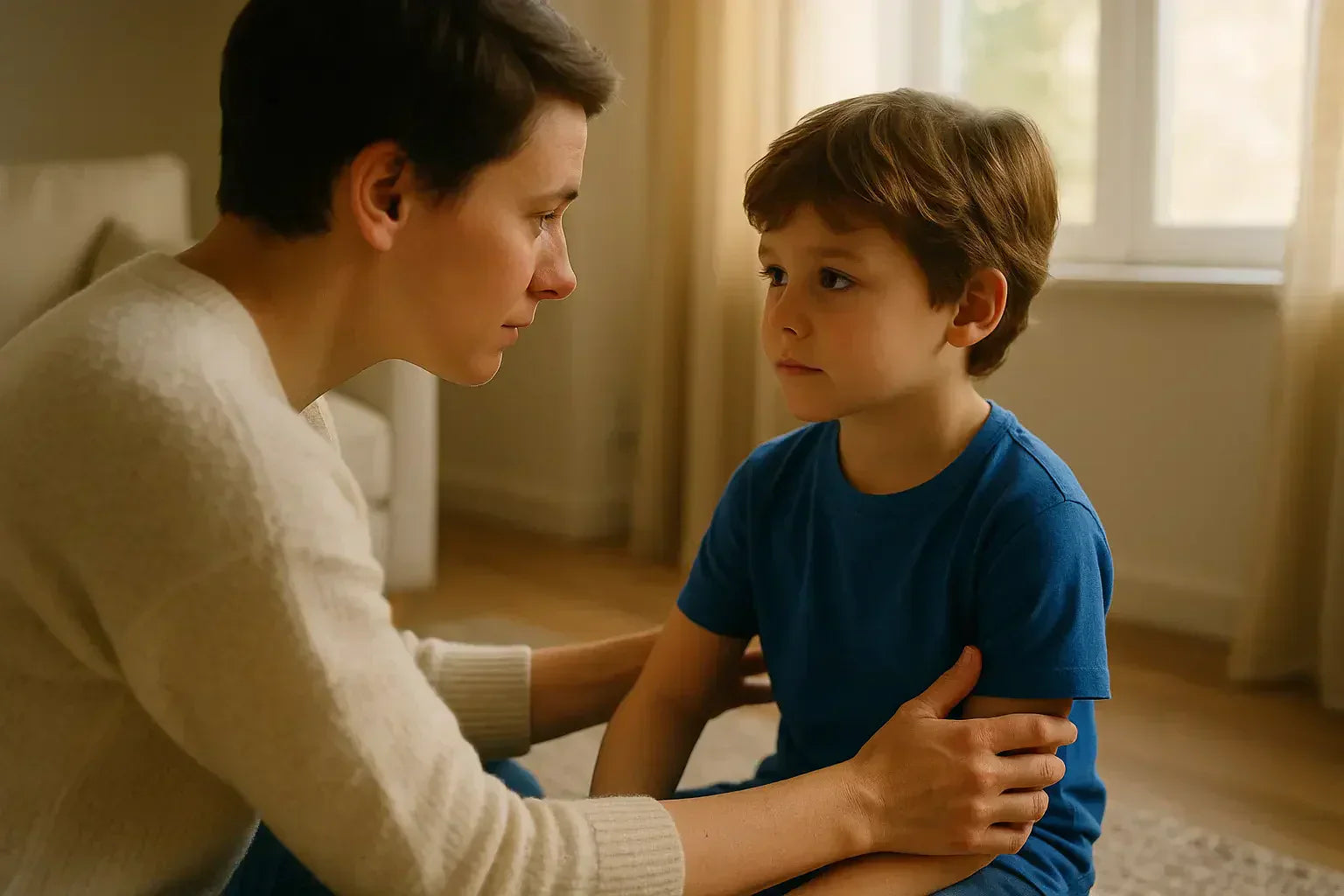
Why does your child swear, and what can you do about it?
- Your child is swearing? Don't panic, here is my approach
- Why your child explores "grown-up" language
- Your parenting superpower: the right, calm reaction
- The anti-swearing toolbox: creative and playful strategies
- Swearing, a sign of intelligence? Separating fact from fiction
- Setting clear and kind family rules
- In short: connection and patience are your best allies
Your child is swearing? Don't panic, here is my approach
I can picture you: your little angel let out an unexpected word first thing in the morning. So now you are wondering whether you did something wrong... or whether the neighbours heard. Rest assured, you are not alone!
My 4-year-old nephew did the same one day, and his father calmly replied: "That word, we keep it for emergencies, okay?" According to child psychiatrist Rafi Kojayan, children's swear words mark a normal stage: exploring language, imitation, or a need for attention. Nothing dramatic!
Panic is understandable, but punishing or shouting achieves nothing. This article shares concrete solutions: understanding the emotion behind the word, staying calm, and using humour to set limits. Because behind every swear word lies a desire to communicate. What if we turned it into a moment of closeness?
Why your child explores "grown-up" language
Hearing a swear word from your child's mouth can be surprising, but it is a normal stage of their development. From age 2 or 3, children imitate what they hear around them, at home, at nursery, on television, especially when words trigger strong reactions. These words are intriguing because they carry a strong emotional charge. Understanding why they use them makes it possible to react calmly and educationally.
The emotional sponge: imitation above all
Children repeat words for their impact. A swear word thrown out by an older brother after a failure becomes a word to test, a way of understanding social codes. It is a developmental phase where they explore family norms. But this imitation can also reveal a need to assert themselves or to catch your attention by testing limits.
When swear words hide big emotions
A "damn it" after a collapsed LEGO castle is not a provocation, but the expression of intense frustration. Young children lack the vocabulary to name their emotions and use these words as "release valves". This is where clear rules become essential: validate their feelings while setting limits. Offer alternatives such as made-up "swaps" ("sugar!", "fiddlesticks!") or redirected phrases ("That's a word that upsets people, we say instead...").
Behind every swear word there is often a raw emotion: anger, fear, or even overflowing joy. By calmly explaining the rules without shouting or laughing, you turn these moments into learning. The goal? Teach them to name their feelings ("I'm annoyed!") while respecting the family rules on language.
Your parenting superpower: the right, calm reaction
Your child has let out a rude word for the first time? Your reaction matters more than you think. Staying calm is the first key. Why? Because a burst of laughter, a shout or a harsh punishment gives the word a power it does not deserve. The child is testing limits: what they remember most is the reaction they trigger.
1. Staying calm: the anti-repeat engine
Imagine: your child says a strong word. You react violently. What is the risk? They try again, just to see. An excessive reaction confirms its importance. The right reaction? A neutral tone, a calm rephrasing: "That word is very strong. Here, we speak differently."
Most children stop using these words within 1 to 2 weeks if parents avoid dramatising. The key? Do not laugh, do not shout, and above all, do not act surprised. Words are tools: they are learning to use them.
2. Being a role model: when example speaks louder than words
Before demanding gentle language, observe your own. How many times a day do you say "damn" or "shit"? The child is a mirror: they repeat what they hear. Consistency is your ally. If you want them to avoid swearing, show the way. One parent explained: "I replaced 'blast!' with 'oh sugar!', and my son followed."
A practical tip: if you slip, apologise. "Sorry, that word isn't nice." It shows that nobody is perfect, but that the effort counts.
3. Listening to the emotion: beyond the words, understanding the message
Behind a swear word, there is always an emotion. Anger, frustration, a need for attention... Understanding emotions is the foundation. Suggest: "That word is strong. Tell me what you're feeling?" This helps them name their anger, their disappointment, without violence.
Concrete example: ask: "Are you angry because he took your toy?" They might answer: "Yes, I wanted to play with it!"
A tip? Use humour to defuse. "That word, we save it for emergencies... Like fireworks!" This sets a limit without dramatising.
The anti-swearing toolbox: creative and playful strategies
Funny replacement words
Turn the forbidden into a game with funny, inventive replacement words. Create a family list of "swaps" such as "peanuts", "fiddlesticks" or "sugar lumps". Let the children suggest their alternatives: "banana", "captain of the bathtub" or "flea bag" defuse tension with a laugh. You can also use old-fashioned expressions like "gadzooks" or inventions like "blackbird's booty". The goal is to keep the atmosphere light while guiding towards respectful language.
The swear-word dump
Offer a safe space to manage emotions: a "dump" where the child lets out their swear words in private. Turn a cardboard box into a "swearing box" decorated with drawings. Explain that this place is for releasing pressure without hurting anyone, for example by whispering into a pillow or shouting in the toilet. This validates their need to express themselves while setting clear limits on public use. You can simply say "This is where you can shout when you're angry" without adding unnecessary rituals.
The family piggy bank
Set up a piggy bank where every swear word (parents included!) earns a small fine. The money collected funds a shared activity: a home cinema night, a trip to a park, or buying a game. This creative strategy strengthens family bonds and shows light consequences, without humiliation. For children, it becomes a playful challenge: "Who will put in the fewest coins this week?" It makes learning interactive and values shared responsibility.
Calculated indifference
For young children testing "forbidden" words, ignore the word without dramatising. Smile slightly, change the subject, then talk calmly later: "That word is hurtful. We can say 'shoot' instead." This method avoids reinforcing the behaviour while setting landmarks. If the child insists, offer a cuddle or a physical game such as gentle wrestling to release tension. Stay emotionally available, without feeding the scene.
Telling swearing and insults apart
Teach the child the difference between a swear word ("Ouch, damn!") and an insult ("You're useless!"). The swearing box accepts the first, but an insult stays unacceptable, because it hurts. Explain simply: "When you bump yourself, 'Ouch, sugar!' is fine. But saying 'You're a pickle' hurts. We don't accept that." React calmly to the insult ("I can't let you say that") while validating their emotion ("I can see you're very angry").
Swearing, a sign of intelligence? Separating fact from fiction
You have surely wondered whether your child's swear words hide a sharp intelligence. Some studies, such as one from the University of Rochester, suggest a correlation between verbal fluency and the use of swear words. But beware: it is not the slang that counts, but the ability to master different registers of language.
Between 2 and 3, children explore their environment. Repeating "forbidden" words reflects their curiosity. An expanding vocabulary, a discovery of strong emotions... It is a phase of language exploration, not a sign of genius. Specialists insist: it is not the word that matters, but understanding the reactions it causes.
In older children, swear words help manage pain or strengthen social bonds. In little ones, it is a way of experimenting with the power of words. So no panic, but an opportunity to support their development with kindness.
In short, the link between swearing and intelligence remains fragile. Above all, it shows that your child is progressing in their mastery of language. The challenge? Helping them tell the difference between funny words among friends and words that hurt. That nuance is the key to giving them confidence.
Setting clear and kind family rules
Do you sometimes feel overwhelmed by the words coming out of your child's mouth? Did you know that kind, clear family rules can really make a difference?
Clear limits are not there to stifle the child, but to give them a familiar space. A secure framework where they know what they can and cannot say.
The first step? Involve your child in defining the rules. Hold a little family meeting. It strengthens the sense of belonging. They feel like a participant in the rules, not a passive recipient.
For example, you can write a list of words to avoid. Discuss it calmly. Explain why these words hurt or are impolite. It makes sense to them.
Next, consistency is crucial. These rules must be applied by everyone: parents, grandparents, brothers and sisters. If it is tolerated one day and forbidden the next, it confuses the child.
Imagine: they learn to tidy their room, but one day they are told it doesn't matter. It loses them. They need consistency to grow up serenely.
And what if you linked it to an approach such as Montessori? The goal is to encourage independence within a secure framework. This strengthens self-esteem and self-confidence.
For example, in this approach, every rule has a reason for being. It is there to guide, not to punish. The child understands the why. They take in the values.
So, how do you do it? Set simple rules. Use language suited to their age. Explain calmly. Always be consistent. And above all, be an example.
In short: connection and patience are your best allies
When your child lets out a swear word, keep in mind that it is not a personal attack. Understanding, connection and leading by example form the winning trio. Try to decode what these words reveal: a need for attention, frustration, or curiosity. The important thing is to stay calm.
Avoid shame or punishment. Welcome the underlying emotions with a cuddle, a fun game or a kind conversation. These gestures strengthen the bond with your child, your best weapon for guiding their choices.
Patience is essential: habits change slowly, especially if adults set the example. If the word keeps coming back, offer funny alternatives or a "swear-word dump" where the child expresses their frustration in private.
Finally, open dialogue remains the key. Discuss acceptable limits, explain the impact of words. Every family will find its balance through listening and kindness. It is this mix of gentleness and consistency that will help your child grow up confident, while choosing their words with care.
In short: patience, connection and kind conversations are your best allies when faced with your child's swearing. By combining understanding, listening to emotions, leading by example and playful tricks, you help them grow up without drama. Every family finds its balance through open dialogue and a solid bond, turning these challenges into opportunities to grow closer.
FAQ
How should I react when a child says a swear word?
When my little one let out a "shit" in the middle of the supermarket, I swear my first instinct was to sink into the ground! But I quickly learned that the best approach is to stay calm. Not easy, I grant you. Rather than getting angry or laughing (which could encourage a repeat), I suggest saying in a neutral voice: "That word is very strong, it hurts people. How are you feeling right now?" Usually, the swear word hides an intense emotion the child cannot express any other way. The important thing is to set limits while staying connected.
At what age does a child start using swear words?
I often asked myself this when my eldest, at only 3, came out with a "poo-poo head" that left us gobsmacked! Know that it is completely normal. From age 2 or 3, children enter the famous scatological phase with words like "wee-wee poo-poo". Between 3 and 5, they move on to the sexual register ("willies and boobies") before tackling real swear words around age 5. It is language learning, a discovery of the power of words and their emotional impact. Nothing to panic about, as long as you set limits gently.
Is swearing a sign of intelligence in children?
I must say I was almost proud the first time my kid used a "grown-up" word, as if it were a sign of intelligence. But the reality is more nuanced. Some studies link the use of swear words to good verbal fluency, but it is not a sign of superior intelligence. It is rather a sign that your child has a growing vocabulary and is exploring different forms of expression. It is a normal phase of linguistic exploration. The key is not to let it become a habit while valuing other forms of expression.
Is it acceptable for a child to use swear words?
Frankly, between us, I think children have the right to use swear words... but with precise limits. It is an unavoidable phase for many. The important thing is to distinguish between a swear word let out in pain ("Ouch!") and an insult aimed at someone. In our house, we chose to tolerate words said "for fun" in the bedroom, but we are firm on respect for others. Every family must find its balance, as long as it stays consistent.
What is Gilles de la Tourette syndrome (formerly called Spirit syndrome)?
I think I understand your concern if your child often repeats the same words or expressions compulsively. You must not confuse a child exploring language with Gilles de la Tourette syndrome, a neurological disorder that shows up as motor and verbal tics. In some rare cases (less than 10%), coprolalia is observed, that is verbal tics involving rude words. But it is very uncommon. If your child uses swear words occasionally, it is probably just a phase of language learning. If the repetitions are uncontrollable and troublesome, it is better to consult for peace of mind.
How should I punish a child who uses hurtful words?
I have to tell you that classic punishments don't work very well with swear words. When my teenager threw a "you're useless" at me, I didn't feel like laughing but I knew that punishing wouldn't solve the root of the problem. I opted for a different approach: "I understand that you're angry, but I can't accept you speaking to me like that. Shall we talk about it when you've calmed down?" With younger ones, you can also use strategies like the "swear jar" where every swear word costs a penny (even for parents!), the money going towards a family outing. The key is to be firm without humiliation.
What educational approach should I take to swearing?
I went through every method before finding our balance. What works best is the kind but firm approach. With my children we set up a "swearing box": if a word is burning on their lips, they can say it into the box rather than blurting it out at the table. We also invented funny "super words" like "bashibazouk" or "sugar and spice". And above all, we chose not to react spectacularly when the word slipped out by accident. The idea is to defuse the interest in these words without making the child feel guilty.
Which illnesses can cause compulsive swearing?
I understand your concern. Fortunately, it is only in very rare cases that the use of swear words hides a medical condition. Gilles de la Tourette syndrome is often mentioned, but less than 10% of those affected have what is called coprolalia (uttering obscene words). Other conditions such as autism or ADHD can sometimes include difficulty controlling language, but these are very specific cases. If your child uses swear words occasionally, it is surely just exploration. If it is compulsive and troublesome on a daily basis, it is better to consult a specialist.
How do I handle a child who gets angry easily and uses violent words?
Ah, I know this situation well! When anger overflows, the words follow. What I learned is that you first have to welcome the emotion before correcting the language. When I see my child is about to explode, I try to say: "I can see you're very angry. Would you like me to help you find other words?" We also set up a "calm" moment where everyone can go and express their anger without hurting others. And above all, we work upstream on managing emotions with role play and calm conversations. It is not an exact science, but patience and consistency end up bearing fruit.

Written by Charles CAIGNOL







Leave a comment
This site is protected by hCaptcha and the hCaptcha Privacy Policy and Terms of Service apply.