
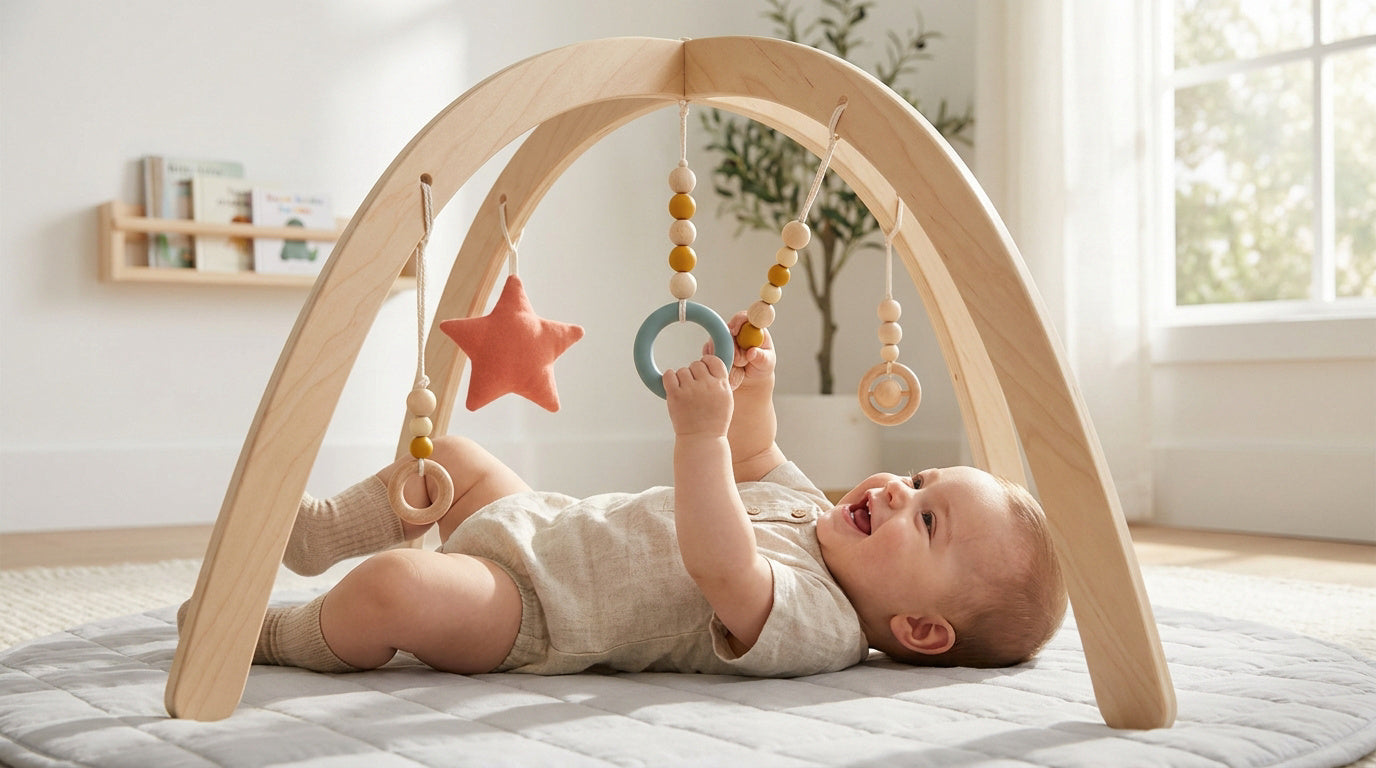
How to get the most out of your climbing arch
What to remember: the birch wood climbing arch is a piece of furniture that grows with your child from 18 months to 6 years. From motor tunnel to climbing module, from rocker to den, it supports independence and self-confidence. One structure, eight uses.
Did you know that a birch wood climbing arch can accompany your child for nearly five years thanks to its versatility?
Yet we often end up using it in a single way, forgetting all its potential for independence and imagination. Let's look at eight concrete ways to make the most of this object to stimulate your little explorers' creativity and gross motor skills.
Why using a climbing arch will transform your home
The Teedum birch wood arch supports free movement from 18 months, from climbing module to imaginative play at around age 6. This structure accompanies natural motor development without constant adult intervention.
This respect for spontaneous movement is precisely what lets your child progress at their own pace.
Respecting the child's pace
The arch acts as a lever for free movement. Your child explores their physical abilities without outside constraint. This independence strengthens their self-confidence with every new attempt. Every small step forward becomes a personal victory.
You watch from a distance, without systematically intervening. Your child then progresses according to their own needs.
The quality of Teedum wood for the home
Birch wood offers proven sturdiness for furniture used every day. The Teedum arch is CE-EN71 certified and its finish is sanded to limit splinters. Wood remains a noble, durable material.
Its clean design suits your living room as well as the bedroom. The minimalist look respects the visual balance of your home.
1. The motor tunnel for the first challenges
Placed on the floor, the arch becomes a tunnel to go through on all fours or crouching.
Passing under the structure requires the child to coordinate their supports and anticipate the available height. They learn to find their bearings in space and adjust their posture, a very complete workout for a game that looks simple.
You can place an object to grab on the other side to give the course a goal. By stringing several passes together, the child gains ease.
It is often the first use a child takes up entirely on their own.
2. A stable support for working on balance
As curiosity grows, the object becomes an ally for standing upright.
The rungs offer a firm grip for little hands. The child leans on them, moves sideways, tests their balance. This stage consolidates the still hesitant walking of the youngest.
The stability of the structure reassures the young climber. They gain confidence without direct outside help.
Core strength is built naturally, without imposed exercise.
3. The climbing module for little climbers
Once balance is acquired, the desire for height naturally takes over.
The arch becomes a mountain to conquer in the living room. Every rung climbed calls on limb coordination. It is an excellent exercise for gross motor skills.
To vary the difficulty, the reversible ramp adds a slide side and a climbing side with holds. Two new uses with a single accessory.
Movements become more fluid with practice. Your child learns to assess risks for themselves, under your watch.
4. The relaxing rocker to ease tension
Dynamic play sometimes gives way to a need to calm down.
Turn the arch over to create a rocking motion. Add the cushion provided for more comfort. This gentle rocking helps them settle after an intense day.
If you want to lock the movement for quiet time or a moment of reading, the wooden wedges hold the rocker still.
The child settles in for a moment of relaxation, and can rock themselves.
5. The secret den for imaginative play
Beyond the body, it is the mind that escapes thanks to the versatile structure.
A simple sheet laid over the arch creates an instant refuge. This little tunnel becomes the stage for many invented stories. Your child's imagination takes over.
This intimate space encourages symbolic play. They hide there to read or play quietly.
Creativity expresses itself without material limits: the arch becomes a castle, a cave or a boat.
6. The sensory board for handling objects
The wooden structure also serves as a support for more delicate activities.
Use the rungs to attach ribbons or varied textures. The child explores tactile sensations while sitting or standing. This handling refines the dexterity of little fingers.
You can vary the accessories with the seasons. This renews interest in the object effortlessly.
Concentration improves during these quiet games.
7. The extra desk for quiet activities
The arch evolves with age to become a functional everyday piece of furniture.
By adding a suitable board, the arch turns into a small desk. Your child has a dedicated space for their first drawings, at their height.
It is a perfect corner for colouring or modelling clay, in a familiar environment.
This more static use extends the life of the product as the child grows.
8. The reading nook and the cradle for cuddly toys
The versatility extends to rest times and pretend play.
Turned over, the arch welcomes soft toys for an imaginary nap. It can also serve as a display for your child's favourite books, cover facing them.
This reading nook encourages independence: the child chooses their story alone.
The wood brings soothing warmth and the space quickly becomes a favourite spot.
Points to watch for peaceful use
To make the most of these uses, a few common-sense rules apply.
Setting up on a suitable floor
Place the arch on a thick floor mat. This cushions any falls during climbing exercises. Check that the surface is level before each use.
Keep visual supervision during dynamic play. Your presence reassures the child without hindering their movements.
Regular care of the wood
Clean the wood with a soft, slightly damp cloth. Avoid harsh chemicals.
Periodically check that the screws are tight. A well-maintained structure is easily passed on to a second child.
Birch keeps its natural shine with simple care.
By going from tunnel to den, from desk to sensory board, you give your child a piece of furniture that evolves with them rather than one more toy. Discover the Teedum Montessori arch, CE-EN71 certified, cushion included and free delivery in France.
FAQ
From what age can my child use a climbing arch?
The Teedum arch is designed for children from 18 months to 6 years. This is the age when the child walks confidently, seeks to climb and can use the structure safely. Before this age, favour a clear floor space and low supports to accompany free movement. Every child progresses at their own pace: go by how comfortable they are standing rather than by their birthday.
Is this structure stable when my child climbs on it?
Stability is a central design point. The arch is made of birch, a wood chosen for its strength, and meets the CE-EN71 standard. For peaceful use, set it up on a level surface and, ideally, on a thick floor mat to cushion little climbers' explorations.
How can I use the arch to stimulate my child's senses?
You can turn it into a sensory board by attaching varied textures: ribbons, feathers, fabrics, wooden rings. This lets your child refine their dexterity and tactile curiosity, whether sitting or standing facing the rungs. Vary the materials regularly to renew interest.
Can the arch be used for something other than climbing?
It is a piece of furniture that grows with your child. Turned over, it becomes a rocker or a cradle for cuddly toys. You can add a board to make it a small extra desk, or use it as a book display to create a reading nook until around age 6.
What care do I need to plan to keep the wood in good condition?
It is simple and quick. A soft, slightly damp cloth is enough to clean the birch and preserve its shine. Remember to check the screws from time to time so the structure stays solid over the years.

Written by Charles CAIGNOL






Leave a comment
This site is protected by hCaptcha and the hCaptcha Privacy Policy and Terms of Service apply.