
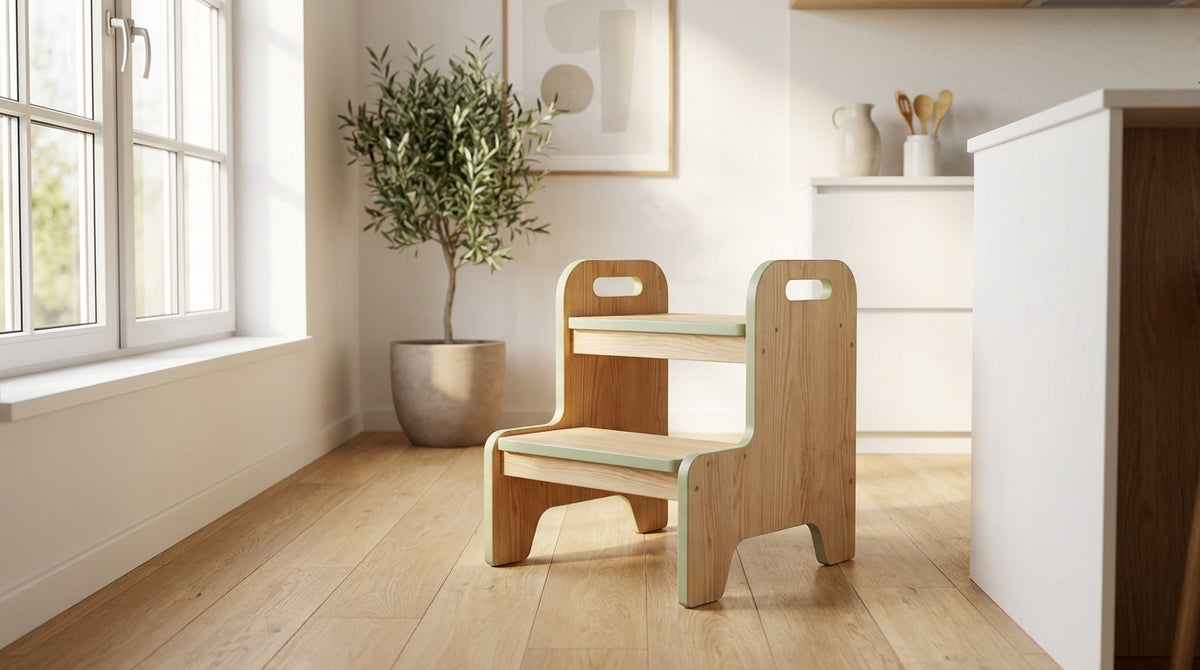
What to do with Montessori furniture? Our second-life ideas
The key takeaway: well-maintained developmental furniture keeps real value on the second-hand market. Four options are open to you when the child grows up: extend its use at home, pass it on, resell it or donate it. The most cost-effective is often to keep using it differently.
Your children have grown, and the furniture that accompanied their first years now takes up space. Should you keep it for a second child, resell it, give it away?
It is also the question that those hesitating to buy ask themselves, implicitly: "and afterwards?". Here are the four options, with what each one concretely involves.
Option 1: extend its use without any DIY
This is the simplest option, and the one most often forgotten. Well-designed furniture already provides for several uses.
The 2-in-1 Montessori tower turns into a table with a stool: when the child no longer needs to be at worktop height, it becomes their drawing corner. The step, adjustable to three heights, follows their growth until then.
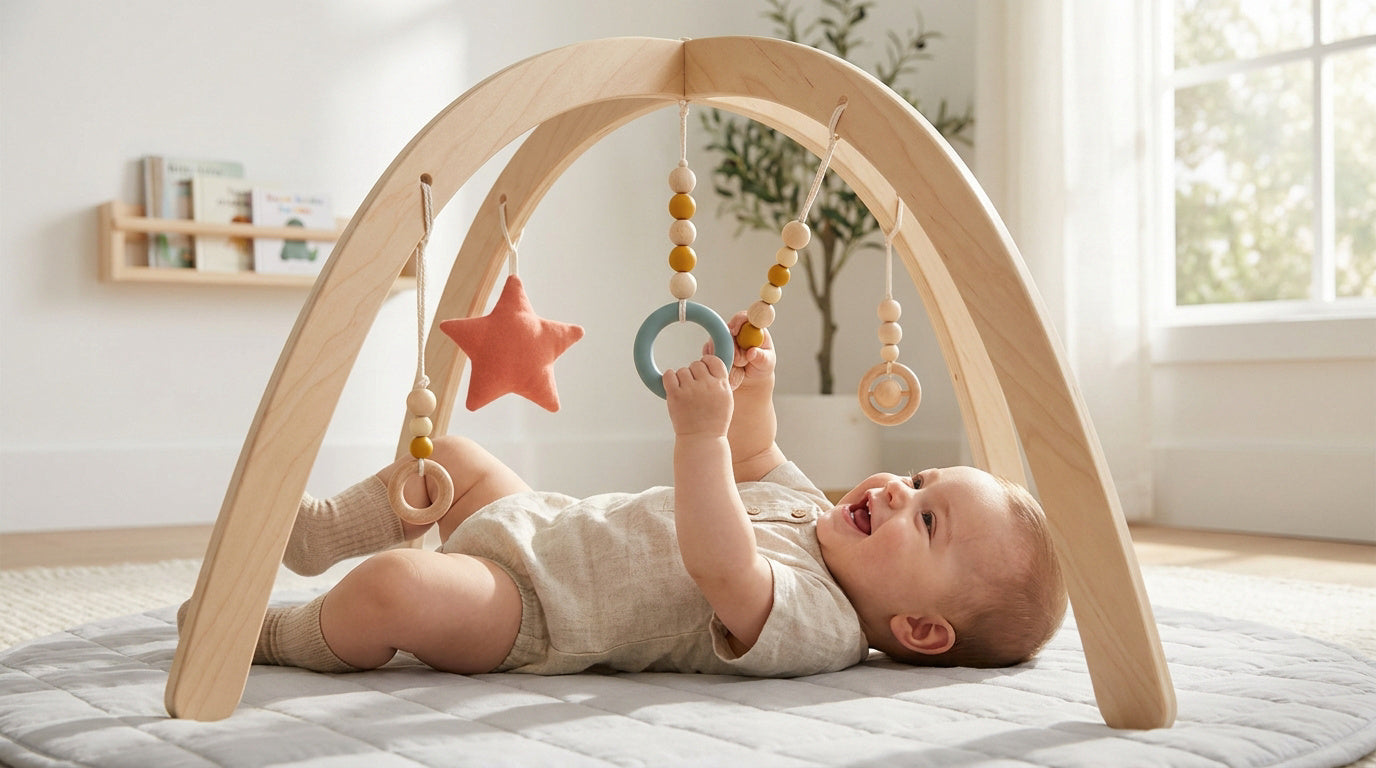
The climbing arch follows the same principle: a structure to climb at first, then a den under a sheet, a rocker once turned over, and finally a book display for a reading nook. The furniture does not change, it is the use that evolves.
An important safety point: never dismantle a safety element to "adapt" a piece of furniture. Removing the guard rail from an observation tower to make a step stool takes away precisely what prevents the fall, and takes the product outside the framework for which it was tested and certified. If you need a step stool, buy a step stool.
Option 2: pass it on
To the second child, first of all. If another baby is planned within two years, keeping the furniture costs less than reselling it and then buying another.
To family or friends next. Developmental furniture circulates very well from cousin to cousin, provided it has been maintained and the screws and fittings are complete.
In both cases, remember to pass on the assembly instructions with the furniture: that is what lets the next person reassemble it correctly.
Option 3: resell
The second-hand market for children's furniture is active, particularly on Leboncoin, Vinted and the Beebs app, which specialises in childcare items.
What really drives resale value
Structural condition above all: no play in the joints, no cracks, complete screws and fittings. A surface scratch can be negotiated, a structure that moves does not sell.
An identifiable brand and the original instructions reassure the buyer, who cannot try the product beforehand.
The original elements: cushion, safety strap, accessories. A complete set sells much better than a structure on its own.
Compliance: mention the standard (CE-EN71 for our furniture) and the age of use. Parent buyers pay attention to this.
The price is set by looking at comparable listings at the time, not according to a theoretical percentage: the going rate depends on the model, the condition and local demand. Be precise about defects, with photos to back it up: that is what avoids negotiations at the time of handover.
Option 4: donate
Emmaüs, the Red Cross and Secours populaire accept children's furniture in good condition. Parenting support associations, community nurseries and toy libraries are often very keen on educational equipment.
For a direct donation between individuals, Geev and Donnons.org let you quickly find someone nearby.
If the furniture is broken to the point of no longer being safe, do not donate it and do not sell it: it goes to the recycling centre, in the furniture skips managed by Ecomaison, which recover the wood.
Caring for the wood so it stays fit to pass on
Light sanding with fine grit erases marks of use on worn areas. Linseed oil or beeswax then nourishes the fibres and protects against moisture.
Check that the screws are tight twice a year: that is what preserves stability over time.
For storage between two children: dismantle it while marking the parts, photograph the joints, store in a dry place at a stable temperature, away from a radiator and above all not in a damp cellar. Wrap the panels in cotton rather than plastic, to avoid condensation, and tape the bag of screws to an upright.
The real cost over five years
This is the calculation that changes how you see the price. A piece of furniture costing 150 euros used for four years comes to less than 40 euros a year. If it is then passed on to the second child, this annual cost is halved. If it is resold, you still have to deduct the amount recovered.
Compared with a succession of toys replaced every six months, the gap quickly widens in favour of furniture that grows with the child.
Well-chosen developmental furniture does not end up in the cellar: it changes use, changes house, or goes round again with another child. Discover the 2-in-1 tower, convertible into a table and stool, CE-EN71 certified.
FAQ
Can you resell second-hand Montessori furniture at a good price?
Yes, the second-hand market for childcare items is dynamic, particularly for wooden furniture with a timeless design. The value depends above all on the structural condition, the presence of the original accessories and the instructions. Look at comparable listings on Leboncoin, Vinted or Beebs to position your price, rather than relying on a theoretical depreciation.
Where can I donate the furniture my child no longer uses?
Emmaüs, the Red Cross and Secours populaire accept children's furniture in good condition. Also think of community nurseries, toy libraries and parenting support associations, which are often in need. For a donation from one individual to another, Geev and Donnons.org work well.
Can you turn an observation tower into a step stool?
It is not recommended. Removing the guard rail takes away the element that prevents the fall and takes the product outside the framework for which it was tested. Favour the transformations planned by the manufacturer: our 2-in-1 tower converts into a table with a stool without any modification, simply by tipping it over.
What to do with furniture too damaged to be resold?
If the structure has a clean break or play in the joints, do not donate it and do not sell it. Take it to the recycling centre, in the furniture skips managed by Ecomaison: the wood is shredded and recovered there.
How do you store furniture while waiting for a second child?
Dismantle it, numbering the parts and photographing the joints. Store in a dry, temperate room, never in a damp cellar or an uninsulated garage. Wrap the panels in old cotton sheets rather than plastic, and fix the bag of screws to one of the uprights.

Written by Charles CAIGNOL






Leave a comment
This site is protected by hCaptcha and the hCaptcha Privacy Policy and Terms of Service apply.