
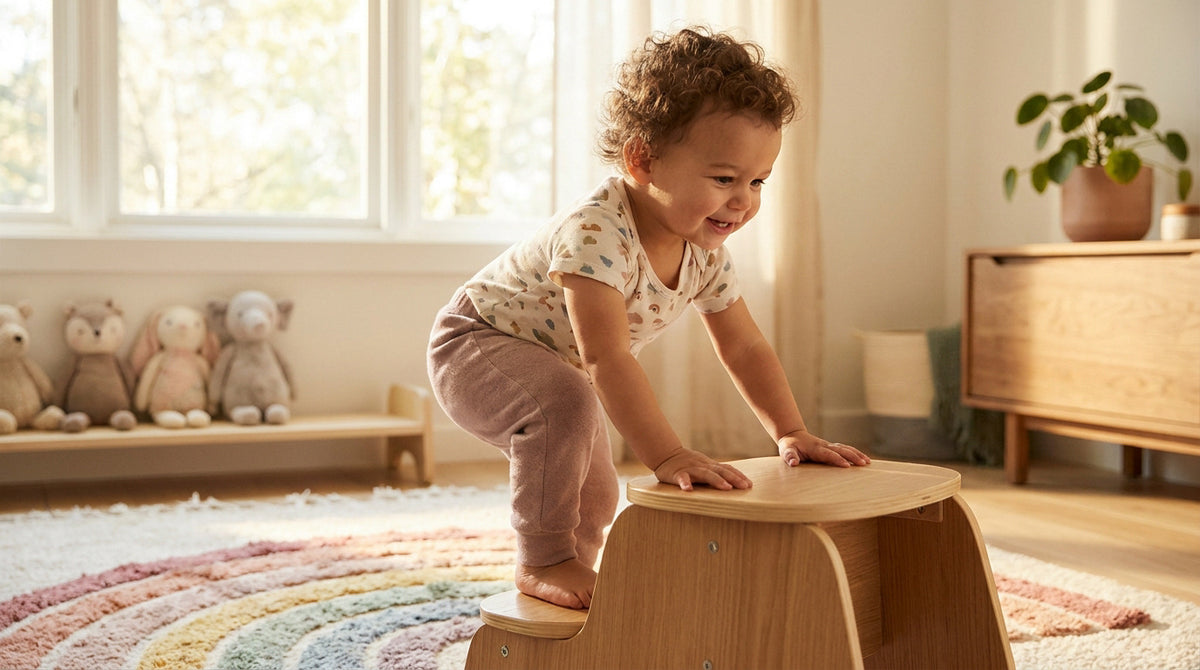
What to do when your baby climbs everywhere? (12-24 months)
The key takeaway: climbing between 12 and 24 months meets a motor need, it is not a whim. Rather than constantly forbidding it, secure the furniture, teach your child to climb down backwards, and give them somewhere to really climb. That is what reduces falls the most.
Between 12 and 24 months, your child turns every piece of furniture in the living room into a summit to conquer. This need to climb is a sign of normal development, even if it puts your nerves to the test.
You end up spending your days on watch. Here is how to make your home safe and channel this energy, rather than fighting it.
If you first want to understand what is going on at this age, we explain it in detail in our article why does your child want to climb everywhere. Here, we move on to concrete solutions.
What climbing brings your child
A real motor need
Climbing works all the muscle groups and refines coordination. The child tests their balance and discovers gravity in a concrete way.
Each successful attempt builds their confidence. It is also how they learn to assess what they can do, a skill that will serve them for a long time.
Curiosity or risk-taking?
At this age, the child does not perceive a drop as a danger. They act without anticipating the fall: it is up to you to organise the environment accordingly.
First identify unstable furniture. An unsecured shelf or chest of drawers is the real risk, far more than climbing onto the sofa.
Also watch for tiredness: a tired child misses their holds and falls more. Better to stop the activity beforehand.
Giving them somewhere to climb
Since the need is irrepressible, you might as well give it a framework rather than fighting it constantly.
Height, safely
A good share of the climbing is about seeing what you are doing. An observation tower directly meets this need: the child is at your height, surrounded by a guard rail, and climbs up or down alone.
If your kitchen is narrow, the foldable version stores flat between uses.
Suggest washing vegetables or stirring a mixture: the energy is channelled into an activity instead of being spent on the back of the sofa. See also the benefits of cooking with your children.
A support designed for climbing
For the pure need to climb, a climbing arch offers a structure designed for it, from 18 months. The child climbs on a stable support, placed on a mat, rather than on a chair that tips over.
Making things safe without forbidding everything
Priorities for the home
Fix chests of drawers and bookcases to the wall with brackets or straps: a child who opens the drawers to use them as a ladder can tip the furniture onto themselves. This is the most serious risk and the easiest to eliminate.
Move chairs, chests and pouffes away from windows and railings: they serve as a step. Fit locks or restrictors on windows.
Install gates at the top and bottom of stairs, with the top one always screwed in.
Teaching them to climb down
This is the move that prevents the most falls. Show them how to turn onto their tummy and slide their feet down to the floor first.
Guide their legs rather than always carrying them: they need to feel their footing. Repeat the move while playing, and it will become automatic.
This technique can be learned as soon as they start climbing, and will serve them everywhere: sofa, bed, slide.
The right attitude as an adult
Guide rather than forbid
Say what is allowed rather than what is not: "we climb here" works better than "get down from there". Avoid shouting: a start can cause the very fall you wanted to avoid.
Stay close without intervening at every movement. Only step in if the danger is immediate.
Handling frustration
When a spot is off-limits, immediately offer an alternative: a cushion course, the arch, the tower. Redirecting works better than forbidding alone.
Stay consistent with your safety rules: repetition is what makes them stick. Welcome the anger without going back on the rule.
Securing furniture, teaching backwards climbing down and offering a dedicated spot: these three actions solve most situations. To go further, see our complete method for keeping your baby safe without shutting them in.
FAQ
Why does my 18-month-old climb on all the furniture?
Between 12 and 24 months, gross motor skills progress quickly and climbing becomes a need: it strengthens the muscles, refines balance and lets them discover gravity. It is a sign of normal development, even if it requires constant vigilance.
How do you make the home safe for a little climber?
The absolute priority: fix chests of drawers and bookcases to the wall, because a child who climbs on open drawers can tip the furniture over. Then move chairs and chests away from windows, install stair gates and protect corners.
How do you teach them to get down from the sofa?
Show them how to turn onto their tummy and slide their feet down to the floor first. Guide their legs without carrying them, so they feel their footing. Repeated while playing, this move becomes an automatic reflex that protects them even when your back is turned.
What to do when they refuse to come down from a dangerous spot?
Stay calm and don't shout: a start can cause a fall. Immediately offer an appealing alternative, such as a cushion course or a support designed for climbing. Stay consistent with the rule while welcoming the frustration.
Does an observation tower really limit climbing?
It meets a large part of the need: seeing what adults are doing. Stable at your height with a guard rail, the child no longer has any reason to climb a chair. It does not remove the urge to climb for climbing's sake, for which a dedicated support remains more suitable.

Written by Charles CAIGNOL






Leave a comment
This site is protected by hCaptcha and the hCaptcha Privacy Policy and Terms of Service apply.