
Cooking with your child: 10 recipes by age (18 months to 6 years)
The key takeaway: from 18 months, a child can really take part in the kitchen, provided they are at the right height and have age-appropriate tasks. Here are 10 recipes sorted by age group, with for each one what the child does themselves and what stays with the adult.
Everyone finds the idea of cooking with your child charming. Then you end up with flour everywhere, a frustrated child who cannot reach anything, and the wish never to do it again.
Two things change everything: height, and choosing tasks that are genuinely within their reach. Here are 10 recipes that work, with a precise split of roles.
Before you start: the right set-up
Height
A worktop is around 90 cm high: out of reach for an 18-month-old. A kitchen chair brings them to height, but with nothing to hold them if they lean.
A learning tower solves this precise point: the child climbs up and down alone, surrounded by a guard rail. The step adjusts to three heights to follow their growth. If your kitchen is small, the foldable version stores flat between uses.
For a very lively child, a safety strap closes off the rear access. It attaches without tools and wipes clean with a sponge.
Utensils
For cutting, a wooden knife slices soft foods without a sharp blade. The risk of cuts is very greatly reduced, but adult supervision remains necessary: a child can pinch themselves, drop the utensil or slip.
Also plan a small bowl, a spoon that fits their hand, and a sponge within reach: being able to clean up what you have spilled yourself is part of the learning.
Safety rules
Set the child up away from the hob and oven when in use. Put kitchen knives and cleaning products out of reach before starting. And stay present: no equipment replaces your supervision.
From 18 months to 3 years: pouring, mixing, washing
At this age, the child manages broad gestures. Precision will come later.
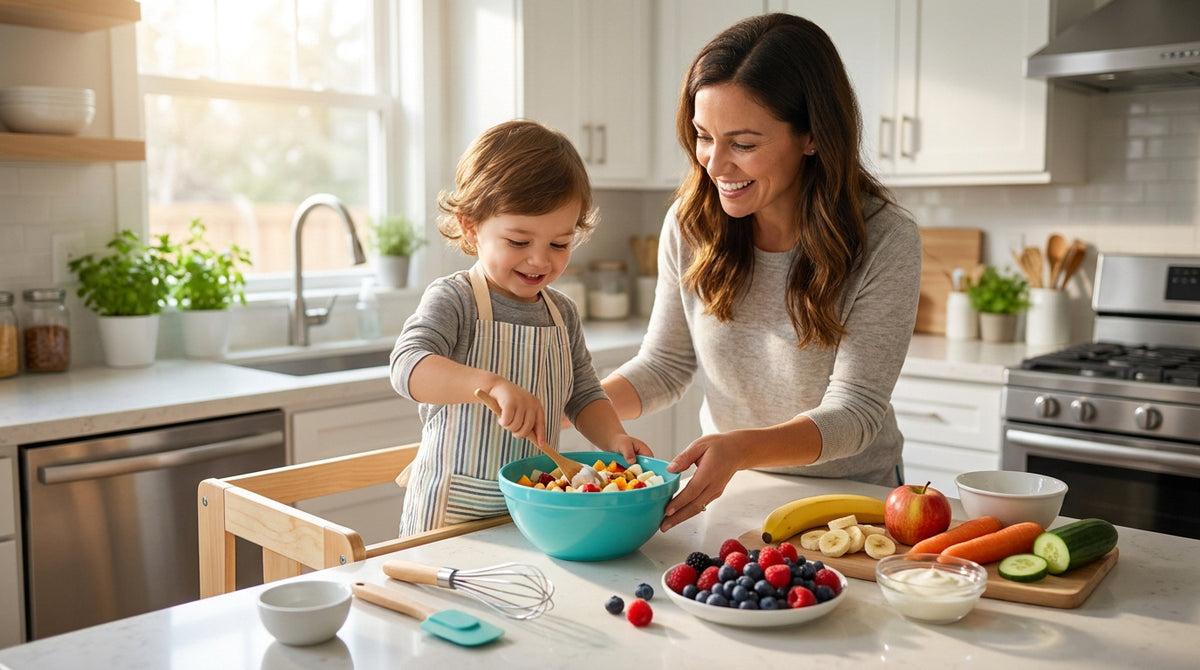
1. Fruit salad. The child washes the fruit, cuts the banana and strawberries with the wooden knife, mixes in the bowl. The adult peels and cuts whatever is hard.
2. Yoghurt cake. The perfect classic: the child empties the yoghurt pot, fills the pot with sugar then flour and pours. They mix. The adult cracks the eggs and handles the oven.
3. Express hummus. The child drains the chickpeas (over a large bowl), adds the lemon and oil. The adult blends.
4. Fruit skewers. With rounded-tip sticks, the child threads the pre-cut pieces. Excellent for the pincer grip.
From 3 to 4 years: measuring and transforming
Coordination gets finer, the child can follow two instructions in a row.
5. Muffins. The child cracks the eggs (in a separate bowl, to fish out the shells), pours the weighed ingredients, mixes and fills the moulds with a spoon.
6. Homemade pizza. The child spreads the sauce, arranges the toppings, kneads the dough a little. The adult handles the hot tray.
7. Cookies. Mixing, forming balls by hand, spacing them out on the tray. Shaping is very popular at this age.
8. Vegetable soup. The child washes, cuts the soft vegetables (cooked courgette, mushroom), counts the pieces. The adult handles the cooking and the blender.
From 5 to 6 years: following a recipe
The child can string the steps together and start reading quantities.
9. Pancakes. They weigh the flour, crack the eggs, pour the milk gradually and whisk until the lumps disappear. Cooking stays with the adult, but they can count the time.
10. Mixed salad or wraps. No cooking: the child washes, cuts, assembles and plates everything. It is the first recipe they can make almost alone, and the pride matches.
What a child can do, by age
18 months to 2 years: wash vegetables, pour from one container to another, mix, mash with a fork, press a cookie cutter.
2 to 3 years: cut soft foods with a wooden knife, pour from a small jug, spread, thread skewers.
3 to 4 years: crack an egg, measure with a measuring spoon, knead, garnish, fill moulds.
5 to 6 years: weigh with scales, follow an illustrated recipe, peel with a suitable peeler, plate up.
Handling the mess without killing the momentum
Anticipate rather than correct: a tea towel under the bowl, an apron, and accept that there will be flour on the floor. It is the entry fee.
Avoid redoing things behind them while they work: nothing discourages a child more than seeing an adult redo their gesture. Correct discreetly afterwards, if necessary.
Allow plenty of time. A 15-minute recipe takes 40 with a 2-year-old. That is normal, and that is the point.
What if they don't eat what they cooked?
It happens often, and it is not a failure. Handling a food, smelling it, seeing it change state: all of this contributes to familiarisation, even without a single mouthful swallowed that day.
Don't turn tasting into a battle. Taking part is already worthwhile in itself. On this subject, see also our article on the benefits of cooking with your children.
Cooking together does not require complicated equipment: the right height, a suitable utensil and tasks within reach are enough. Discover the 2-in-1 Montessori tower, adjustable to three heights and convertible into a table.
FAQ
From what age can you cook with your child?
From around 18 months, when the child stands alone confidently. At this age they wash, pour and mix. Cutting soft foods comes more around 2 to 3 years, and recipes followed from start to finish around 5 to 6.
Is a learning tower essential?
It is not essential, but it solves the main problem: height. A worktop is about 90 cm high, and a chair offers no side protection. The tower lets the child climb up and down alone, surrounded by a guard rail.
How do you teach them to cut without getting hurt?
Use a wooden knife: its blade is not sharp and only cuts soft foods such as banana or cooked cucumber. Show the sawing motion, the free hand curled in a "claw", and stay alongside. The risk is greatly reduced, but supervision remains necessary.
Which recipes to start with?
For 18 to 36 months: fruit salad, yoghurt cake, skewers. From 3 to 4: muffins, pizza, cookies. From 5 to 6: pancakes or mixed salad, which they can make almost alone. Choose recipes that tolerate imprecision.
How do you manage risks in the kitchen?
Set the child up away from the hob and oven, put knives and cleaning products out of reach before starting, and stay present. Check the stability of the support used and its compliance with standards. No equipment removes the need for supervision.

Written by Charles CAIGNOL







Leave a comment
This site is protected by hCaptcha and the hCaptcha Privacy Policy and Terms of Service apply.