
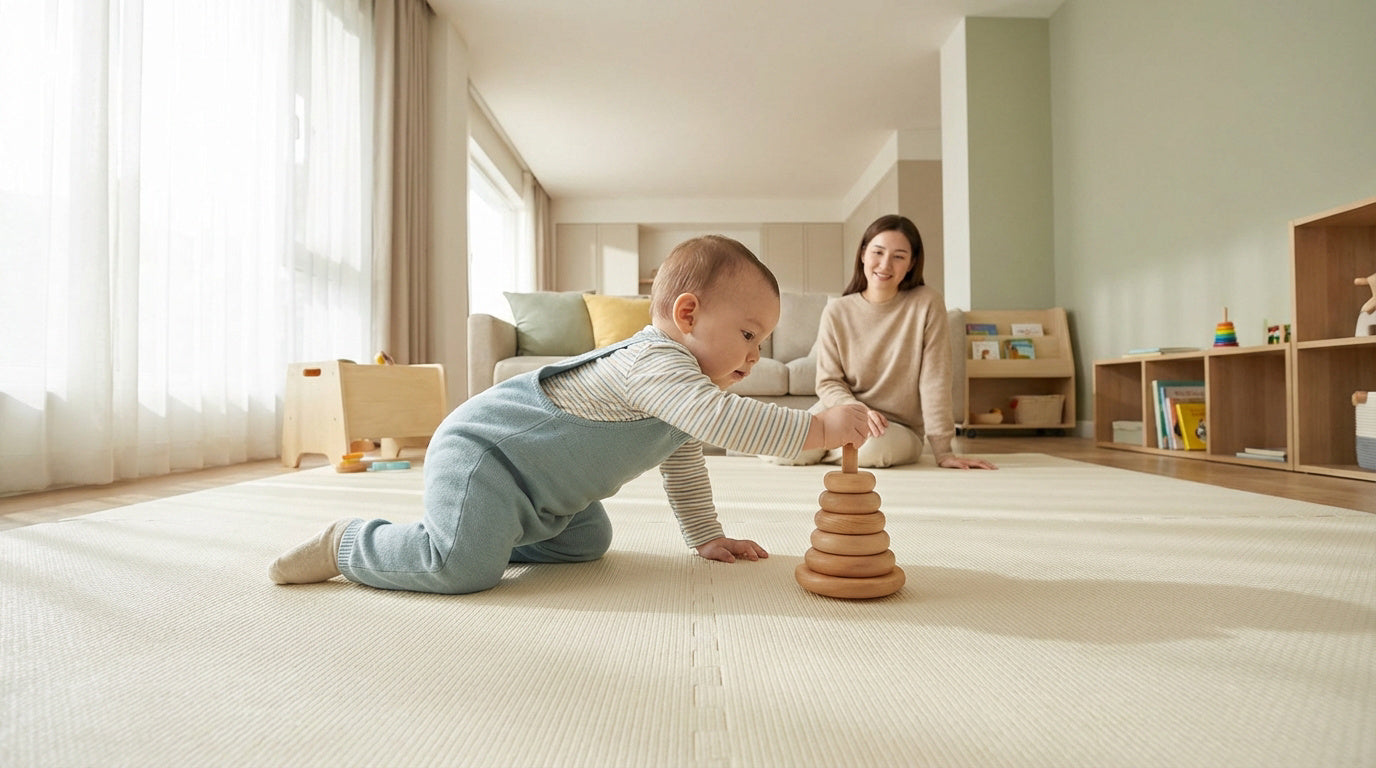
Understanding free movement to help your baby thrive
- Where does free movement come from and why take an interest in it?
- 3 major benefits for your baby's independence
- Setting up a safe space to encourage exploration
- Adopting the right adult attitude without guilt
Where does free movement come from and why take an interest in it?
After briefly introducing the importance of movement in newborns, let's explore the historical and theoretical roots of this revolutionary approach.
Emmi Pikler's legacy and the birth of the concept
Do you know Emmi Pikler? This Hungarian paediatrician transformed early childhood from the 1960s onwards. Her major observations come from the Lóczy nursery, where she studied babies. Here is Emmi Pikler's work (in French).
Her philosophy is crystal clear. Spontaneous activity is the true driver of development. The child progresses better when they move of their own accord.
Here, the child is the actor. They are never a passive object to be handled without reason.
This vision matches Teedum's. Respecting the natural pace is a fundamental value of our brand in supporting your little ones.
The key principles for respecting the biological rhythm
What is freedom of movement? It is the absence of physical constraints imposed by us, the adults. We never place a baby in a position they cannot manage alone. It is the foundation of their confidence.
Your child discovers their abilities without help. They explore their limits safely and learn to fall. See this complete guide to free movement to go further.
The floor is your best ally. It is the richest and safest play space for progressing freely.
3 major benefits for your baby's independence
Understanding the origin is essential, but what are the concrete benefits for your child's daily development?
Developing solid, natural motor coordination
Your little one's body follows a logical physiological evolution. They naturally move from lying on their back to rolling over, then crawling. Each stage strengthens their body deeply.
Through independent repetition, they strengthen their footing without skipping steps. They gain strength in a balanced way. This effectively prevents poor posture for their future as a walker.
Moving freely also protects the health of their skull by avoiding flat head. This is what the recommendations of the French Health Authority (HAS) highlight to protect our infants every day.
Building a sense of competence from the first months
There is a direct link between motor success and self-esteem. Managing a complex movement alone brings immense joy. The child then feels capable, proud and truly in charge.
By moving without hindrance, they become aware of their real bodily limits. They grasp the space around them better. As a result, they become naturally more careful, agile and attentive to their movements.
This freedom also boosts their attention because they concentrate on their own sensations. To go further, discover the link between the Montessori approach and independence in our dedicated guide.
Setting up a safe space to encourage exploration
For these benefits to emerge, the living environment must become a true caring ground for experimentation.
Creating a stimulating everyday environment
First choose a firm mat for the floor. It must not be too soft, so as to allow good footing. This marks out a clear, safe zone.
Then offer simple objects to grasp. Use fabrics, sensory balls or rings. Simplicity really encourages your child's concentration.
Here is my approach to the essentials:
- A firm floor mat.
- A few textured objects within reach.
- A mirror at child height.
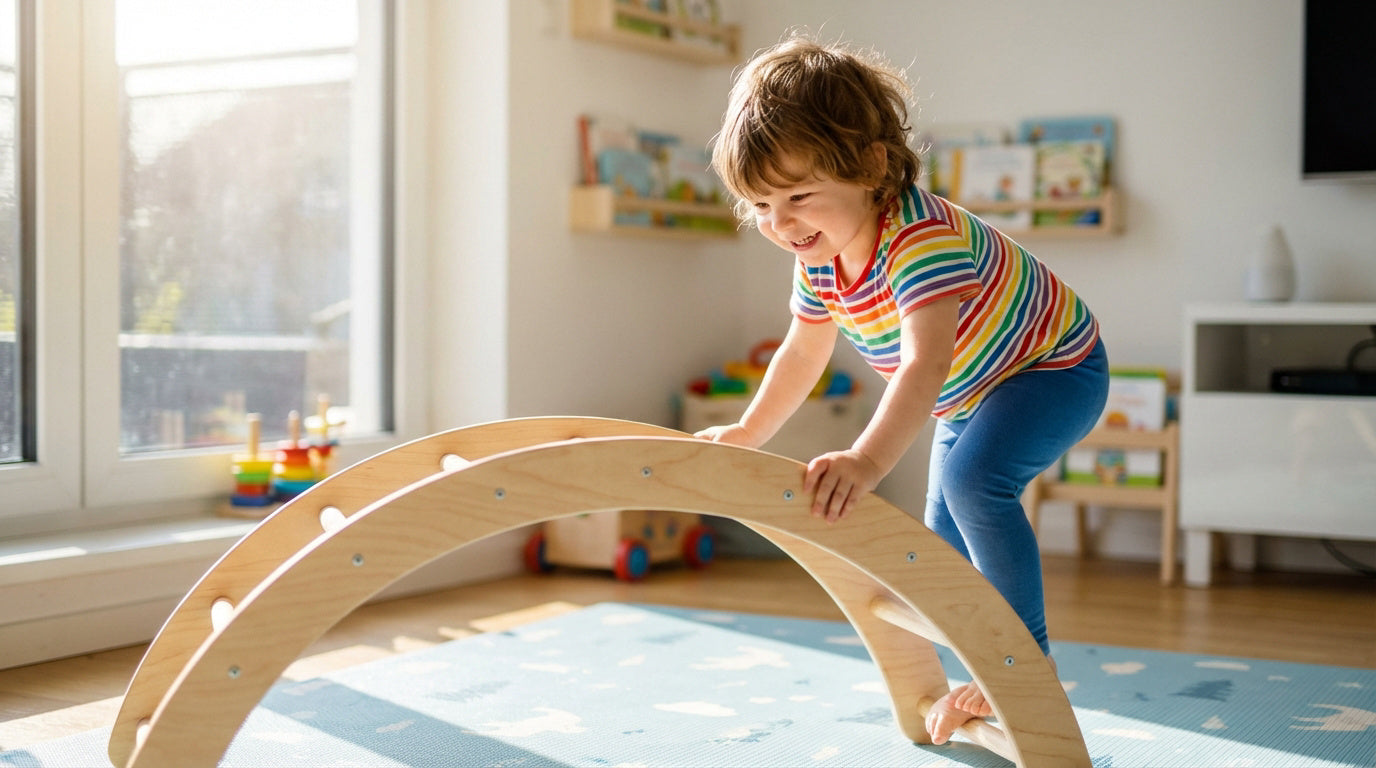
- A stable climbing arch.
The objects that hold back development and those to favour
Beware of baby walkers and bouncers. These objects often freeze the baby in artificial positions. They unfortunately limit the natural discovery of balance.
As for clothes, favour loose garments that do not restrict. Bare feet are perfect. They provide grip and tactile sensations that are vital on the floor.
Try turning to durable wooden equipment. It is an excellent alternative for independence. Discover the benefits of the Pikler triangle for their development.
Adopting the right adult attitude without guilt
Beyond equipment, it is your gaze and your presence that will make all the difference in this process of development.
Practising observation instead of systematic assistance
Your presence must above all be reassuring. I have learned that observing without directly intervening in play is a gift. Your caring gaze is more than enough to reassure the child.
You must always respond to emotional needs. If your little one seeks contact, simply be there. Independence does not mean isolation, it is accompanied freedom.
| Situation | Usual reaction | Free movement approach |
|---|---|---|
| Baby struggles to roll over | We turn them over ourselves. | Encouragement with a look. |
| Baby wants to grab a toy far away | We hand them the object. | We let them crawl alone. |
| Baby grumbles a little | We pick them up straight away. | We put their effort into words. |
Handling crying and care moments calmly
Handling frustration on the floor takes patience. Crying is not always a call for help. Sometimes it is just the expression of an intense effort to progress.
Consider care moments as precious. Nappy changes and meals become real times of connection. Use them to explain each of your gestures to the child.
Overall emotional security is the foundation of everything. A child who is well cared for and listened to will dare to explore their environment more. Find out how to strengthen this parent-child relationship through play.
By respecting Emmi Pikler's pace, you give your baby natural coordination and lasting self-confidence. Quickly set up their safe floor space to boost their independence. Free their movement now to forge a fulfilled adult in command of their body.

Written by Charles CAIGNOL






Leave a comment
This site is protected by hCaptcha and the hCaptcha Privacy Policy and Terms of Service apply.