
Montessori activity table or busy board: which one to choose?
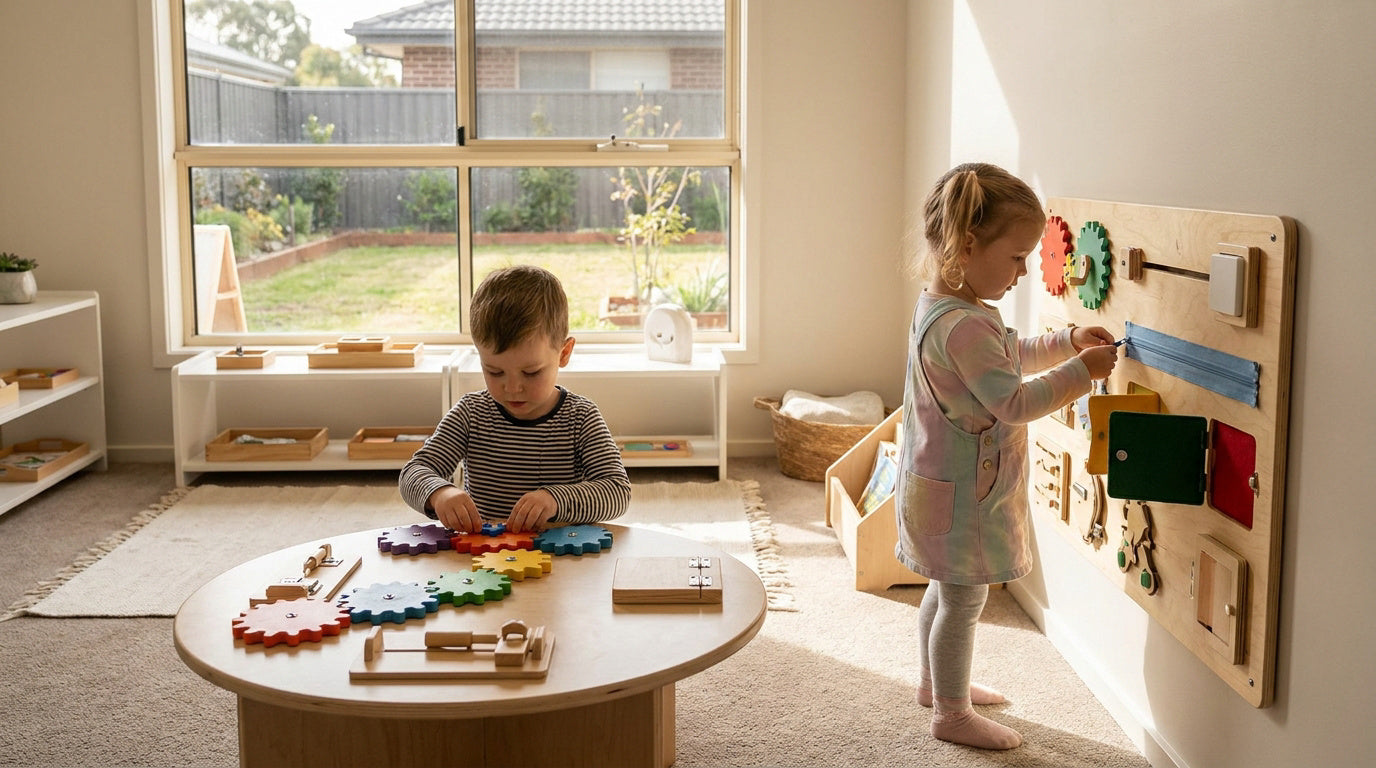
The key takeaway: these are two different objects. The activity board (busy board) is a board of mechanisms to handle, which works fine motor skills from around 12 months. The activity table is a piece of furniture, a workspace for drawing and creating, more useful from age 2 or 3. The choice depends on age and the space available.
Between the activity table and the sensory board, shop windows keep the confusion going: both carry the "Montessori" label, both are made of wood, and yet they serve completely different purposes.
Let's take stock so you can choose with full knowledge, or decide to do without.
Two objects, two functions
The activity board, or busy board
It is a board onto which mechanisms are fixed: latches, bolts, switches, zips, gears, wheels.
The child handles, opens, closes, turns. The work is on fine motor skills: the pincer grip, hand-eye coordination, measured force.
It is fixed to the wall or placed on the floor, and takes up little space.
The activity table
It is a piece of furniture: a small table at child height, sometimes with a blackboard top or built-in storage.
It serves as a workstation: drawing, modelling, gluing, leafing through books. Its value is not the mechanism but the space, and the fact that the child can settle there alone.
It does, however, take up real floor space.
At what age?
The activity board becomes interesting when the child sits up and grasps deliberately, around 10 to 12 months. Before that, they look and tap without understanding the mechanisms.
Be wary of "from 6 months" labels: at that age the child puts everything in their mouth, and a panel covered in small moving parts is not the most suitable object. The real interest runs from about 1 to 4 years.
The activity table makes sense around age 2, when the child starts drawing and staying seated on an activity. It then serves until age 6 and beyond.
What each one develops, and its limits
The activity board
It works precision of movement and understanding of cause and effect. Each mechanism mastered builds confidence, and the child gets familiar with everyday gestures: opening a bolt, doing up a zip.
Its limit: it only meets one need. An 18-month-old also and above all needs to move, climb and let off steam. The busy board occupies ten minutes, not an afternoon.
The activity table
It offers a space of their own and encourages independence: the child settles in, chooses their materials, tidies up.
Its limit: a coffee table or a simple board on low trestles often fulfils the same function for much less money.
What to check before buying
On an activity board, first check how firmly the elements are attached: pull firmly on each part. Before age 3, no element must be able to come off.
Check the CE marking and compliance with standards EN 71-1 (mechanical properties) and EN 71-3 (migration of certain elements). Handmade models sold online are not always tested: be careful.
As for the finish: smooth sanding, rounded corners, no strong smell of varnish. And no cord or chain longer than a few centimetres.
Finally, these objects are used under supervision: they reduce boredom, not risks.
Making it yourself?
It is a great DIY classic, and it is doable: a sanded plywood board, a few hardware latches, and there you go.
Two precautions: fix each element from the back with through screws rather than glue, and leave out anything with sharp edges or small detachable parts. A loose nut on a homemade panel becomes a choking risk.
If you are not comfortable with this type of build, a certified model remains safer.
What these supports do not cover
Let's be clear: neither the table nor the board meets the need for gross motor skills, which largely dominates between ages 1 and 3. A child who climbs on the sofa will not calm down in front of a busy board.
For that need, you need something to climb on and let off steam: a climbing arch from 18 months, or quite simply a clear floor space with cushions.
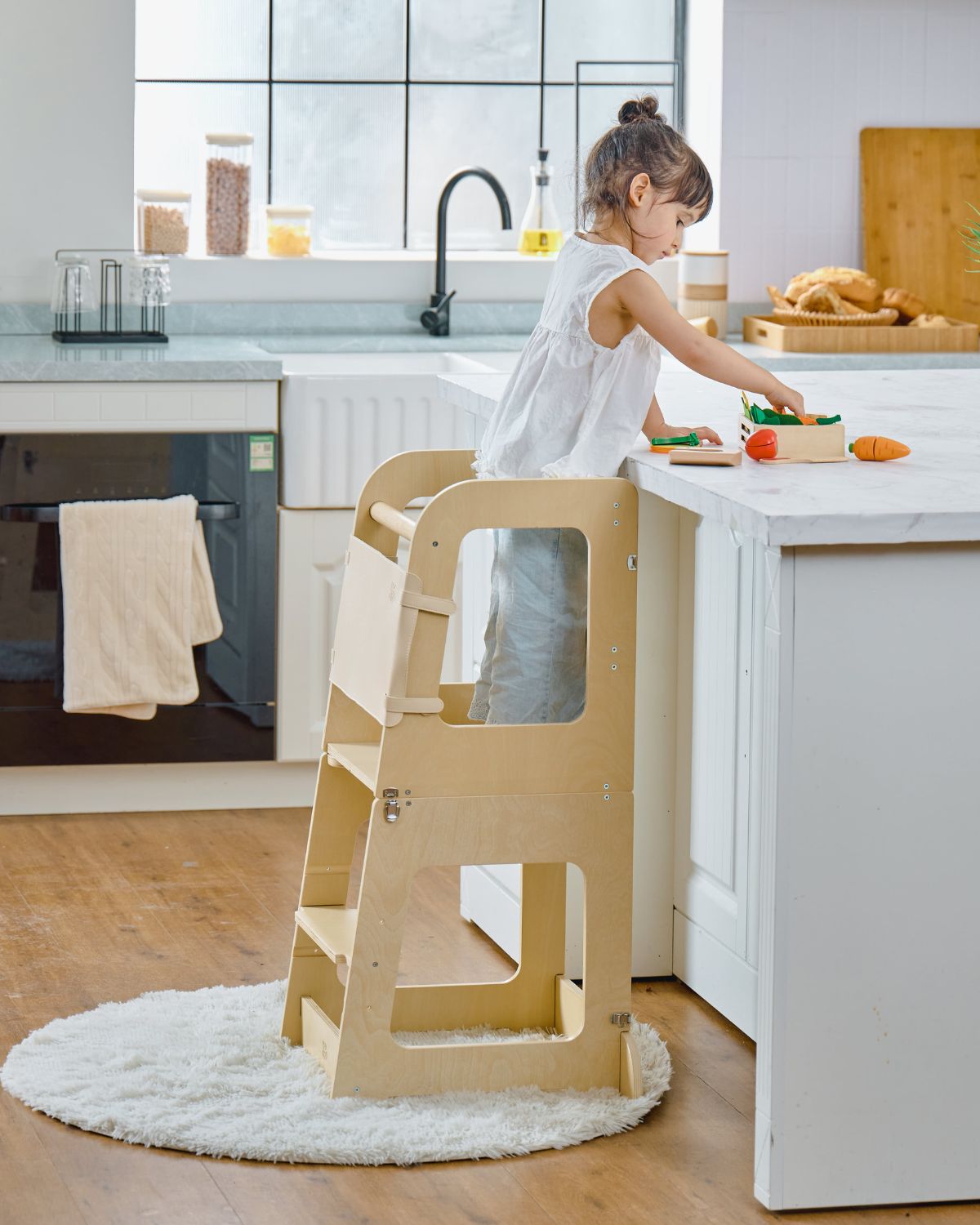
Another need not covered: doing things like the grown-ups. Handling real objects, taking part in everyday tasks. That is what a learning tower in the kitchen allows, or a wooden knife to cut a banana. Real gestures engage fine motor skills at least as much as a latch, with a result you can eat.
So the right reflex is to look at what is missing at home: if the child already has ways to move and take part, an activity board rounds things off nicely. If not, start there.
Care
A soft cloth, slightly damp if needed, and wipe dry immediately. Avoid harsh products that attack the finish.
Periodically check that screws and mechanisms are tight: that is what prevents a part coming off with use.
FAQ
What is the difference between an activity table and an activity board?
The activity board, or busy board, is a board of mechanisms to handle: latches, gears, fasteners. It works fine motor skills. The activity table is a piece of furniture, a workspace for drawing and creating. One occupies the hands, the other offers a workstation.
From what age is an activity board suitable?
Around 10 to 12 months, when the child sits up and grasps deliberately. "From 6 months" labels are optimistic: at that age, the child puts everything in their mouth. The real interest extends from about 1 to 4 years.
What should you check before buying?
How firmly the elements are attached, above all: pull on each part, nothing must come off before age 3. Then the CE marking and standards EN 71-1 and EN 71-3, a sanded finish and no long cord. Handmade models are not always tested.
Can you make one yourself?
Yes, with a sanded board and standard hardware. Fix the elements from the back with through screws rather than glue, and leave out anything with sharp edges or small detachable parts.
Is it enough to keep a child occupied?
No. These supports meet the need for handling, but not the need to move and climb, which dominates between ages 1 and 3, nor the need to take part in adult activities. They complete an environment, they do not replace it.

Written by Charles CAIGNOL





%20is%20a%20board%20of%20mechanisms%20to%20handle,%20which%20works%20fine%20motor%20skills%20from%20around%2012%20months.%20The%20activity%20table%20is%20a%20p...)
Leave a comment
This site is protected by hCaptcha and the hCaptcha Privacy Policy and Terms of Service apply.